1 Indications And Usage
NEREUS is indicated for the prevention of vomiting induced by motion in adults.
The following Structured Product Label (SPL) was submitted to the FDA by Vanda Pharmaceuticals Inc. for the product Nereus (NDC 43068-585). This document serves as the official prescribing information, containing essential scientific data and clinical materials required for healthcare providers and patients.
This specific version of the label includes detailed information regarding 1 indications and usage, 2.1 recommended dosage and administration, 3 dosage forms and strengths, 4 contraindications, 5.1 effects on the ability to drive or operate machinery, 6.1 clinical trials experience, 7.1 effects of other drugs on nereus, 8.1 pregnancy, and other regulatory disclosures. Use the navigation below to review specific sections of the FDA submission.
NEREUS is indicated for the prevention of vomiting induced by motion in adults.
Capsules: 85 mg, supplied as a white opaque body capsule with “VANDA 85mg” printed on the black opaque cap.
None.
In placebo-controlled clinical trials, somnolence (6%, 12%) and fatigue (6%, 8%) were adverse reactions reported in subjects who took a single dose of 85 mg or 170 mg NEREUS, respectively [see Adverse Reactions (6.1)]. NEREUS may impair the mental and/or physical abilities required for driving a motor vehicle or operating heavy machinery. Concomitant use of other drugs that cause central nervous system depression and strong CYP3A4 inhibitors may increase this effect [see Drug Interactions (7.1)]. If concomitant use is unavoidable, warn patients against driving and other activities requiring complete mental alertness.
Because clinical trials are conducted under widely varying conditions, adverse reaction rates observed in the clinical trials of a drug cannot be directly compared to rates in the clinical trials of another drug and may not reflect the rates observed in practice.
The safety of a single 85 mg or 170 mg dose of NEREUS was evaluated in adult subjects with a history of motion sickness in two randomized, double-blind, placebo-controlled trials, Study 1 and Study 2 [see Clinical Studies (14)]. Additional safety data for the 170 mg dose of NEREUS were obtained from a randomized, double-blind, placebo-controlled trial, Study 3 (NCT03772340).
Adverse reactions reported in at least 5% of subjects treated with a single NEREUS 85 mg or 170 mg dose and at a higher frequency than subjects who received placebo, are shown in Table 1.
aReported in at least 5% of subjects and at a higher frequency than placebo. bNEREUS was administered as a single 85 mg dose approximately 60 minutes prior to a boat trip and without food. cNEREUS was administered as a single 170 mg dose approximately 60 minutes prior to a boat trip and without food. | ||||
| Studies 1 and 2 | Studies 1, 2, and 3 | |||
| Adverse Reaction | NEREUS 85 mgb N=227 n (%) | Placebo N=228 n (%) | NEREUS 170 mgc N=289 n (%) | Placebo N=291 n (%) |
| Somnolence | 14 (6) | 9 (4) | 36 (12) | 17 (6) |
| Headache | 16 (7) | 12 (5) | 28 (10) | 17 (6) |
| Fatigue | 14 (6) | 6 (3) | 24 (8) | 6 (2) |
In a 12-month randomized, open-label study, 382 subjects with a history of motion sickness were instructed to administer NEREUS 85 mg (N=199) or 170 mg (N=183) as a single dose 60 minutes before a travel event of at least 60 minutes in duration expected to induce symptoms of motion sickness. Subjects were allowed to take up to 90 doses during the study. The median exposure was 18 doses and the majority of subjects (69%) did not take more than 30 doses. Most subjects (95%) did not take more than 8 doses in any 30-day period. Adverse reactions were consistent with those observed in Study 1, Study 2, and Study 3.
Strong CYP3A4 Inhibitors
Tradipitant is a CYP3A4 substrate. Strong CYP3A4 inhibitors may increase tradipitant exposure, which may increase the risk of adverse reactions to NEREUS.
Risk Summary
Available data from clinical trials with NEREUS use in pregnant women are insufficient to inform a drug-associated risk of major birth defects, miscarriage, or other adverse maternal or fetal outcomes.
In animal reproduction studies, no adverse developmental effects were observed with oral administration of tradipitant to pregnant rats during organogenesis through lactation or to pregnant rabbits during organogenesis at doses up to approximately 3.3 and 1.4 times the exposure to tradipitant at the maximum recommended human dose (MRHD), respectively.
The background risk of major birth defects and miscarriage for the indicated population(s) is unknown. All pregnancies have a background risk of birth defect, loss, or other adverse outcomes. In the U.S. general population, the estimated background risk of major birth defects and miscarriage in clinically recognized pregnancies is 2 to 4% and 15 to 20%, respectively.
Data
Animal Data
In a combined fertility and embryo-fetal development study in pregnant rats, tradipitant was administered at oral doses of 10, 100, or 1000 mg/kg (approximately 1.4, 1.9, and 2.2 times the exposure to tradipitant at the MRHD) during the periods of mating and organogenesis, through gestation day 17. No adverse effects on maternal performance or embryo-fetal development were observed at any tested dose.
In an embryo-fetal development study in pregnant rabbits, tradipitant was administered at oral doses 30, 175, or 1000 mg/kg/day (approximately 0.2, 0.4, and 1.4 times the exposure to tradipitant at the MRHD) during the period of organogenesis, from gestation day 7 to 19. No adverse effects on maternal performance or embryo-fetal development were observed at any tested dose.
In a pre- and post-natal development study in pregnant rats, tradipitant was administered at oral doses of 100, 300, or 1000 mg/kg/day (approximately 2.3, 2.4, and 3.3 times the exposure to tradipitant at the MRHD) from gestation day 6 through lactation day 20. No maternal toxicity or developmental effects on the offspring were observed at any tested dose.
Risk Summary
Lactation studies have not been conducted to assess the presence of tradipitant or its metabolites in human milk, the effects on the breastfed infant, or the effects on milk production. Tradipitant is present in rat milk (see Data). When a drug is present in animal milk, it is likely that the drug will be present in human milk. Monitor breastfed infants for somnolence. The developmental and health benefits of breastfeeding should be considered along with the mother’s clinical need for NEREUS and any potential adverse effects on the breastfed child from NEREUS or the underlying maternal condition.
Data
Tradipitant was excreted in milk of lactating rats that received tradipitant at 100, 300, or 1000 mg/kg (2.3, 2.4, and 3.3 times the exposure to tradipitant at the MRHD) during pregnancy from gestation day 6 through lactation day 20. Serum concentrations of tradipitant and its major metabolites in pups were approximately 1% to 3% of maternal serum concentrations on lactation day 4 and up to 1% of those in the dams on lactation day 11.
The safety and effectiveness of NEREUS have not been established in pediatric patients.
Of the total number of NEREUS-treated subjects in controlled clinical studies for vomiting induced by motion, 69 (13%) were 65 years of age and older, while 4 (0.8%) were 75 years of age and older [see Adverse Reactions (6.1) and Clinical Studies (14)]. No overall differences in safety or effectiveness were observed between subjects 65 years of age and older and younger adult subjects, and other reported clinical experience has not identified differences in responses between geriatric and younger adult subjects, but greater sensitivity of some older individuals cannot be ruled out.
The recommended dosage of NEREUS in patients with mild and moderate renal impairment (estimated glomerular filtration rate (eGFR) of at least 30 mL/minute/1.73m2) is the same as in patients with normal renal function. Tradipitant has not been studied in subjects with severe renal impairment (eGFR ≤ 29 mL/min/1.73m2) [see Clinical Pharmacology (12.3)]. Avoid use of NEREUS in patients with severe renal impairment.
Tradipitant has not been studied in patients with any degree of hepatic impairment (Child-Pugh Class A to C). Avoid NEREUS in patients with mild, moderate, or severe hepatic impairment.
NEREUS (tradipitant) is a substance P/neurokinin-1 (NK-1) receptor antagonist designated by the chemical name, as {2-[1-(3,5-Bistrifluoromethylbenzyl)-5-pyridin-4-yl-1H-[1,2,3]triazol-4- yl]-pyridin-3-yl}-(2-chlorophenyl)-methanone, with molecular formula C28H16ClF6N5O, and molecular weight 587.9. The chemical structure for tradipitant is:
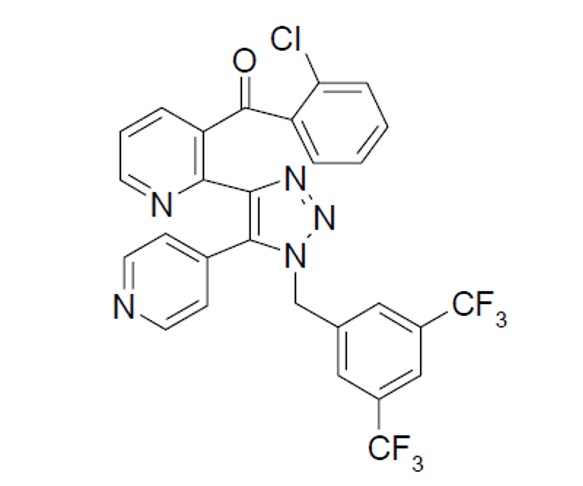
Chemical Structure (Tradipitant 01)
Tradipitant is a white to off-white crystalline powder. It is practically insoluble in water, soluble in methanol, and slightly soluble in isopropyl alcohol and simulated gastric fluid.
NEREUS is supplied as white opaque body capsules with “VANDA 85mg” printed in white on the black opaque cap for oral administration, each containing 85 mg tradipitant. Inactive ingredients are croscarmellose sodium, lactose monohydrate, magnesium stearate, microcrystalline cellulose, povidone, and sodium lauryl sulfate. The capsule contains FD&C blue No 1, FD&C red No 40, and FD&C yellow No 6, gelatin, and titanium dioxide.
Tradipitant is a selective, high-affinity antagonist of human substance P/neurokinin 1 (NK1) receptors. Tradipitant does not have affinity for NK2 and NK3 receptors, serotonin (5-HT3), dopamine (D2), cholinergic, or histamine (H1) receptors.
Tradipitant has been shown in animal models to inhibit drug induced emesis. Human Positron Emission Tomography (PET) studies with tradipitant have shown that tradipitant crosses the blood brain barrier and occupies brain NK-1 receptors.
The exact mechanism by which tradipitant exerts its therapeutic effect is not fully established.
Tradipitant inhibits the NK1 receptor with a Ki of 0.062 ± 0.01 nM and inhibits substance P (SP) induced intracellular calcium mobilization with a Kb of 0.095 ± 0.025 nM. The major metabolites of tradipitant (M2, M3, M4, and M8) showed a similar degree of binding at the NK-1 receptor.
NK1 Receptor Occupancy
A clinical study using PET imaging demonstrated a dose- and concentration-dependent increase in frontal cortex NK-1 receptor occupancy of tradipitant. The maximum receptor occupancy was 93% after multiple administrations of 100 mg NEREUS.
Cardiac Electrophysiology
At the mean maximum concentration provided by the maximum recommended single dose (170 mg) administered without food, clinically significant QTc prolongation was not observed.
Absorption
Absolute oral bioavailability has not been studied in humans. Following a single dose of 85 mg tradipitant in healthy subjects under fasting conditions, tradipitant geometric mean Cmax was 84.7 ng/mL, AUC 0-inf was 1839 ng*h/mL, and the median Tmax was 2.0 hours. Following a single dose of 170 mg tradipitant in healthy subjects under fasting conditions, tradipitant geometric mean Cmax was 112 ng/mL, AUC0-inf was 3,526 ng*h/mL, and the median Tmax was 1.50 hours.
Effect of food
Tradipitant Cmax and AUC0-inf increased approximately 4.7-fold and 2.4-fold, respectively, and Tmax was delayed by 2 hours, when 85 mg tradipitant was administered with a high-fat meal (800 to 1,000 calories, 50% fat) compared to fasted conditions in healthy subjects. After administration of 170 mg tradipitant with a high-fat meal, Cmax and AUC0-inf increased approximately 6.9-fold and 2.9-fold, respectively, and Tmax was delayed by 2.5 hours [see Dosage and Administration (2.1)].
Distribution
The apparent volume of distribution (Vd/F) of tradipitant is 1956 L in healthy subjects. Tradipitant plasma protein binding ranged from 96% to >99% in vitro.
Elimination
The observed mean elimination half-life for tradipitant is approximately 34 hours and apparent oral clearance of tradipitant is 41.7 L/hour in healthy subjects.
Metabolism
Tradipitant is extensively metabolized; however, the metabolic pathways have not been fully characterized. In vitro findings suggest that non-CYP450-mediated processes and CYP enzymes (CYP3A4, CYP2C19, and to a lesser extent by CYP2C8) are involved in the metabolism of tradipitant. Tradipitant is also glucuronidated by UGT1A4 and UGT2B7.
Four major metabolites (M2, M3, M4, and M8) were identified in plasma. Following a single dose of 85 mg tradipitant in healthy subjects under fasting conditions, the AUCs of M2, M3, M4, and M8 represent 40%, 33%, 43%, and 42% of the parent AUC, respectively.
Excretion
Following a single oral dose of radiolabeled tradipitant 25 mg, approximately 88% of the dose was recovered, with 80% of the dose in feces and 7% in urine. Unchanged tradipitant was minimal in feces and was not detected in urine.
Specific Populations
Patients with Renal Impairment
Based on population pharmacokinetic analysis, no clinically significant difference was observed in pharmacokinetics of tradipitant between subjects with normal renal function and subjects with mild to moderate renal impairment (estimated glomerular filtration rate (eGFR) of at least 30 mL/minute/1.73m2). The impact of severe renal impairment (eGFR ≤29 mL/min/1.73m2) on the pharmacokinetics of tradipitant is unknown [see Use in Specific Populations (8.6)].
Patients with Hepatic Impairment
Tradipitant has not been studied in subjects with any degree of hepatic impairment (Child-Pugh Class A to C). The impact of mild, moderate, or severe hepatic impairment on the pharmacokinetics of tradipitant is unknown. [see Use in Specific Populations (8.7)]
Drug Interaction Studies
Clinical Studies
Midazolam (CYP3A4 Substrate)
Co-administration of tradipitant did not result in clinically significant change in pharmacokinetics of midazolam or 1-OH-midazolam.
Ethanol
Co-administration of tradipitant with ethanol (20% w/v alcohol in orange juice (240 mL for men and 200 mL women) increased tradipitant Cmax by 9% and AUC0-24s by 14%. This increase in exposure is not considered to be clinically relevant.
In Vitro Studies
Based on in vitro studies, tradipitant does not inhibit CYP1A2, CYP2B6, CYP2C8, CYP2C9, CYP2C19, CYP2D6, nor induces CYP1A2, CYP2B6, CYP2C8, CYP2C9, CYP2C19.
Based on in vitro studies, tradipitant may inhibit and induce CYP3A4. However, an in vivo study showed no clinically significant differences in midazolam pharmacokinetics when co-administered with tradipitant.
Tradipitant is a P-gp substrate and is not a substrate of BCRP, OATP1B1, OATP1B3, MATE1 or MATE2-K. In vitro, tradipitant did not inhibit P-gp, BCRP, OATP1B1, OATP1B3, OCT2, OAT1, OAT3, MATE1, and MATE2K at clinically relevant concentrations.
Carcinogenesis
In transgenic rasH2 mice orally administered tradipitant (15, 50, or 1500 mg/kg/day) for 26 weeks, there was no increase in tumors.
In rats orally administered tradipitant (10, 30, or 150 mg/kg/day) for at least 104 weeks, a dose- related increase in the incidence of thyroid follicular cell tumors (adenomas or adenomas combined with carcinomas), correlating with the findings of thyroid masses and cysts, was observed at all tested doses in both males (less than the exposure at the MRHD) and females (1.4 times the exposure to tradipitant at the MRHD). These findings in the thyroid are likely rodent specific, secondary to the induction of hepatic metabolic enzymes and not relevant to humans.
Mutagenesis
Tradipitant was not genotoxic in a battery of in vitro (Ames, chromosomal aberration in human peripheral blood lymphocytes) and in vivo (mouse micronucleus) assays.
Impairment of Fertility
In a combined fertility and embryofetal development study, no effects were observed on fertility or reproductive performance in male or female rats administered oral doses of tradipitant at 10, 100, or 1000 mg/kg/day (up to 2.2 times the exposure to tradipitant at the MRHD) prior to and through mating, conception, and implantation.
The efficacy of NEREUS for the prevention of vomiting induced by motion was evaluated in two randomized, double-blind, placebo-controlled studies: Study 1 (NCT04327661) and Study 2 (NCT05903924). In both studies, subjects were randomized 1:1:1 to receive a single dose of NEREUS 85 mg, 170 mg, or placebo approximately 60 minutes prior to a boat trip scheduled to last approximately 2 to 5 hours. Subjects with conditions causing chronic nausea were not eligible for enrollment. Subjects were instructed to take study medication without food. Use of anti-nausea or anti-emetic medications was not allowed during the studies. The efficacy of NEREUS for the treatment of established nausea and vomiting was not evaluated in the studies.
There were 365 subjects in Study 1 and 316 in Study 2 with a mean age of 48 years (range from 18 to 75 years), 62% were female, 12% identified as Hispanic or Latino, 81% identified as White, 9% as Asian, 5% as Black or African American, and 4% identified as another racial group.
The duration of the boat trip in these studies ranged from 2 to 4.4 hours. The peak wave height ranged from 0.3 to 2.5 meters.
The primary endpoint in both studies was the percentage of subjects with vomiting during the boat trip. Vomiting was assessed every 30 minutes using a 1-item questionnaire completed by subjects indicating whether they had vomited in the last 30 minutes.
Prevention of Vomiting Endpoint Results
The percentage of subjects with vomiting during a boat trip in Studies 1 and 2, is shown in Table 2.
CI = confidence interval aNEREUS was administered as a single 85 mg or 170 mg dose approximately 60 minutes prior to a boat trip and without food. bThe difference (%) for NEREUS minus placebo is based on the unadjusted risk difference. The 95% CI is calculated using the Wald method. | |||
| NEREUS 85 mga | NEREUS 170 mga | Placebo | |
| Study 1 | N=123 | N=120 | N=122 |
| Incidence of Vomiting (%) | 20% | 18% | 44% |
| Treatment | -25% | -26% | |
| Difference (95% CI)b | (-36%, -14%) | (-37%, -15%) | |
| Study 2 | N=104 | N=106 | N=106 |
| Incidence of Vomiting (%) | 18% | 10% | 38% |
| Treatment | -19% | -27% | |
| Difference (95% CI)b | (-31%, -8%) | (-38%, -16%) | |
Prevention of Nausea Endpoint Results
In Study 1 and Study 2 during a boat trip, a secondary endpoint of worst nausea score, assessed over the preceding 30 minutes on a 5-point scale where 0 indicates no nausea and 4 indicates very severe nausea, was 2.4 for NEREUS 85 mg and 2.3 for NEREUS 170 mg compared to 2.4 for placebo in Study 1 and 2.5 for NEREUS 85 mg and 2.2 for NEREUS 170 mg compared to 2.4 for placebo in Study 2. These differences did not reach statistical significance in either study.
NEREUS (tradipitant) capsules 85 mg are supplied as white opaque body with “VANDA 85mg” printed in white on the black opaque cap and packaged as 36-count in an HDPE bottle with child-resistant cap and a 2-g desiccant pouch and as 60-count in an HDPE bottle with child resistant cap and a 2-g desiccant canister.
Store NEREUS capsules at controlled room temperature, 25°C (77°F); excursions permitted to 15°C to 30°C (59° - 86°F) [See USP Controlled Room Temperature].
Protect NEREUS capsules from exposure to light and moisture.
Effects on the Ability to Drive or Operate Machinery
Advise patients NEREUS may cause somnolence and/or fatigue and impair the mental and/or physical abilities required for driving a motor vehicle or operating heavy machinery and to avoid concomitant use of other drugs with NEREUS as it may increase this effect [see Drug Interactions (7.1)]. If concomitant use is unavoidable, warn patients against driving and other activities requiring complete mental alertness [see Warnings and Precautions (5.1)].
Administration Information
Advise the patient:
Lactation
Advise breastfeeding women using NEREUS to monitor infants for somnolence and to seek medical care if they notice this sign [see Use in Specific Populations (8.2)].
Distributed By:
Vanda Pharmaceuticals Inc.
Washington, D.C. 20037 USA
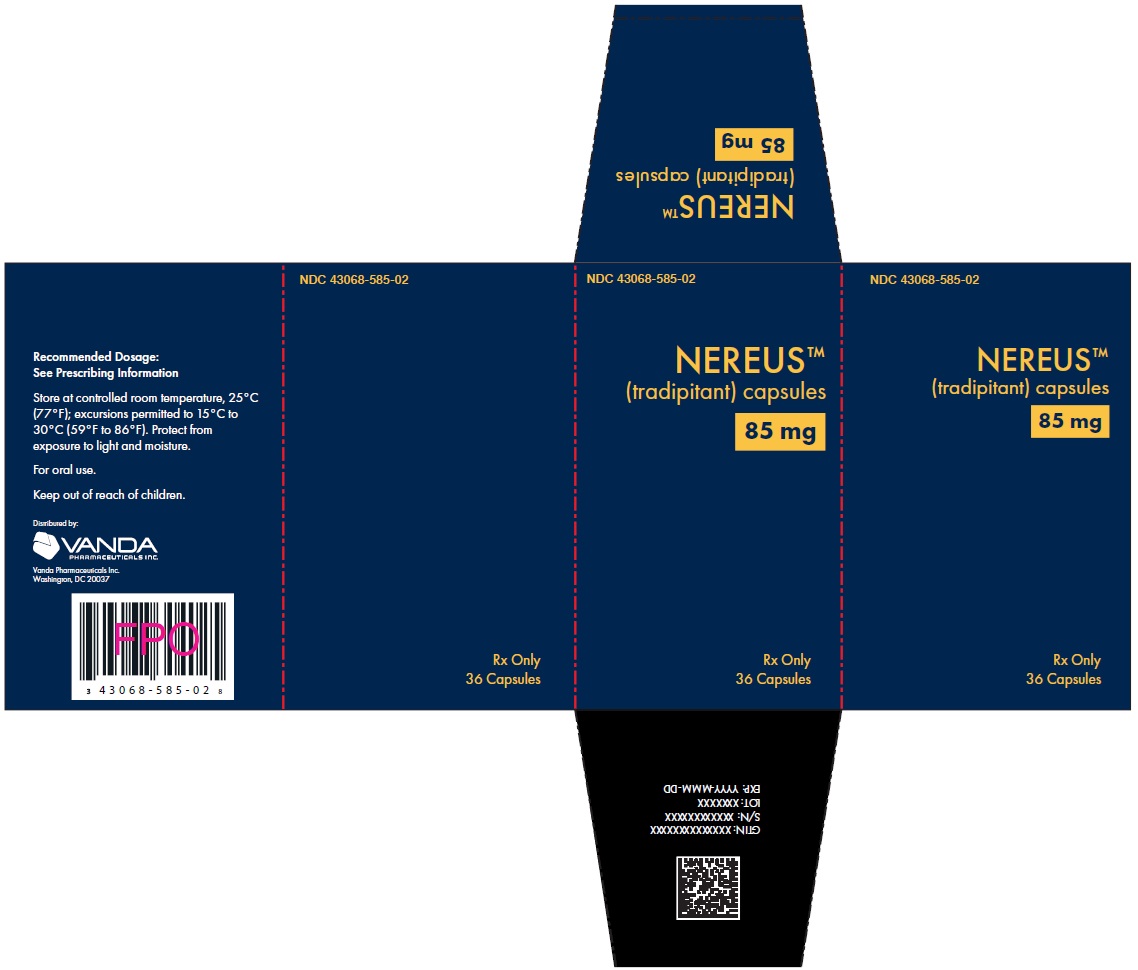
85mg Tradipitant Capsules (Carton Label)
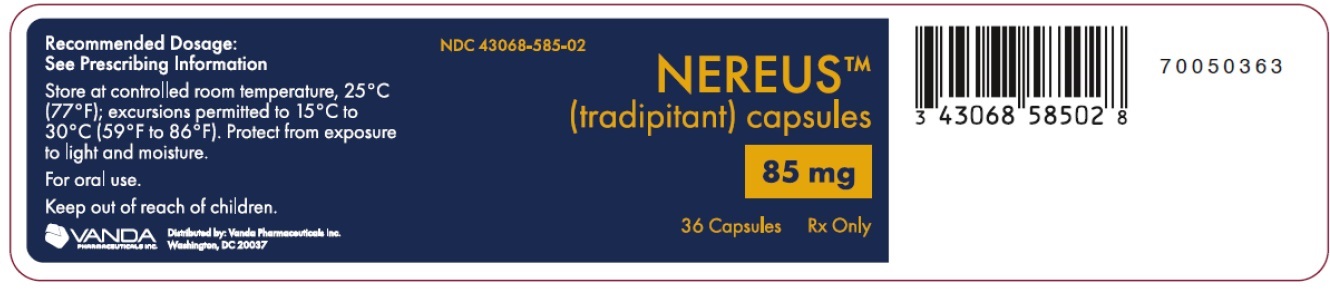
85mg Tradipitant Capsules (Container Label)
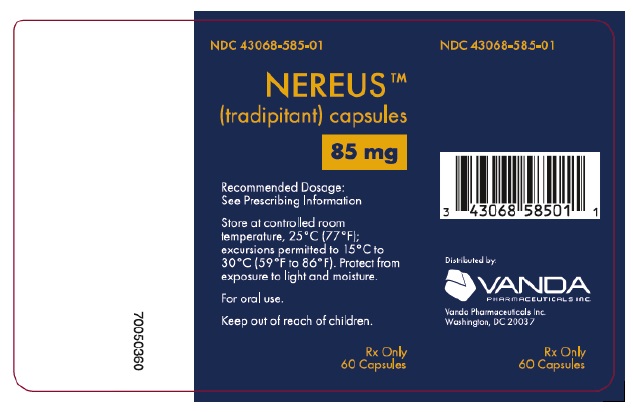
85mg Tradipitant Capsules (60 Count Container Label)
* Please review the disclaimer below.
