Limitation of Use
Patients with a serum creatinine > 5 mg/dL are unlikely to experience benefit.
Risk Summary
Based on findings from the published literature and on its mechanism of action, TERLIVAZ may cause fetal harm when administered to a pregnant woman [see Clinical Pharmacology (12.1)]. In small, published studies, administration of a single intravenous dose of terlipressin to pregnant women during the first trimester induced uterine contractions and endometrial ischemia. The limited published data are not sufficient to determine a drug-associated risk for major birth defects or miscarriage. If TERLIVAZ is used during pregnancy, the patient should be informed of the potential risk to the fetus.
The background risk of major birth defects and miscarriage for the indicated population is unknown. In the U.S. general population, the estimated background risk of major birth defects and miscarriage in clinically recognized pregnancies is 2% to 4% and 15% to 20%, respectively.
Data
Animal Data
In published reproductive toxicity animal studies, administration of terlipressin to pregnant guinea pigs at doses lower than the maximum recommended human dose of 4 mg/day caused a marked decrease in blood flow to the uterus and placenta. In rabbits, terlipressin is both embryotoxic and teratogenic (increased resorptions, increased implantation loss, fetal anomalies and fetal deformities).
Risk Summary
There are no data on the presence of terlipressin in human or animal milk, the effects on the breastfed infant, or the effect on milk production. The developmental and health benefits of breastfeeding should be considered along with the mother's clinical need for TERLIVAZ and any potential adverse effects on the breastfed child from TERLIVAZ or from the underlying maternal condition.
Cardiac Electrophysiology
The effect of terlipressin on QTc interval was evaluated in 41 patients with HRS-1. Patients received an initial dose of 1 mg terlipressin acetate every 6 hours for a period of up to 14 days. No clinically meaningful changes from baseline were detected in the trial based on the Fridericia correction method. Increases of the mean QTc interval of <10 ms were reported.
Distribution
The volume of distribution (Vd) of terlipressin was 6.3 L and 1370 L for lysine-vasopressin.
Elimination
The clearance of terlipressin was 27.4 L/hr and 318 L/hr for lysine-vasopressin. There were no dose-dependent changes in the elimination rate constant of terlipressin in healthy subjects. Clearance of terlipressin in HRS-1 patients increased with body weight, while body weight had no effect on the clearance of lysine-vasopressin.
The terminal half-life of terlipressin was 0.9 hours and 3.0 hours for lysine-vasopressin.
Metabolism
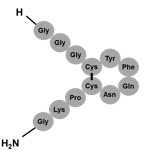
Terlipressin is metabolized by cleavage of the N-terminal glycyl residues of terlipressin by various tissue peptidases, resulting in release of the pharmacologically active metabolite lysine-vasopressin. Once formed, lysine-vasopressin is metabolized by body tissue via various peptidase-mediated routes. Terlipressin is not metabolized in blood or plasma. Due to the ubiquitous nature of peptidases in body tissue, it is unlikely that the metabolism of terlipressin will be affected by disease state or other drugs.
Excretion
Less than 1% of terlipressin and <0.1% of lysine-vasopressin is excreted in urine in healthy subjects.
Specific Populations
Gender, age, creatinine clearance, Child-Pugh score, serum alkaline phosphatase, serum alanine aminotransferase (ALT), serum aspartate aminotransferase (AST), and total bilirubin do not appear to have any clinically significant effect on clearance of either terlipressin or lysine-vasopressin.
Drug Interactions
In vitro studies in human liver microsomes demonstrated that there was little or no evidence that terlipressin was a direct-, time-, or metabolism-dependent inhibitor and inducer of any of the CYP enzymes evaluated. In addition, there was little or no evidence that terlipressin is an inhibitor and substrate of human ABC and SLC transporters. No significant drug-drug interactions are anticipated with TERLIVAZ.
Embryo-Fetal Toxicity
Inform female patients of reproductive potential that TERLIVAZ may cause fetal harm and to inform their prescriber of a known or suspected pregnancy [see Use in Specific Populations (8.1)].
Distributed by:
Mallinckrodt Hospital Products Inc.
Bedminster, NJ 07921, USA
Mallinckrodt, the "M" brand mark and the Mallinckrodt Pharmaceuticals logo are trademarks of a Mallinckrodt company. Other brands are trademarks of a Mallinckrodt company or their respective owners. ©2022 Mallinckrodt.
For a list of patents, see https://www.mallinckrodt.com/patents/
Part # PCR-750-16379