In a multicenter, randomized, double-blind, vehicle (placebo)-controlled clinical trial, the safety and effectiveness of hydroxyprogesterone caproate injection for the reduction of the risk of spontaneous preterm birth was studied in women with a singleton pregnancy (age 16 to 43 years) who had a documented history of singleton spontaneous preterm birth (defined as delivery at less than 37 weeks of gestation following spontaneous preterm labor or premature rupture of membranes). At the time of randomization (between 16 weeks, 0 days and 20 weeks, 6 days of gestation), an ultrasound examination had confirmed gestational age and no known fetal anomaly. Women were excluded for prior progesterone treatment or heparin therapy during the current pregnancy, a history of thromboembolic disease, or maternal/obstetrical complications (such as current or planned cerclage, hypertension requiring medication, or a seizure disorder).
A total of 463 pregnant women were randomized to receive either hydroxyprogesterone caproate injection (N=310) or vehicle (N=153) at a dose of 250 mg administered weekly by intramuscular injection starting between 16 weeks, 0 days and 20 weeks, 6 days of gestation, and continuing until 37 weeks of gestation or delivery. Demographics of the hydroxyprogesterone caproate injection-treated women were similar to those in the control group, and included: 59.0% Black, 25.5% Caucasian, 13.9% Hispanic and 0.6% Asian. The mean body mass index was 26.9 kg/m2.
The proportions of women in each treatment arm who delivered at < 37 (the primary study endpoint), < 35, and < 32 weeks of gestation are displayed in Table 5.
Table 5 Proportion of Subjects Delivering at < 37, < 35 and < 32 Weeks Gestational Age (ITT Population)
Delivery Outcome
| Hydroxyprogesterone Caproate Injection1 (N=310)
%
| Control
(N=153)
%
| Treatment difference and 95% Confidence Interval2
|
<37 weeks
| 37.1
| 54.9
| -17.8% [-28.0%, -7.4%]
|
<35 weeks
| 21.3
| 30.7
| -9.4% [-19.0%, -0.4%]
|
<32 weeks
| 11.9
| 19.6
| -7.7% [-16.1%, -0.3%]
|
1 Four hydroxyprogesterone caproate injection-treated subjects were lost to follow-up. They were counted as deliveries at their gestational ages at time of last contact (184, 220, 343 and 364 weeks).
2 Adjusted for interim analysis.
Compared to controls, treatment with hydroxyprogesterone caproate injection reduced the proportion of women who delivered preterm at < 37 weeks. The proportions of women delivering at < 35 and < 32 weeks also were lower among women treated with hydroxyprogesterone caproate injection. The upper bounds of the confidence intervals for the treatment difference at < 35 and < 32 weeks were close to zero. Inclusion of zero in a confidence interval would indicate the treatment difference is not statistically significant. Compared to the other gestational ages evaluated, the number of preterm births at < 32 weeks was limited.
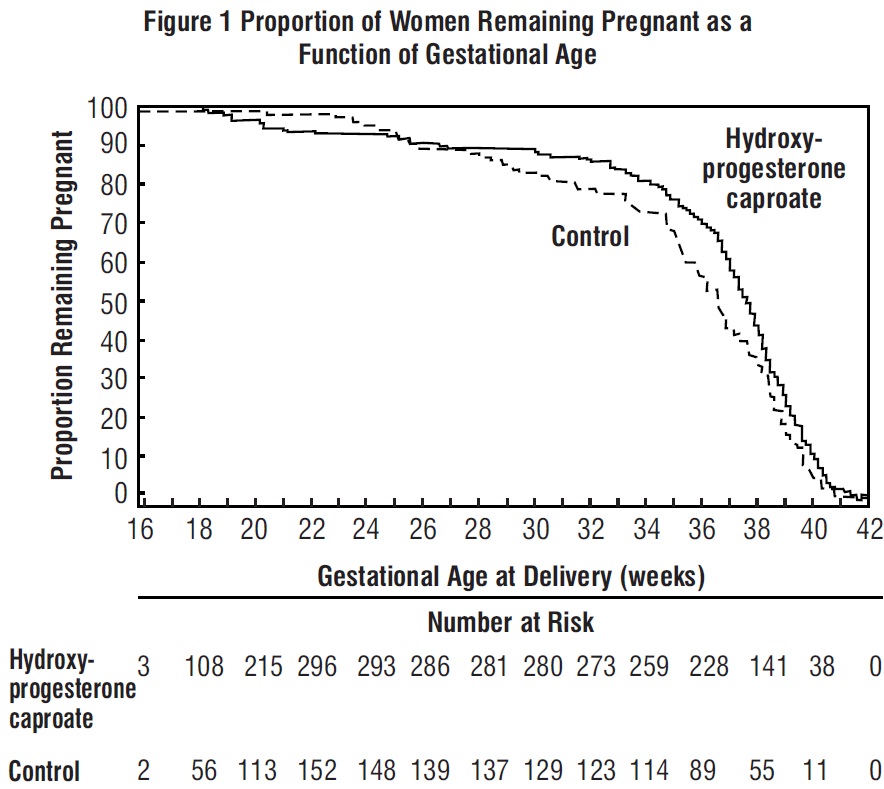
After adjusting for time in the study, 7.5% of hydroxyprogesterone caproate injection-treated subjects delivered prior to 25 weeks compared to 4.7% of control subjects; see Figure 1.
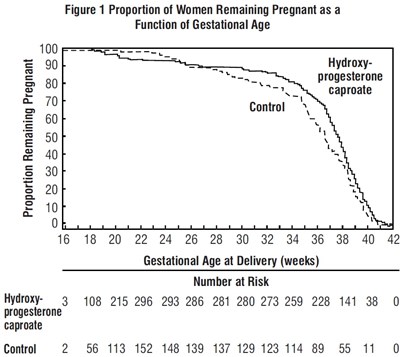
Spl-hydroxyprogesterone-caproate-figure-1 (Spl Hydroxyprogesterone Caproate Figure 1)
The rates of fetal losses and neonatal deaths in each treatment arm are displayed in Table 6. Due to the higher rate of miscarriages and stillbirths in the hydroxyprogesterone caproate injection arm, there was no overall survival difference demonstrated in this clinical trial.
Table 6 Fetal Losses and Neonatal Deaths
Complication
| Hydroxyprogesterone Caproate Injection
N=306 A
n (%) B
| Control
N=153
n (%) B
|
Miscarriages <20 weeks gestation C
| 5 (2.4)
| 0
|
Stillbirth
| 6 (2.0)
| 2 (1.3)
|
Antepartum stillbirth
| 5 (1.6)
| 1 (0.6)
|
Intrapartum stillbirth
| 1 (0.3)
| 1 (0.6)
|
Neonatal deaths
| 8 (2.6)
| 9 (5.9)
|
Total Deaths
| 19 (6.2)
| 11 (7.2)
|
A Four of the 310 hydroxyprogesterone caproate injection-treated subjects were lost to follow-up and stillbirth or neonatal status could not be determined
B Percentages are based on the number of enrolled subjects and not adjusted for time on drug
C Percentage adjusted for the number of at risk subjects (n=209 for hydroxyprogesterone caproate injection, n=107 for control) enrolled at <20 weeks gestation.
A composite neonatal morbidity/mortality index evaluated adverse outcomes in live births. It was based on the number of neonates who died or experienced respiratory distress syndrome, bronchopulmonary dysplasia, grade 3 or 4 intraventricular hemorrhage, proven sepsis, or necrotizing enterocolitis. Although the proportion of neonates who experienced 1 or more events was numerically lower in the hydroxyprogesterone caproate injection arm (11.9% vs. 17.2%), the number of adverse outcomes was limited and the difference between arms was not statistically significant.