Mechanism of Action
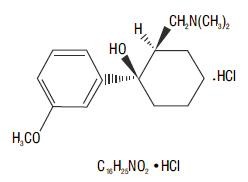
Tramadol hydrochloride extended-release tablets, contain tramadol, an opioid agonist inhibitor of norepinenphrine and serotonin re-uptake. Although the mode of action of tramadol is not completely understood, the analgesic effect of tramadol is believed to be due to binding to μ-opioid receptors and weak inhibition of reuptake of norepinephrine and serotonin.
Opioid activity of tramadol is due to both low affinity binding of the parent compound and higher affinity binding of the O-demethylated metabolite (M1) to mu-opioid receptors. In animal models, M1 is up to 6 times more potent than tramadol in producing analgesia and 200 times more potent in mu-opioid binding. Tramadol-induced analgesia is only partially antagonized by the opiate antagonist naloxone in several animal tests. The relative contribution of both tramadol and M1 to human analgesia is dependent upon the plasma concentrations of each compound.
Tramadol has been shown to inhibit reuptake of norepinephrine and serotonin in vitro, as have some other opioid analgesics. These mechanisms may contribute independently to the overall analgesic profile of tramadol.
Apart from analgesia, tramadol hydrochloride administration may produce various symptoms (including dizziness, somnolence, nausea, constipation, sweating and pruritus) similar to that of other opioids. In contrast to morphine, tramadol has not been shown to cause histamine release. At therapeutic doses, tramadol has no effect on heart rate, left-ventricular function or cardiac index. Orthostatic hypotension has been observed.
Pharmacodynamics
Effects on the Central Nervous System
Tramadol produces respiratory depression by direct action on brain stem respiratory centers. The respiratory depression involves a reduction in the responsiveness of the brain stem respiratory centers to both increases in carbon dioxide tension and electrical stimulation.
Tramadol causes miosis, even in total darkness. Pinpoint pupils are a sign of opioid overdose but are not pathognomonic (e.g., pontine lesions of hemorrhagic or ischemic origins may produce similar findings). Marked mydriasis rather than miosis may be seen due to hypoxia in overdose situations.
Effects on the Gastrointestinal Tract and Other Smooth Muscle
Tramadol causes a reduction in motility associated with an increase in smooth muscle tone in the antrum of the stomach and duodenum. Digestion of food in the small intestine is delayed and propulsive contractions are decreased. Propulsive peristaltic waves in the colon are decreased, while tone may be increased to the point of spasm, resulting in constipation. Other opioid-induced effects may include a reduction in biliary and pancreatic secretions, spasm of sphincter of Oddi, and transient elevations in serum amylase.
Effects on the Cardiovascular System
Tramadol produces peripheral vasodilation, which may result in orthostatic hypotension or syncope. Manifestations of histamine release and/or peripheral vasodilation may include pruritus,flushing, red eyes, sweating, and/or orthostatic hypotension.
Effects on the Endocrine System
Opioids inhibit the secretion of adrenocorticotropic hormone (ACTH), cortisol, and luteinizing hormone (LH) in humans [see ADVERSE REACTIONS]. They also stimulate prolactin, growth hormone (GH) secretion, and pancreatic secretion of insulin and glucagon.
Chronic use of opioids may influence the hypothalamic-pituitary-gonadal axis, leading to androgen deficiency that may manifest as low libido, impotence, erectile dysfunction, amenorrhea, or infertility. The causal role of opioids in the clinical syndrome of hypogonadism is unknown because the various medical, physical, lifestyle, and psychological stressors that may influence gonadal hormone levels have not been adequately controlled for in studies conducted to date [see ADVERSE REACTIONS].
Effects on the Immune System
Opioids have been shown to have a variety of effects on components of the immune system. The clinical significance of these findings is unknown. Overall, the effects of opioids appear to be modestly immunosuppressive.
Concentration–Efficacy Relationships
The minimum effective analgesic concentration will vary widely among patients, especially among patients who have been previously treated with potent opioid agonists. The minimum effective analgesic concentration of tramadol for any individual patient may increase over time due to an increase in pain, the development of a new pain syndrome, and/or the development of analgesic tolerance [see DOSAGE AND ADMINISTRATION].
Concentration–Adverse Reaction Relationships
There is a relationship between increasing tramadol plasma concentration and increasing frequency of dose-related opioid adverse reactions such as nausea, vomiting, CNS effects, and respiratory depression. In opioid-tolerant patients, the situation may be altered by the development of tolerance to opioid-related adverse reactions [see DOSAGE AND ADMINISTRATION].
Pharmacokinetics
Tramadol hydrochloride extended-release tablets are formulated as a racemate and both tramadol and M1 are detected in the circulation.
The pharmacokinetics of tramadol and M1 are dose-proportional over a 100 to 300 mg dose range in healthy subjects.
Absorption
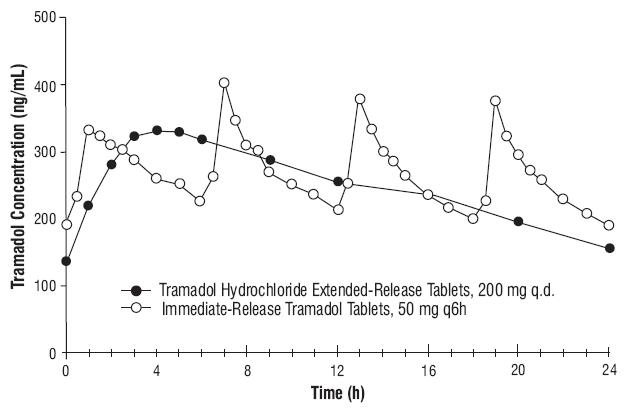
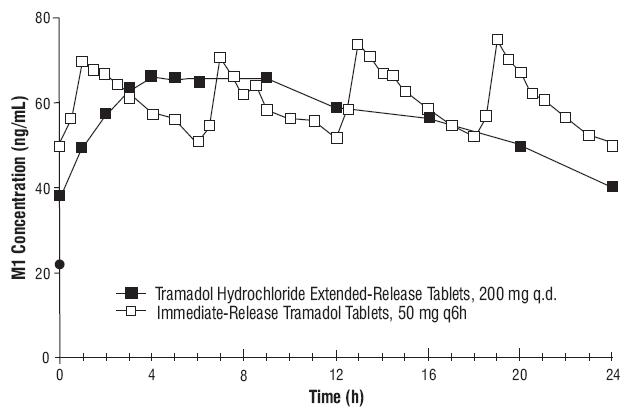
The median time to peak plasma concentrations of tramadol and M1 after multiple-dose administration of a tramadol hydrochloride extended-release tablet 200 mg to healthy subjects are attained at about 4 h and 5 h, respectively (Table 1 and Figure 1).
The pharmacokinetic parameter values of a tramadol hydrochloride extended-release tablet 200 mg administered once daily and tramadol immediate-release 50 mg administered every six hours are provided in Table 1. The relative bioavailability of a 200 mg tramadol hydrochloride extended-release tablet compared to a 50 mg immediate-release tablet dosed every six hours was approximately 95% in healthy subjects.
Table 1. Mean (%CV) Steady-State Pharmacokinetic Parameter Values (n=26).
Pharmacokinetic
Parameter
| Tramadol
| M1 Metabolite
|
Tramadol Hydrochloride Extended-Release 200 mg Tablet
Once-Daily
| Immediate-
Release Tramadol
50 mg Tablet
Every 6 Hours
| Tramadol Hydrochloride Extended-Release 200 mg Tablet
Once-Daily
| Immediate-
Release Tramadol
50 mg Tablet
Every 6 Hours
|
AUC0-24 (ng·h/mL)
| 5991 (22)
| 6399 (28)
| 1361 (27)
| 1438 (23)
|
Cmax (ng/mL)
| 345 (21)
| 423 (23)
| 71 (27)
| 79 (22)
|
Cmin (ng/mL)
| 157 (31)
| 190 (34)
| 41 (30)
| 50 (29)
|
| Tmax (hr) Tmax is presented as Median (Range)
| 4.0 (3.0 to 9.0)
| 1.0 (1.0 to 3.0)
| 5.0 (3.0 to 20)
| 1.5 (1.0 to 3.0)
|
Fluctuation (%)
| 77 (26)
| 91 (22)
| 53 (29)
| 49 (26)
|
Steady-state plasma concentrations are reached within approximately 48 hours.
Figure 1. Mean Tramadol Plasma Concentrations at Steady State Following Five Days of Oral Administration of A Tramadol Hydrochloride Extended-Release Tablet 200 mg Once Daily and Immediate-Release Tramadol 50 mg Every 6 Hours.

Spl-tramadol-figure1 (Spl Tramadol Figure1)
Figure 2. Mean M1 Plasma Concentrations at Steady State Following Five Days of Oral Administration of A Tramadol Hydrochloride Extended-Release Tablet 200 mg Once Daily and Immediate-Release Tramadol 50 mg Every 6 Hours
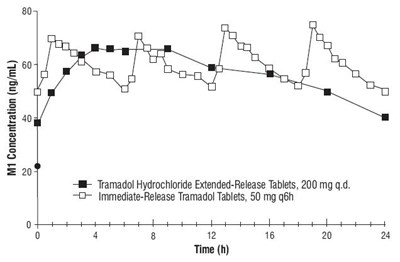
Spl-tramadol-figure2 (Spl Tramadol Figure2)
Food Effect
Coadministration with a high fat meal did not significantly affect AUC (overall exposure to tramadol); however, Cmax (peak plasma concentration) increased 67% following a single 300 mg tablet administration and 54% following a single 200 mg tablet administration. Tramadol hydrochloride extended-release tablets were administered without regard to food in all clinical trials.
Distribution
The volume of distribution of tramadol is 2.6 and 2.9 L/kg in males and females, respectively, following a 100 mg intravenous dose. The binding of tramadol to human plasma proteins is approximately 20%. Protein binding also appears to be independent of concentration up to 10 mcg/mL. Saturation of plasma protein binding occurs only at concentrations outside the clinically relevant range.
Elimination
After single administration of tramadol hydrochloride extended-release tablets, the mean terminal plasma elimination half-lives of racemic tramadol and racemic M1 are 6.5 ± 1.5 and 7.5 ± 1.4 hours, respectively.
Metabolism
Tramadol is extensively metabolized after oral administration. The major metabolic pathways appear to be N- and O-demethylation and glucuronidation or sulfation in the liver. N-demethylation is mediated by CYP3A4 and CYP2B6. One metabolite (O-desmethyltramadol, denoted M1) is pharmacologically active in animal models. Formation of M1 is dependent on CYP2D6 and as such is subject to inhibition and polymorphism, which may affect the therapeutic response [see P RECAUTIONS - Drug Interactions].
Excretion
Approximately 30% of the dose is excreted in the urine as unchanged drug, whereas 60% of the dose is excreted as metabolites. The remainder is excreted either as unidentified or as unextractable metabolites.
Special Populations
Hepatic Impairment
The metabolism of tramadol and M1 is reduced in patients with advanced cirrhosis of the liver, resulting in both a larger area under the concentration time curve (AUC) for tramadol and longer mean tramadol and M1 elimination half-lives (13 hours for tramadol and 19 hours for M1) after the administration of tramadol immediate-release tablets. Tramadol hydrochloride extended-release tablets have not been studied in patients with hepatic impairment. The limited availability of dose strengths and once daily dosing of tramadol hydrochloride extended-release tablets do not permit the dosing flexibility required for safe use in patients with hepatic impairment. Therefore, tramadol hydrochloride extended-release tablets should not be used in patients with hepatic impairment [see WARNINGS, Use in Renal and Hepatic Disease and DOSAGE AND ADMINISTRATION].
Renal Impairment
Impaired renal function results in a decreased rate and extent of excretion of tramadol and its active metabolite, M1 in patients taking an immediate-release formulation of tramadol. Tramadol hydrochloride extended-release tablets have not been studied in patients with renal impairment. The limited availability of dose strengths and once daily dosing of tramadol hydrochloride extended-release tablets do not permit the dosing flexibility required for safe use in patients with severe renal impairment. Therefore, tramadol hydrochloride extended-release tablets should not be used in patients with severe renal impairment (creatinine clearance less than 30 mL/min) [see WARNINGS, Use in Renal and Hepatic Disease and DOSAGE AND ADMINISTRATION].The total amount of tramadol and M1 removed during a 4-hour dialysis period is less than 7% of the administered dose.
Geriatric Patients
Healthy elderly subjects aged 65 to 75 years administered an immediate-release formulation of tramadol, have plasma concentrations and elimination half-lives comparable to those observed in healthy subjects less than 65 years of age. In subjects over 75 years, mean maximum plasma concentrations are elevated (208 vs. 162 ng/mL) and the mean elimination half-life is prolonged (7 vs. 6 hours) compared to subjects 65 to 75 years of age. Adjustment of the daily dose is recommended for patients older than 75 years [see DOSAGE AND ADMINISTRATION].
Sex
Following a 100 mg IV dose of tramadol, plasma clearance was 6.4 mL/min/kg in males and 5.7 mL/min/kg in females. Following a single oral dose of immediate-release tramadol, and after adjusting for body weight, females had a 12% higher peak tramadol concentration and a 35% higher area under the concentration-time curve compared to males. The clinical significance of this difference is unknown.
Drug Interaction Studies
Potential for Tramadol to Affect Other Drugs
In vitro studies indicate that tramadol is unlikely to inhibit the CYP3A4-mediated metabolism of other drugs when tramadol is administered concomitantly at therapeutic doses. Tramadol does not appear to induce its own metabolism in humans, since observed maximal plasma concentrations after multiple oral doses are higher than expected based on single-dose data.
Poor/Extensive Metabolizers, CYP2D6
The formation of the active metabolite of tramadol, M1, is mediated by CYP2D6, a polymorphic enzyme. Approximately 7% of the population has reduced activity of CYP2D6. These individuals are "poor metabolizers" of debrisoquine, dextromethorphan and tricyclic antidepressants, among other drugs. In studies in healthy subjects administered immediate-release tramadol products, concentrations of tramadol were approximately 20% higher in "poor metabolizers" versus “extensive metabolizers”, while M1 concentrations were 40% lower.
CYP2D6 Inhibitors
In vitro drug interaction studies in human liver microsomes indicate that concomitant administration with inhibitors of CYP2D6 such as (fluoxetine paroxetine, and amitriptyline could result in some inhibition of the metabolism of tramadol.
Quinidine
Quinidine is a selective inhibitor of CYP2D6, so that concomitant administration of quinidine and tramadol hydrochloride extended-release tablets may result in increased concentrations of tramadol and reduced concentrations of M1. The clinical consequences of these findings are unknown [see PRECAUTIONS]. In vitro drug interaction studies in human liver microsomes indicate that tramadol has no effect on quinidine metabolism.
CYP3A4 Inhibitors and Inducers
Tramadol is also metabolized by CYP3A4. Administration of CYP3A4 inhibitors such as ketoconazole and erythromycin, or inducers, such as rifampin and St. John’s Wort, with tramadol hydrochloride extended-release tablets may affect the metabolism of tramadol leading to altered tramadol exposure [see PRECAUTIONS].
Cimetidine
Concomitant administration of tramadol immediate-release tablets with cimetidine, a weak CYP3A4 inhibitor, does not result in clinically significant changes in tramadol pharmacokinetics. No alteration of the tramadol hydrochloride extended-release tablets dosage regimen with cimetidine is recommended.
Carbamazepine
Carbamazepine, a CYP3A4 inducer, increases tramadol metabolism. Patients taking carbamazepine may have a significantly reduced analgesic effect of tramadol. Concomitant administration of tramadol hydrochloride extended-release tablets and carbamazepine is not recommended [see PRECAUTIONS].