- Administer as an intravenous infusion only.
- Do not use an in-line filter to administer LUNSUMIO.
- Do not mix LUNSUMIO with, or administer through the same infusion line, as other medicinal products.
- No incompatibilities have been observed between LUNSUMIO and intravenous infusion bags with product contacting materials of polyvinyl chloride (PVC), or polyolefins (PO) such as polyethylene (PE) and polypropylene (PP). In addition, no incompatibilities have been observed with infusion sets or infusion aids with product contacting materials of PVC, PE, polyurethane (PUR), polybutadiene (PBD), silicone, acrylonitrile butadiene styrene (ABS), polycarbonate (PC), polyetherurethane (PEU), fluorinated ethylene propylene (FEP), or polytetrafluorethylene (PTFE), or with drip chamber filter membrane composed of polyamide (PA).
Relapsed or Refractory Follicular Lymphoma
GO29781
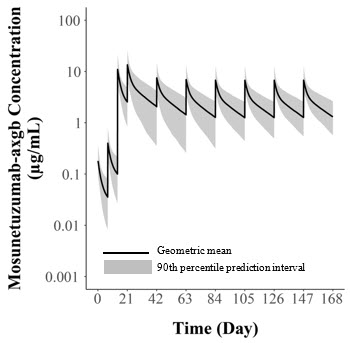
The safety of LUNSUMIO was evaluated in GO29781, an open-label, multicenter, multi-cohort study which included a cohort of 90 patients with relapsed or refractory follicular lymphoma (FL) [see Clinical Studies (14)]. In this cohort, patients with relapsed or refractory FL were required to have received at least two prior lines of systemic therapy, including an anti-CD20 monoclonal antibody and an alkylating agent. Patients received step-up doses of 1 mg on Cycle 1 Day 1 and 2 mg on Cycle 1 Day 8, followed by 60 mg on Cycle 1 Day 15 and 60 mg on Cycle 2 Day 1, then 30 mg every 3 weeks in subsequent cycles. A treatment cycle was 21 days. The median number of cycles was 8 (range: 1 – 17). In the relapsed or refractory FL cohort, 77% were exposed for at least 8 cycles and 12% were exposed for 17 cycles.
The median age of the patients who received LUNSUMIO in the relapsed or refractory FL cohort was 60 years (range: 29 to 90 years), 61% were male, 82% were White, 4% were Black or African American, 9% were Asian, and 8% were Hispanic or Latino.
Serious adverse reactions occurred in 47% of patients who received LUNSUMIO. Serious adverse reactions in ≥ 2% of patients included cytokine release syndrome, infection (including urinary tract infection, sepsis, pneumonia, EBV viremia, and COVID-19), renal insufficiency, pyrexia, and tumor flare.
Permanent discontinuation of LUNSUMIO due to an adverse reaction occurred in 3% of patients. Adverse reactions resulting in permanent discontinuation of LUNSUMIO included cytokine release syndrome and EBV viremia.
Dosage interruptions of LUNSUMIO due to an adverse reaction occurred in 37% of patients. Adverse reactions which required dosage interruption in ≥ 5% of patients included neutropenia, infection, and cytokine release syndrome.
Table 8 summarizes the adverse reactions in patients with relapsed or refractory FL in GO29781.
Table 8. Adverse Reactions (≥ 10%) in Patients with Relapsed or Refractory FL Who Received LUNSUMIO in GO29781| Adverse Reaction Adverse reactions were graded based on CTCAE Version 4.0, with the exception of CRS, which was graded per ASTCT 2019 criteria | LUNSUMIO
(N = 90) |
|---|
All Grades
(%) | Grade 3 or 4
(%) |
|---|
| Immune system disorders |
| Cytokine release syndrome | 44 | 2.2 |
| General disorders and administration site conditions |
| Fatigue Fatigue includes fatigue, asthenia, and lethargy | 42 | 0 |
| Pyrexia | 29 | 1.1 Only Grade 3 adverse reactions occurred |
| Edema Edema includes edema, edema peripheral, peripheral swelling, face edema, swelling face, pulmonary edema, fluid overload, and fluid retention | 17 | 1.1 |
| Chills | 13 | 1.1 |
| Skin and subcutaneous tissue disorders |
| Rash Rash includes rash, rash erythematous, exfoliative rash, rash macular, rash maculo-papular, rash papular, rash pruritic, rash pustular, erythema, palmar erythema, dermatitis, and dermatitis acneiform | 39 | 4.4 |
| Pruritus | 21 | 0 |
| Dry skin | 16 | 0 |
| Skin exfoliation | 10 | 0 |
| Nervous system |
| Headache Headache includes headache and migraine | 32 | 1.1 |
| Peripheral neuropathy Peripheral neuropathy includes peripheral neuropathy, peripheral sensory neuropathy, paresthesia, dysaesthesia, hypoaesthesia, burning sensation, and neuralgia | 20 | 0 |
| Dizziness Dizziness includes dizziness and vertigo | 12 | 0 |
| Musculoskeletal and connective tissue disorders |
| Musculoskeletal pain Musculoskeletal pain includes musculoskeletal pain, back pain, myalgia, musculoskeletal chest pain, and neck pain | 28 | 1.1 |
| Arthralgia | 11 | 0 |
| Respiratory, thoracic, and mediastinal disorders |
| Cough Cough includes cough, productive cough, and upper airway cough syndrome | 22 | 0 |
| Dyspnea Dyspnea includes dyspnea and dyspnea exertional | 11 | 1.1 |
| Gastrointestinal disorders |
| Diarrhea | 17 | 0 |
| Nausea | 17 | 0 |
| Abdominal pain Abdominal pain includes abdominal pain, lower abdominal pain, and abdominal discomfort | 12 | 1.1 |
| Infections |
| Upper respiratory tract infection Upper respiratory tract infection includes upper respiratory tract infection, nasopharyngitis, sinusitis, and rhinovirus infection | 14 | 2.2 |
| Urinary tract infection Urinary tract infection includes urinary tract infection and acute pyelonephritis | 10 | 1.1 |
| Psychiatric disorder |
| Insomnia | 12 | 0 |
Clinically relevant adverse reactions in < 10% of patients who received LUNSUMIO included pneumonia, sepsis, COVID-19, EBV viremia, mental status changes, tumor lysis syndrome, renal insufficiency, anxiety, motor dysfunction (including ataxia, gait disturbance and tremor), and tumor flare.
Table 9 summarizes the laboratory abnormalities in patients with relapsed or refractory FL in GO29781.
Table 9. Select Laboratory Abnormalities (≥ 20%) That Worsened from Baseline in Patients with Relapsed or Refractory FL Who Received LUNSUMIO in GO29781| Laboratory Abnormality | LUNSUMIO The denominator used to calculate the rate varied from 72 to 90 based on the number of patients with a baseline value and at least one post-treatment value. |
|---|
All Grades
(%) | Grade 3 or 4
(%) |
|---|
| Hematology |
| Lymphocyte count decreased | 100 | 98 |
| Hemoglobin decreased | 68 | 12 |
| White blood cells decreased | 60 | 13 |
| Neutrophils decreased | 58 | 40 |
| Platelets decreased | 46 | 10 |
| Chemistry |
| Phosphate decreased | 78 | 46 |
| Glucose increased | 42 | 42 |
| Aspartate aminotransferase increased | 39 | 4.4 |
| Gamma-glutamyl transferase increased | 34 | 9 |
| Magnesium decreased | 34 | 0 |
| Potassium decreased | 33 | 6 |
| Alanine aminotransferase increased | 32 | 7 |
| Uric acid increased | 22 | 22 |
Effect of LUNSUMIO on CYP450 Substrates
LUNSUMIO causes release of cytokines [see Clinical Pharmacology (12.2)] that may suppress activity of CYP450 enzymes, resulting in increased exposure of CYP450 substrates. Increased exposure of CYP450 substrates is more likely to occur after the first dose of LUNSUMIO on Cycle 1 Day 1 and up to 14 days after the second 60 mg dose on Cycle 2 Day 1 and during and after CRS [see Warnings and Precautions (5.1)]. Monitor for toxicity or concentrations of drugs that are CYP450 substrates where minimal concentration changes may lead to serious adverse reactions. Consult the concomitant CYP450 substrate drug prescribing information for recommended dosage modification.
Risk Summary
Based on the mechanism of action, LUNSUMIO may cause fetal harm when administered to a pregnant woman [see Clinical Pharmacology (12.1)]. There are no available data on the use of LUNSUMIO in pregnant women to evaluate for a drug-associated risk. No animal reproductive or developmental toxicity studies have been conducted with mosunetuzumab-axgb.
Mosunetuzumab-axgb causes T-cell activation and cytokine release; immune activation may compromise pregnancy maintenance. In addition, based on expression of CD20 on B-cells and the finding of B-cell depletion in non-pregnant animals, mosunetuzumab-axgb can cause B-cell lymphocytopenia in infants exposed to mosunetuzumab-axgb in-utero. Human immunoglobulin G (IgG) is known to cross the placenta; therefore, LUNSUMIO has the potential to be transmitted from the mother to the developing fetus. Advise women of the potential risk to the fetus.
In the U.S. general population, the estimated background risk of major birth defects and miscarriage in clinically recognized pregnancies is 2% – 4% and 15% – 20%, respectively.
Risk Summary
There is no information regarding the presence of mosunetuzumab-axgb in human milk, the effect on the breastfed child, or milk production. Because human IgG is present in human milk, and there is potential for mosunetuzumab-axgb absorption leading to B-cell depletion, advise women not to breastfeed during treatment with LUNSUMIO and for 3 months after the last dose.
Pregnancy Testing
Verify pregnancy status in females of reproductive potential prior to initiating LUNSUMIO.
Contraception
Females
Advise females of reproductive potential to use effective contraception during treatment with LUNSUMIO and for 3 months after the last dose.
Distribution
The mean (CV%) volume of distribution of mosunetuzumab-axgb was 5.49 L (31%).
Elimination
The steady-state geometric mean (CV%) terminal elimination half-life of mosunetuzumab-axgb was 16.1 (17.3%) days. The geometric mean (CV%) clearance at baseline and at steady state are 1.08 L/day (63%) and 0.584 L/day (18%), respectively.
Specific Populations
There were no clinically significant differences in the pharmacokinetics of mosunetuzumab-axgb based on age (19 to 96 years), sex, race (Asian and Non-Asian), ethnicity (Hispanic/Latino and not Hispanic/Latino), mild or moderate renal impairment (estimated Creatinine clearance [CrCL] by Cockcroft-Gault formula: 30 to 89 mL/min), or mild hepatic impairment (total bilirubin less than or equal to upper limit of normal [ULN] with AST greater than ULN or total bilirubin greater than 1 to 1.5 times ULN with any AST). The effects of severe renal impairment (CrCL 15 to 29 mL/min) or moderate to severe hepatic impairment (total bilirubin greater than 1.5 times ULN with any AST) on the pharmacokinetics of mosunetuzumab-axgb are unknown.
Drug Interaction Studies
No clinical studies evaluating the drug interaction potential of mosunetuzumab-axgb have been conducted.
Cytokine Release Syndrome (CRS) – Discuss the signs and symptoms associated with CRS, including fever, chills, hypotension, tachycardia, hypoxia, and headache. Counsel patients to seek immediate medical attention should signs or symptoms of CRS occur at any time. Advise patients who experience symptoms that impair consciousness not to drive and refrain from operating heavy or potentially dangerous machinery until events resolve [see Warnings and Precautions (5.1)].
Neurologic Toxicity – Discuss the signs and symptoms associated with neurologic toxicity, including ICANS, headache, peripheral neuropathy, dizziness, or mental status changes. Advise patients to immediately contact their healthcare provider if they experience any signs or symptoms of neurologic toxicity. Advise patients who experience neurologic toxicity that impairs consciousness to refrain from driving or operating heavy or potentially dangerous machinery until neurologic toxicity resolves [see Warnings and Precautions (5.2)].
Infections – Discuss the signs or symptoms associated with infection [see Warnings and Precautions (5.3)].
Cytopenias – Discuss the signs and symptoms associated with cytopenias, including neutropenia and febrile neutropenia, anemia, and thrombocytopenia [see Warnings and Precautions (5.4)].
Tumor Flare – Inform patients of the potential risk of tumor flare reaction and to report any signs and symptoms associated with this event to their healthcare provider for evaluation [see Warnings and Precautions (5.5)].
Embryo-Fetal Toxicity – Advise pregnant women of the potential risk to a fetus. Advise females of reproductive potential to inform their healthcare provider if they are pregnant or become pregnant [see Use in Specific Populations (8.1)]. Advise females of reproductive potential to use effective contraception during treatment with LUNSUMIO and for 3 months after the last dose [see Use in Specific Populations (8.3)].
Lactation – Advise women not to breastfeed during treatment with LUNSUMIO and for 3 months after the last dose [see Use in Specific Populations (8.2)].
Manufactured by:
Genentech, Inc.
A Member of the Roche Group
1 DNA Way
South San Francisco, CA 94080-4990
LUNSUMIO is a trademark of Genentech, Inc.
©2022 Genentech, Inc.
U.S. License No.: 1048