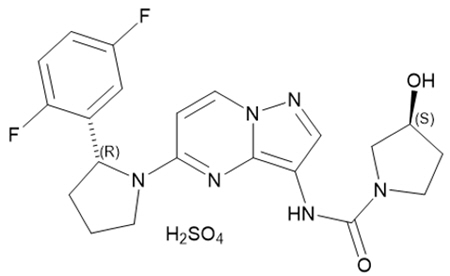
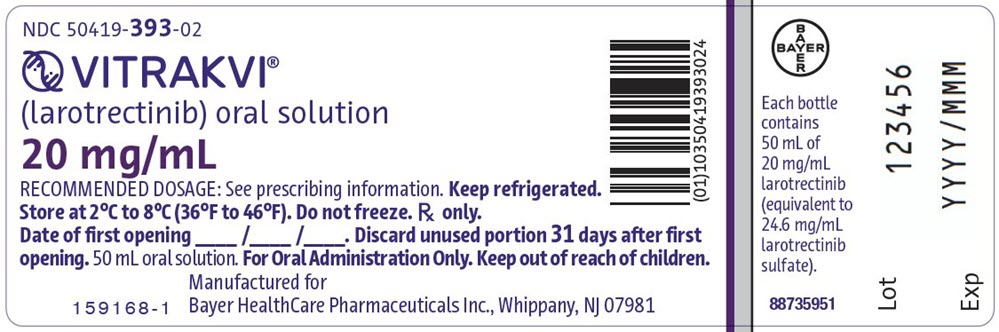
- 20 mg/mL: colorless to yellow or orange or red or brownish solution. 20 mg/mL larotrectinib is equivalent to 24.6 mg/mL larotrectinib sulfate.
Strong and Moderate CYP3A4 Inhibitors
Coadministration of VITRAKVI with a strong or moderate CYP3A4 inhibitor may increase larotrectinib plasma concentrations, which may result in a higher incidence of adverse reactions [see Clinical Pharmacology (12.3)]. Avoid coadministration of VITRAKVI with strong CYP3A4 inhibitors, including grapefruit or grapefruit juice. If coadministration of strong CYP3A4 inhibitors cannot be avoided, modify VITRAKVI dose as recommended [see Dosage and Administration (2.5)]. In patients coadministered a moderate CYP3A4 inhibitor with VITRAKVI, monitor for adverse reactions more frequently and reduce the VITRAKVI dosage based on the severity of emergent adverse reactions [see Dosage and Administration (2.3)].
Strong and Moderate CYP3A4 Inducers
Coadministration of VITRAKVI with a strong or moderate CYP3A4 inducer may decrease larotrectinib plasma concentrations, which may decrease the efficacy of VITRAKVI [see Clinical Pharmacology (12.3)]. Avoid coadministration of VITRAKVI with strong CYP3A4 inducers, including St. John's wort. If coadministration of strong CYP3A4 inducers cannot be avoided, modify VITRAKVI dose as recommended. For coadministration with moderate CYP3A4 inducers, modify VITRAKVI dose as recommended [see Dosage and Administration (2.6)].
Sensitive CYP3A4 Substrates
Coadministration of VITRAKVI with sensitive CYP3A4 substrates may increase their plasma concentrations, which may increase the incidence or severity of adverse reactions [see Clinical Pharmacology (12.3)]. Avoid coadministration of VITRAKVI with sensitive CYP3A4 substrates. If coadministration of these sensitive CYP3A4 substrates cannot be avoided, monitor patients for increased adverse reactions of these drugs.
Risk Summary
Based on literature reports in human subjects with congenital mutations leading to changes in TRK signaling, findings from animal studies, and its mechanism of action [see Clinical Pharmacology (12.1)], VITRAKVI can cause embryo-fetal harm when administered to a pregnant woman. There are no available data on VITRAKVI use in pregnant women. Administration of larotrectinib to pregnant rats and rabbits during the period of organogenesis resulted in malformations at maternal exposures that were approximately 11- and 0.7-times, respectively, those observed at the clinical dose of 100 mg twice daily (see Data). Advise pregnant women of the potential risk to a fetus.
In the U.S. general population, the estimated background risk of major birth defects and miscarriage in clinically recognized pregnancies is 2% to 4% and 15% to 20%, respectively.
Data
Human Data
Published reports of individuals with congenital mutations in TRK pathway proteins suggest that decreases in TRK-mediated signaling are correlated with obesity, developmental delays, cognitive impairment, insensitivity to pain, and anhidrosis.
Animal Data
Larotrectinib crosses the placenta in animals. Larotrectinib did not result in embryolethality at maternally toxic doses [up to 40 times the human exposure based on area under the curve (AUC) at the clinical dose of 100 mg twice daily] in embryo-fetal development studies in pregnant rats dosed during the period of organogenesis; however, larotrectinib was associated with fetal anasarca in rats from dams treated at twice-daily doses of 40 mg/kg [11 times the human exposure (AUC) at the clinical dose of 100 mg twice daily]. In pregnant rabbits, larotrectinib administration was associated with omphalocele at twice-daily doses of 15 mg/kg (0.7 times the human exposure at the clinical dose of 100 mg twice daily).
Risk Summary
There are no data on the presence of larotrectinib or its metabolites in human milk and no data on its effects on the breastfed child or on milk production. Because of the potential for serious adverse reactions in breastfed children, advise women not to breastfeed during treatment with larotrectinib and for 1 week after the last dose.
Pregnancy Testing
Verify pregnancy status in females of reproductive potential prior to initiating VITRAKVI [see Use in Specific Populations (8.1)].
Contraception
VITRAKVI can cause embryo-fetal harm when administered to a pregnant woman [see Use in Specific Populations (8.1)].
Females
Advise female patients of reproductive potential to use effective contraception during treatment with VITRAKVI and for 1 week after the last dose.
Males
Advise males with female partners of reproductive potential to use effective contraception during treatment with VITRAKVI and for 1 week after the last dose.
Infertility
Females
Based on histopathological findings in the reproductive tracts of female rats in a 1-month repeated-dose study, VITRAKVI may reduce fertility [See Nonclinical Toxicology (13.1)].
Juvenile Animal Toxicity Data
Larotrectinib was administered in a juvenile toxicity study in rats at twice daily doses of 0.2, 2 and 7.5 mg/kg from postnatal day (PND) 7 to 27 and at twice daily doses of 0.6, 6 and 22.5mg/kg between PND 28 and 70. The dosing period was equivalent to human pediatric populations from newborn to adulthood. The doses of 2/6 mg/kg twice daily [approximately 0.7 times the human exposure (AUC) at the clinical dose of 100 mg twice daily] and 7.5/22.5 mg/kg twice daily (approximately 4 times the human exposure at the clinical dose of 100 mg twice daily) resulted in mortality between PND 9 to 99; a definitive cause of death was not identified in the majority of cases.
The main findings were transient central nervous system-related signs including head flick, tremor, and circling in both sexes. An increase in the number of errors in a maze swim test occurred in females at exposures of approximately 4 times the human exposure (AUC) at the clinical dose of 100 mg twice daily. Decreased growth and delays in sexual development occurred in the mid- and high-dose groups. Mating was normal in treated animals, but a reduction in pregnancy rate occurred at the high-dose of 7.5/22.5 mg/kg twice daily (approximately 4 times the human exposure at the clinical dose of 100 mg twice daily).
Cardiac Electrophysiology
At a dose 9-fold higher than the recommended adult dose, VITRAKVI does not prolong QTc intervals to any clinically relevant extent.
Absorption
The mean absolute bioavailability of VITRAKVI capsules was 34% (range: 32% to 37%). In healthy subjects, the AUC of VITRAKVI oral solution was similar to that of the capsules and the Cmax was 36% higher with the oral solution.
Effect of Food
The AUC of larotrectinib was similar and the Cmax was reduced by 35% after oral administration of a single 100 mg capsule of VITRAKVI to healthy subjects taken with a high-fat meal (approximately 900 calories, 58 grams carbohydrate, 56 grams fat and 43 grams protein) compared to the Cmax and AUC in the fasted state.
Distribution
The mean (CV%) volume of distribution (Vss) of larotrectinib is 48 (38%) L following intravenous administration of larotrectinib in healthy subjects.
Larotrectinib is 70% bound to human plasma proteins in vitro and binding is independent of drug concentrations. The blood-to-plasma concentration ratio is 0.9.
Elimination
The mean (CV%) clearance (CL/F) of larotrectinib is 98 (44%) L/h and the half-life is 2.9 hours following oral administration of VITRAKVI in healthy subjects.
Metabolism
Larotrectinib is metabolized predominantly by CYP3A4. Following oral administration of a single [14C] radiolabeled 100 mg dose of larotrectinib to healthy subjects, unchanged larotrectinib constituted 19% and an O-linked glucuronide constituted 26% of the major circulating radioactive drug components in plasma.
Excretion
Following oral administration of a single [14C] radiolabeled 100 mg dose of larotrectinib to healthy subjects, 58% (5% unchanged) of the administered radioactivity was recovered in feces and 39% (20% unchanged) was recovered in urine.
Specific Populations
Age (range: 28 days to 82 years), sex, and body weight (range: 3.8 kg to 179 kg) had no clinically meaningful effect on the pharmacokinetics of larotrectinib.
Pediatric Patients
In pediatric patients, the larotrectinib geometric mean (%CV) AUC0-24hr by age subgroup was: 3348 (66%) ng*h/mL in patients 1 month to < 2 years (n = 9), 4135 (36%) ng*h/mL in patients 2 to < 12 years (n = 15), and 3108 (69%) ng*h/mL and in patients 12 to < 18 years (n = 9).
Patients with Renal Impairment
Following oral administration of a single 100 mg dose of VITRAKVI capsules in subjects with end-stage renal disease (e.g., subjects who required dialysis), the AUC0-INF of larotrectinib increased 1.5-fold and Cmax increased 1.3-fold as compared to that in subjects with normal renal function (creatinine clearance ≥ 90 mL/min as estimated by Cockcroft-Gault). The pharmacokinetics of VITRAKVI in patients with moderate to severe renal impairment (creatinine clearance ≤ 60 mL/min) have not been studied.
Patients with Hepatic Impairment
Following oral administration of a single 100 mg dose of VITRAKVI capsules, the AUC0-INF of larotrectinib increased 1.3-fold in subjects with mild hepatic impairment (Child-Pugh A), 2-fold in subjects with moderate hepatic impairment (Child-Pugh B) and 3.2-fold in subjects with severe hepatic impairment (Child-Pugh C) as compared to that in subjects with normal hepatic function. The Cmax was similar in subjects with mild and moderate hepatic impairment and the Cmax of larotrectinib increased 1.5-fold in subjects with severe hepatic impairment as compared to that in subjects with normal hepatic function [see Dosage and Administration (2.7), Use in Specific Populations (8.6)].
Drug Interaction Studies
Clinical Studies
Effect of CYP3A Inhibitors: Coadministration of a single 100 mg dose of VITRAKVI capsules with itraconazole (strong CYP3A inhibitor) increased the AUC0-INF of larotrectinib by 4.3-fold and the Cmax by 2.8-fold as compared to VITRAKVI administered alone [see Dosage and Administration (2.5), Drug Interactions (7.1)].
Coadministration of VITRAKVI with fluconazole (moderate CYP3A4 inhibitor) is predicted to increase VITRAKVI steady state AUC by 2.7-fold and Cmax by 1.9-fold.
Effect of CYP3A Inducers: Coadministration of a single 100 mg dose of VITRAKVI capsules with rifampin (strong CYP3A inducer) decreased the AUC0-INF of larotrectinib by 81% and the Cmax by 71% as compared to VITRAKVI administered alone [see Dosage and Administration (2.6), Drug Interactions (7.1)].
Coadministration of VITRAKVI with efavirenz (moderate CYP3A4 inducer) is predicted to decrease steady state AUC of VITRAKVI by approximately 72% and Cmax by 60% compared to VITRAKVI administered alone [see Dosage and Administration (2.6), Drug Interactions (7.1)].
Effect of Strong P-glycoprotein (P-gp) Inhibitors: Coadministration of a single 100 mg dose of VITRAKVI capsules with a P-gp inhibitor (rifampin) increased the AUC0-INF of larotrectinib by 1.7-fold and the Cmax by 1.8-fold as compared to VITRAKVI administered alone.
Effect of Larotrectinib on CYP3A4 Substrates: Coadministration of VITRAKVI capsules 100 mg twice daily with a sensitive CYP3A4 substrate (midazolam) increased both the AUC0-INF and Cmax of midazolam by 1.7-fold as compared to midazolam administered alone. The AUC0-INF and Cmax of 1-hydroxymidazolam, the main metabolite of midazolam, were both increased 1.4-fold as compared to when midazolam was administered alone [see Drug Interactions (7.2)].
In Vitro Studies
Effect of Transporter on Larotrectinib: Larotrectinib is a substrate for P-gp and BCRP. Larotrectinib is not a substrate of OAT1, OAT3, OCT1, OCT2, OATP1B1, or OATP1B3.
Effect of Larotrectinib on Transporters: Larotrectinib is not an inhibitor of BCRP, P-gp, OAT1, OAT3, OCT1, OCT2, OATP1B1, OATP1B3, BSEP, MATE1 and MATE2-K at clinically relevant concentrations.
Effect of Larotrectinib on CYP Substrates: Larotrectinib is not an inhibitor or inducer of CYP1A2, CYP2B6, CYP2C8, CYP2C9, CYP2C19, or CYP2D6 at clinically relevant concentrations.
Capsules
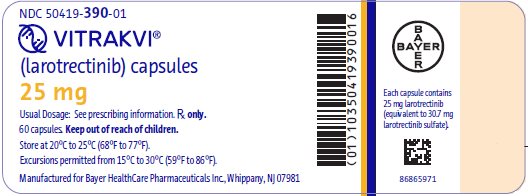
25 mg: Hard gelatin opaque white capsule size #2 with blue printing of "BAYER" cross and "25 mg" on the body of the capsule.
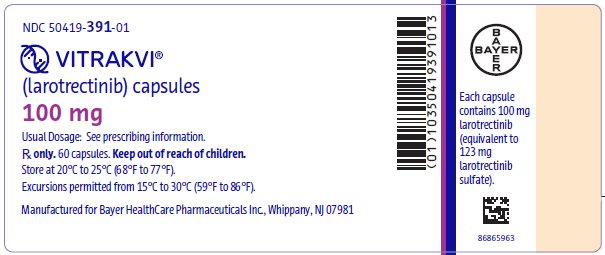
100 mg: Hard gelatin opaque white capsule size #0 with blue printing of "BAYER" cross and "100 mg" on the body of the capsule.
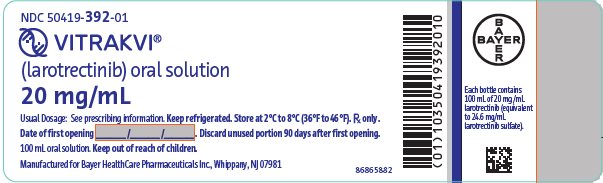
Oral Solution Packaged in One Bottle Containing 100 mL
20 mg/mL: Clear yellow to orange solution.
- One bottle containing 100 mL
| NDC# 50419-392-01 |
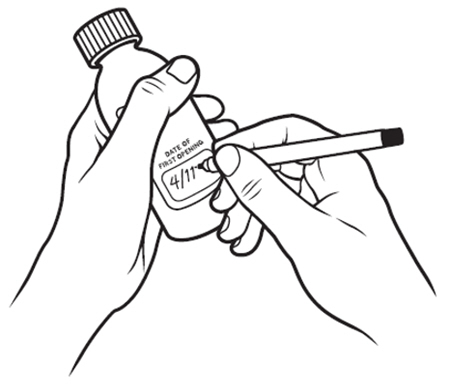
Refrigerate oral solution at 2°C to 8°C (36°F to 46°F). Do not freeze.
Oral Solution Packaged in Two Bottles Each Containing 50 mL
20 mg/mL: Colorless to yellow or orange or red or brownish solution.
- Two bottles each containing 50 mL
| NDC# 50419-393-03 |
Refrigerate oral solution at 2°C to 8°C (36°F to 46°F). Do not freeze.
Central Nervous System Effects
Advise patients to notify their healthcare provider if they experience new or worsening neurotoxicity. Advise patients not to drive or operate hazardous machinery if they are experiencing neurologic adverse reactions [see Warnings and Precautions (5.1)].
Skeletal Fractures
Inform patients that bone fractures can occur in patients taking VITRAKVI. Advise patients to report symptoms such as pain, changes in mobility, or deformity to their healthcare provider [see Warnings and Precautions (5.2)].
Hepatotoxicity
Advise patients that they will need to undergo laboratory tests to monitor liver function [see Warnings and Precautions (5.3)].
Embryo-Fetal Toxicity
Advise males and females of reproductive potential of the potential risk to a fetus [see Warnings and Precautions (5.4), Use in Specific Populations (8.1)].
Advise females of reproductive potential to inform their healthcare provider of a known or suspected pregnancy and to use effective contraception during the treatment with VITRAKVI and for 1 week after the last dose [see Use in Specific Populations (8.3)].
Advise males with female partners of reproductive potential to use effective contraception during treatment with VITRAKVI and for 1 week after the last dose [see Use in Specific Populations (8.3)].
Lactation
Advise women not to breastfeed during treatment with VITRAKVI and for 1 week following the last dose [see Use in Specific Populations (8.2)].
Infertility
Advise females of reproductive potential that VITRAKVI may impair fertility [See Nonclinical Toxicology (13.1)].
Drug Interactions
Advise patients and caregivers to inform their healthcare provider of all concomitant medications, including prescription medicines, over-the-counter drugs, vitamins, and herbal products. Inform patients to avoid St. John's wort, grapefruit or grapefruit juice while taking VITRAKVI [see Drug Interactions (7.1, 7.2)].
Manufactured for Bayer HealthCare Pharmaceuticals Inc., Whippany, NJ 07981