Product Images Clopidogrel
View Photos of Packaging, Labels & Appearance
- Figure 1 - clopidogrel fig1
- Figure 2: Cardiovascular Death, Myocardial Infarction, and Stroke in the CURE Study - clopidogrel fig2
- Figure-3 - clopidogrel fig3
- Figure 4: Cumulative Event Rates for Death in the COMMIT Study - clopidogrel fig4
- Figure 5: Cumulative Event Rates for the Combined Endpoint Re-Infarction, Stroke or Death in the COMMIT Study - clopidogrel fig5
- Figure 6: Effects of Adding Clopidogrel Bisulfate to Aspirin on the Combined Primary Endpoint across Baseline and Concomitant Medication Subgroups for the COMMIT Study - clopidogrel fig6
- Figure 7: Fatal or Non-Fatal Vascular Events in the CAPRIE Study - clopidogrel fig7
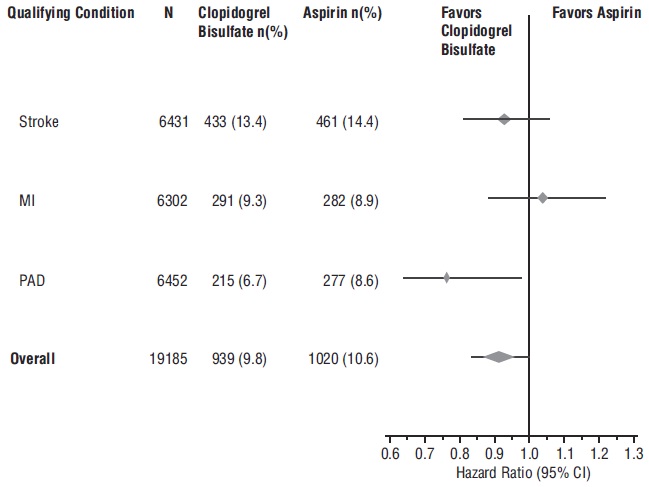
- Figure 8: Hazard Ratio and 95% CI by Baseline Subgroups in the CAPRIE Study - clopidogrel fig8
- Chemical Structure - clopidogrel str
- Label Image - lbl504369986
Product Label Images
The following 10 images provide visual information about the product associated with Clopidogrel NDC 50436-9986 by Unit Dose Services, such as packaging, labeling, and the appearance of the drug itself. This resource could be helpful for medical professionals, pharmacists, and patients seeking to verify medication information and ensure they have the correct product.
Figure 1 - clopidogrel fig1
This description describes the effect of the co-administration of proton pump inhibitors (PPIs) on the exposure to Clopidogrel active metabolite following multiple doses of Clopidogrel Bisulfate 75 mg. The figure shows the mean and 90% confidence interval of the effect of four different PPIs, Dexlansoprazole 60 mg, Lansoprazole 30 mg, Pantoprazole 80 mg, and Omeprazole 80 mg, on the active metabolite AUC. It also shows the change, relative to Clopidogrel Bisulfate administered alone, in the exposure to the active metabolite following the co-administration of different PPIs.*
Figure 2: Cardiovascular Death, Myocardial Infarction, and Stroke in the CURE Study - clopidogrel fig2
This is a description of a chart or graph showing the cumulative event rate (in percentages) for cardiovascular death, myocardial infarction, and stroke over a 12-month follow-up period. The data includes results for both placebo and clopidogrel bisulfate (both taken with aspirin) and indicates that the clopidogrel group had a lower event rate. The graph also notes that other standard therapies were used as appropriate and provides a P value for statistical significance.*
Figure-3 - clopidogrel fig3
This appears to be a table with various categories and data sets. It is not clear what the data represents as the headings are not fully readable and the text contains several errors due to .*
Figure 4: Cumulative Event Rates for Death in the COMMIT Study - clopidogrel fig4
This is a clinical trial study comparing the effects of placebo and clopidogrel in reducing the death rate before first discharge. The study found that the percentage of deaths was higher in the placebo group (8.1%) compared to the clopidogrel group (7.5%), showing a 7% risk reduction with clopidogrel. The study also measured the effect over 28 days, with a statistically significant reduction in mortality noted after day 7.*
Figure 5: Cumulative Event Rates for the Combined Endpoint Re-Infarction, Stroke or Death in the COMMIT Study - clopidogrel fig5
This is a report on a clinical trial comparing the efficacy of Placebo and Clopidogrel in reducing the risk of cardiovascular events. The number of patients who experienced events while on Placebo was 2310 (10.1%) while on Clopidogrel it was 2121 (9.2%). A proportional risk reduction of 9% in death, re-infarction, or stroke was observed in the Clopidogrel group compared to the Placebo group, with a p-value of 0.002. The timeline of the trial was up to 28 days, and the data was collected at various intervals during this period.*
Figure 6: Effects of Adding Clopidogrel Bisulfate to Aspirin on the Combined Primary Endpoint across Baseline and Concomitant Medication Subgroups for the COMMIT Study - clopidogrel fig6
Figure 7: Fatal or Non-Fatal Vascular Events in the CAPRIE Study - clopidogrel fig7
This appears to be a graph showing the cumulative event rate (in percentages) for fatal or non-fatal vascular events in relation to the use of Aspirin and Clopidogrel Bisultate over a period of 36 months of follow-up.*
Figure 8: Hazard Ratio and 95% CI by Baseline Subgroups in the CAPRIE Study - clopidogrel fig8
This text appears to be a table with four qualifying conditions: stroke, MI, PAD, and overall. The table includes information about the number of individuals with each condition and the percentage of those individuals taking either Clopidogrel Bisulfate or Aspirin. The table also includes a section labeled "Favors" with corresponding years and "Hazard Ratio (95% C1)" at the end. Without additional context, it's unclear what the numbers in these sections represent.*
* The product label images have been analyzed using a combination of traditional computing and machine learning techniques. It should be noted that the descriptions provided may not be entirely accurate as they are experimental in nature. Use the information in this page at your own discretion and risk.