CURE
The CURE study included 12,562 patients with ACS without ST-elevation (UA or NSTEMI) and presenting within 24 hours of onset of the most recent episode of chest pain or symptoms consistent with ischemia. Patients were required to have either ECG changes compatible with new ischemia (without ST-elevation) or elevated cardiac enzymes or troponin I or T to at least twice the upper limit of normal.
Patients were randomized to receive clopidogrel bisulfate (300 mg loading dose followed by 75 mg once daily) or placebo, and were treated for up to one year. Patients also received aspirin (75 to 325 mg once daily) and other standard therapies such as heparin. The use of GPIIb/IIIa inhibitors was not permitted for three days prior to randomization.
The patient population was largely White (82%) and included 38% women, and 52% age ≥ 65 years of age. Only about 20% of patients underwent revascularization during the initial hospitalization and few underwent emergent or urgent revascularization.
The number of patients experiencing the primary outcome (CV death, MI, or stroke) was 582 (9.3%) in the clopidogrel bisulfate-treated group and 719 (11.4%) in the placebo-treated group, a 20% relative risk reduction (95% CI of 10% to 28%; p < 0.001) for the clopidogrel bisulfate-treated group (see Table 4).
Table 4: Outcome Events in the CURE Primary Analysis
* Other standard therapies were used as appropriate.
† The individual components do not represent a breakdown of the primary and co-primary outcomes, but rather the total number of subjects experiencing an event during the course of the study. |
Outcome
| Clopidogrel Bisulfate
(+ aspirin)* (n=6259)
| Placebo
(+ aspirin)* (n=6303)
| Relative Risk Reduction (%)
(95% CI)
|
Primary outcome
(Cardiovascular death, MI,
stroke)
| 582
(9.3%)
| 719
(11.4%)
| 20%
(10.3, 27.9)
p < 0.001
|
All Individual Outcome Events:†
|
|
|
|
CV death
| 318
(5.1%)
| 345
(5.5%)
| 7%
(-7.7, 20.6)
|
MI
| 324
(5.2%)
| 419
(6.6%)
| 23%
(11, 33.4)
|
Stroke
| 75
(1.2%)
| 87
(1.4%)
| 14%
(-17.7, 36.6)
|
Most of the benefit of clopidogrel bisulfate occurred in the first two months, but the difference from placebo was maintained throughout the course of the trial (up to 12 months) (see Figure 2).
Figure 2: Cardiovascular Death, Myocardial Infarction, and Stroke in the CURE Study

Figure 2: Cardiovascular Death, Myocardial Infarction, And Stroke In The Cure Study (Clopidogrel Fig2)
The effect of clopidogrel did not differ significantly in various subgroups, as shown in Figure 3. The benefits associated with clopidogrel bisulfate were independent of the use of other acute and long-term cardiovascular therapies, including heparin/LMWH, intravenous glycoprotein IIb/IIIa (GPIIb/IIIa) inhibitors, lipid-lowering drugs, beta-blockers, and ACE-inhibitors. The efficacy of clopidogrel bisulfate was observed independently of the dose of aspirin (75 to 325 mg once daily). The use of oral anticoagulants, non-study antiplatelet drugs, and chronic NSAIDs was not allowed in CURE.
Figure 3: Hazard Ratio for Patient Baseline Characteristics and On-Study Concomitant Medications/Interventions for the CURE Study
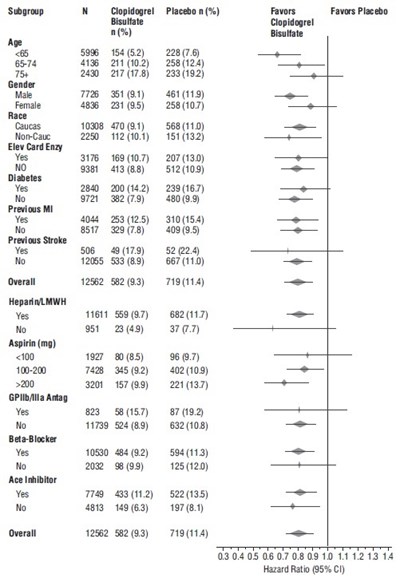
Figure-3 (Clopidogrel Fig3)
The use of clopidogrel bisulfate in CURE was associated with a decrease in the use of thrombolytic therapy (71 patients [1.1%] in the clopidogrel bisulfate group, 126 patients [2%] in the placebo group; relative risk reduction of 43%), and GPIIb/IIIa inhibitors (369 patients [5.9%] in the clopidogrel bisulfate group, 454 patients [7.2%] in the placebo group, relative risk reduction of 18%). The use of clopidogrel bisulfate in CURE did not affect the number of patients treated with CABG or PCI (with or without stenting), (2253 patients [36%] in the clopidogrel bisulfate group, 2324 patients [36.9%] in the placebo group; relative risk reduction of 4%).
COMMIT
In patients with STEMI, the safety and efficacy of clopidogrel bisulfate were evaluated in the randomized, placebo-controlled, double-blind study, COMMIT. COMMIT included 45,852 patients presenting within 24 hours of the onset of the symptoms of myocardial infarction with supporting ECG abnormalities (i.e., ST-elevation, ST-depression or left bundle-branch block). Patients were randomized to receive clopidogrel bisulfate (75 mg once daily) or placebo, in combination with aspirin (162 mg per day), for 28 days or until hospital discharge, whichever came first.
The primary endpoints were death from any cause and the first occurrence of re-infarction, stroke or death.
The patient population was 28% women and 58% age ≥ 60 years (26% age ≥ 70 years). Fifty-five percent (55%) of patients received thrombolytics and only 3% underwent PCI.
As shown in Table 5 and Figure 4 and Figure 5 below, clopidogrel bisulfate significantly reduced the relative risk of death from any cause by 7% (p=0.029), and the relative risk of the combination of re-infarction, stroke or death by 9% (p=0.002).
Table 5: Outcome Events in COMMIT
* 9 patients (2 clopidogrel and 7 placebo) suffered both a non-fatal stroke and a non-fatal MI.
** Non-fatal MI and non-fatal stroke exclude patients who died (of any cause). |
Event
| Clopidogrel Bisulfate
(+ aspirin) (N=22961)
| Placebo
(+ aspirin) (N=22891)
| Odds ratio
(95% CI)
| p-value
|
Composite endpoint: Death,
MI, or Stroke*
| 2121 (9.2%)
| 2310 (10.1%)
| 0.91 (0.86, 0.97)
| 0.002
|
Death
Non-fatal MI**
Non-fatal Stroke**
| 1726 (7.5%) 270 (1.2%)
127 (0.6%)
| 1845 (8.1%)
330 (1.4%)
142 (0.6%)
| 0.93 (0.87, 0.99) 0.81 (0.69, 0.95) 0.89 (0.7, 1.13)
| 0.029
0.011
0.33
|
Figure 4: Cumulative Event Rates for Death in the COMMIT Study*

Figure 4: Cumulative Event Rates For Death In The Commit Study (Clopidogrel Fig4)
*All treated patients received aspirin.
Figure 5: Cumulative Event Rates for the Combined Endpoint Re-Infarction, Stroke or
Death in the COMMIT Study*

Figure 5: Cumulative Event Rates For The Combined Endpoint Re-infarction, Stroke Or Death In The Commit Study (Clopidogrel Fig5)
* All treated patients received aspirin.
The effect of clopidogrel bisulfate did not differ significantly in various pre-specified subgroups as shown in Figure 6. The effect was also similar in non-prespecified subgroups including those based on infarct location, Killip class or prior MI history. Such subgroup analyses should be interpreted cautiously.
Figure 6: Effects of Adding Clopidogrel Bisulfate to Aspirin on the Combined Primary Endpoint across Baseline and Concomitant Medication Subgroups for the COMMIT Study

Figure 6: Effects Of Adding Clopidogrel Bisulfate To Aspirin On The Combined Primary Endpoint Across Baseline And Concomitant Medication Subgroups For The Commit Study (Clopidogrel Fig6)
* CI is 95% for Overall row only.