Highlights Of Prescribng Information
These highlights do not include all the information needed to use ESMOLOL HYDROCHLORIDE INJECTION safely and effectively. See full prescribing information for ESMOLOL HYDROCHLORIDE INJECTION.
ESMOLOL HYDROCHLORIDE injection, for intravenous use
Initial U.S. Approval: 1986
INDICATIONS AND USAGE
Esmolol hydrochloride injection is a beta adrenergic blocker indicated for the short-term treatment of:
Control of ventricular rate in supraventricular tachycardia including atrial fibrillation and atrial flutter and control of heart rate in noncompensatory sinus tachycardia (
1-1.1)
Control of perioperative tachycardia and hypertension (
1-1.2)
DOSAGE AND ADMINISTRATION
Administer intravenously (
2-2.1,
2-2.2)
Titrate using ventricular rate or blood pressure at ≥ 4 minute intervals (
2-2.1,
2-2.2)
Supraventricular tachycardia (SVT) or noncompensatory sinus tachycardia (
2-2.1)
Optional loading dose: 500 mcg per kg infused over one minute
Then 50 mcg per kg per minute for the next 4 minutes
Adjust dose as needed to a maximum of 200 mcg per kg per minute
Additional loading doses may be administered
Perioperative tachycardia and hypertension ( 2-2.2)
Loading dose: 500 mcg per kg over 1 minute for gradual control (1 mg per kg over 30 seconds for immediate control)
Then 50 mcg per kg per minute for gradual control (150 mcg per kg per minute for immediate control) adjusted to a maximum of 200 (tachycardia) or 300 (hypertension) mcg per kg per minute (
2-2.2)
DOSAGE FORMS AND STRENGTHS
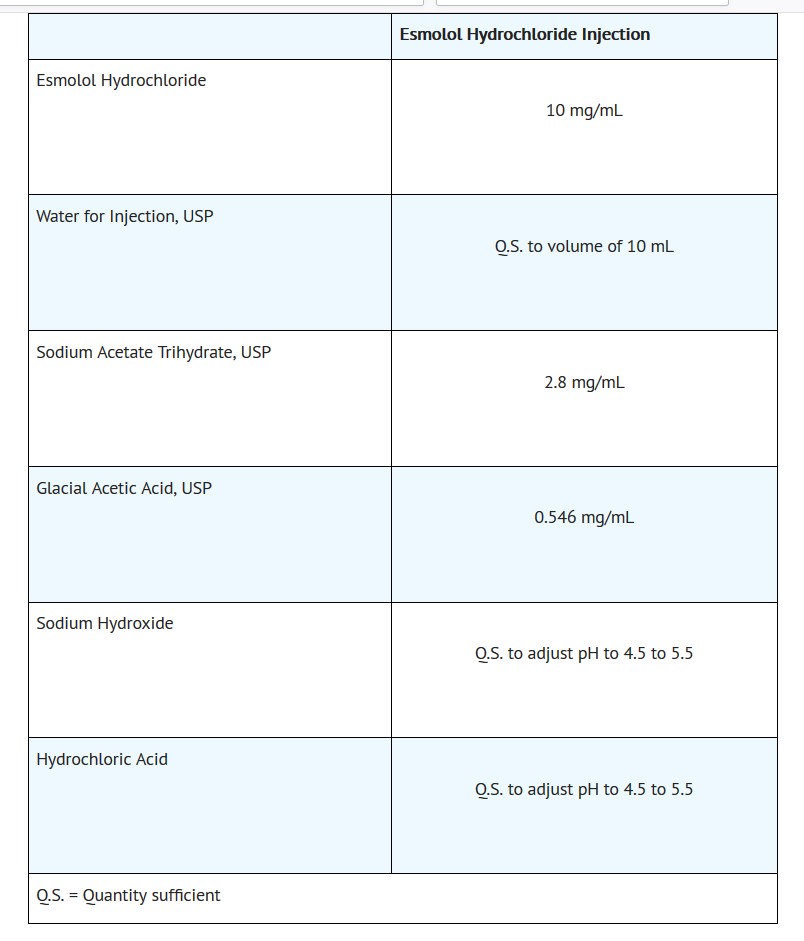
Injection: 100 mg/10 mL (10 mg/mL) in 10 mL vial ( 3)
CONTRAINDICATIONS
Severe sinus bradycardia (
4)
Heart block greater than first degree (
4)
Sick sinus syndrome (
4)
Decompensated heart failure (
4)
Cardiogenic shock (
4)
Coadministration of IV cardiodepressant calcium-channel antagonists (e.g. verapamil) in close proximity to esmolol hydrochloride (
4,
7)
Pulmonary hypertension (
4)
Known hypersensitivity to esmolol (
4)
WARNINGS AND PRECAUTIONS
Risk of hypotension, bradycardia, and cardiac failure: Reduce or discontinue use (
5-5.1, 5.2, 5.3, 5.10)
Risk of exacerbating reactive airway disease (
5-5.5)
Diabetes mellitus: Increases the effect of hypoglycemic agents and masks hypoglycemic tachycardia (
5-5.6)
Risk of unopposed alpha-agonism and severe hypertension in untreated pheochromocytoma (
5-5.9)
Risk of myocardial ischemia when abruptly discontinued in patients with coronary artery disease (
5-5.12,
5-5.15)
ADVERSE REACTIONS
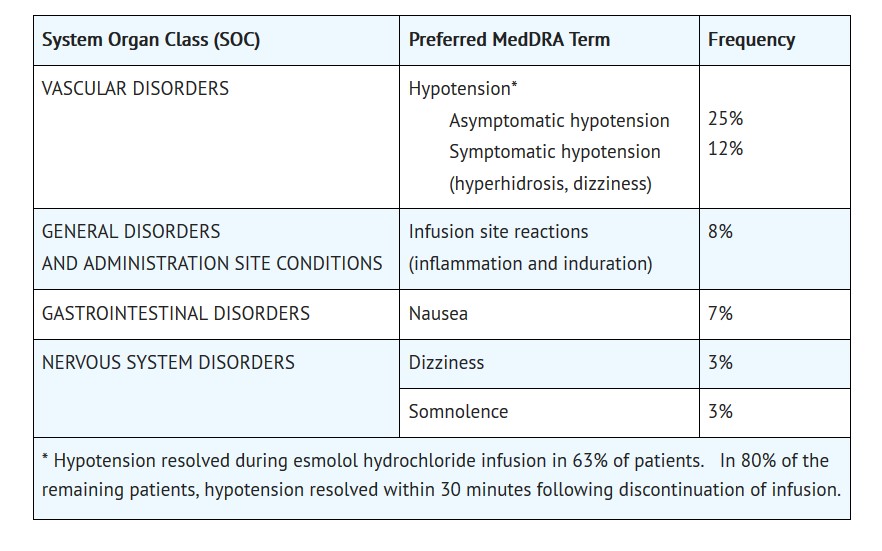
Most common adverse reactions (incidence > 10%) are symptomatic hypotension (hyperhidrosis, dizziness) and asymptomatic hypotension ( 6)
To report SUSPECTED ADVERSE REACTIONS, contact Fresenius Kabi USA, LLC at 1-800-551-7176 or FDA at 1-800-FDA-1088 or www.fda.gov/medwatch.
DRUG INTERACTIONS
Digitalis glycosides: Risk of bradycardia
(7)
Anticholinesterases: Prolongs neuromuscular blockade (
7)
Antihypertensive agents: Risk of rebound hypertension (
7)
Sympathomimetic drugs: Dose adjustment needed (
7)
Vasoconstrictive and positive inotropic effect substances: Avoid concomitant use (
7)
See 17 for PATIENT COUNSELING INFORMATION.
Revised: 2/2016