Highlights Of Prescribing Information
These highlights do not include all the information needed to use GLUCAGON FOR INJECTION safely and effectively. See full prescribing information for GLUCAGON FOR INJECTION.
GLUCAGON for injection, for subcutaneous, intramuscular or intravenous use
Initial U.S. Approval: 1960
RECENT MAJOR CHANGES
INDICATIONS AND USAGE
Glucagon for Injection is an antihypoglycemic agent and a gastrointestinal motility inhibitor indicated:
for the treatment of severe hypoglycemia in pediatric and adult patients with diabetes (
1-1.1)
as a diagnostic aid for use during radiologic examinations to temporarily inhibit movement of the gastrointestinal tract in adult patients (
1-1.2)
DOSAGE AND ADMINISTRATION
Dosage in adults and pediatric patients using the glucagon emergency kit for low blood sugar to treat severe hypoglycemia ( 2-2.2)
Adults and Pediatric Patients Weighing More Than 25 kg or for Pediatric Patients with Unknown Weight 6 Years and Older:
-
The recommended dosage is 1 mg (1 mL) injected subcutaneously or intramuscularly into the upper arm, thigh, or buttocks, or intravenously.
-
If there has been no response after 15 minutes, an additional 1 mg dose (1 mL) of Glucagon for Injection may be administered using a new kit while waiting for emergency assistance.
Pediatric Patients Weighing Less Than 25 kg or for Pediatric Patients with Unknown Weight Less Than 6 Years of Age:
-
The recommended dosage is 0.5 mg (0.5 mL) injected subcutaneously or intramuscularly into the upper arm, thigh, or buttocks, or intravenously.
-
If there has been no response after 15 minutes, an additional 0.5 mg dose (0.5 mL) of Glucagon for Injection may be administered using a new kit while waiting for emergency assistance.
Important Administration Instructions for Using the Glucagon Emergency Kit for Low Blood Sugar to Treat
Severe Hypoglycemia ( 2-2.1)
Glucagon for Injection is for subcutaneous, intramuscular, or intravenous injection. Administer intravenously ONLY under medical supervision.
See the Full Prescribing Information for administration instructions
Dosage in Adults for Using Glucagon for Injection Diagnostic Kit and Glucagon for Injection Single-Dose Vial as a Diagnostic Aid ( 2-2.4)
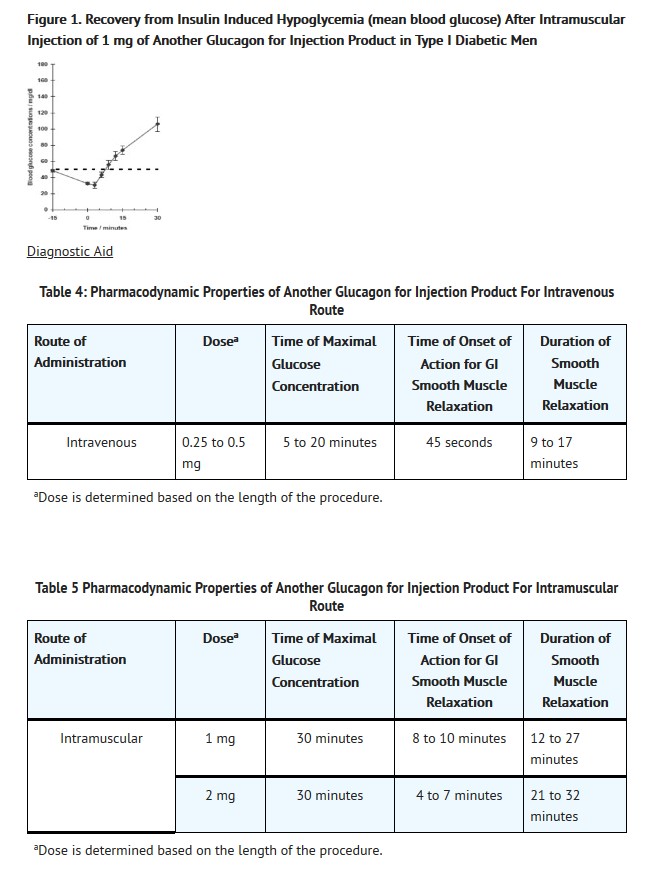
The recommended diagnostic dose for relaxation of the stomach, duodenal bulb, duodenum, and small bowel is 0.2 mg to 0.5 mg administered intravenously or 1 mg administered intramuscularly; the recommended dose to relax the colon is 0.5 mg to 0.75 mg administered intravenously or 1 mg to 2 mg administered intramuscularly.
See the Full Prescribing Information for administration instructions (
2-2.3)
DOSAGE FORMS AND STRENGTHS
For Injection ( 3):
Treatment of Severe Hypoglycemia: 1 mg single-dose vial of Glucagon for Injection with a 1 mL single-dose syringe of Sterile Water for Injection, USP (Glucagon Emergency Kit for Low Blood Sugar)
Use as a Diagnostic Aid: 1 mg single-dose vial of Glucagon for Injection
Use as a Diagnostic Aid: 1 mg single-dose vial of Glucagon for Injection with a 1 mL single-dose vial of Sterile Water for Injection, USP (Diagnostic Kit)
CONTRAINDICATIONS
Pheochromocytoma (
4)
Insulinoma (
4)
Known hypersensitivity to glucagon or to any of the excipients (
4)
Glucagonoma when used as a diagnostic aid (
4)
WARNINGS AND PRECAUTIONS
Catecholamine Release in Patients with Pheochromocytoma: Contraindicated in patients with pheochromocytoma because Glucagon for Injection may stimulate the release of catecholamines from the tumor. (
4,
5-5.1)
Hypoglycemia in Patients with Insulinoma: In patients with insulinoma, administration may produce an initial increase in blood glucose; however, Glucagon for Injection may stimulate exaggerated insulin release from an insulinoma and cause hypoglycemia. If a patient develops symptoms of hypoglycemia after a dose of Glucagon for Injection, give glucose orally or intravenously. (
4,
5-5.2)
Hypersensitivity and Allergic Reactions: Allergic reactions have been reported and include generalized rash, and in some cases anaphylactic shock with breathing difficulties, and hypotension. (
4,
5-5.3)
Lack of Efficacy in Patients with Decreased Hepatic Glycogen: Glucagon for Injection is effective in treating hypoglycemia only if sufficient hepatic glycogen is present. Patients in states of starvation, with adrenal insufficiency or chronic hypoglycemia may not have adequate levels of hepatic glycogen for Glucagon for Injection to be effective. Patients with these conditions should be treated with glucose. (
5-5.4)
Necrolytic Migratory Erythema (NME): a skin rash, has been reported postmarketing following continuous glucagon infusion and resolved with discontinuation of the glucagon. Should NME occur, consider whether the benefits of continuous glucagon infusion outweigh the risks. (
5-5.5)
Hyperglycemia in Patients with Diabetes Mellitus when Used as a Diagnostic Aid: Treatment with Glucagon for Injection in patients with diabetes mellitus may cause hyperglycemia. Monitor diabetic patients for changes in blood glucose levels during treatment and treat if indicated.(
5-5.6)
Blood Pressure and Heart Rate Increase in Patients with Cardiac Disease when Used as a Diagnostic Aid: Glucagon for Injection may increase myocardial oxygen demand, blood pressure, and pulse rate. Cardiac monitoring is recommended in patients with cardiac disease during use of Glucagon for Injection as a diagnostic aid, and an increase in blood pressure and pulse rate may require therapy. (
5-5.7)
Hypoglycemia in Patients with Glucagonoma when Used as a Diagnostic Aid: Glucagon administered to patients with glucagonoma may cause secondary hypoglycemia. Test patients suspected of having glucagonoma for blood levels of glucagon prior to treatment, and monitor blood glucose levels during treatment. If a patient develops hypoglycemia, give glucose orally or intravenously. (
5-5.8)
ADVERSE REACTIONS
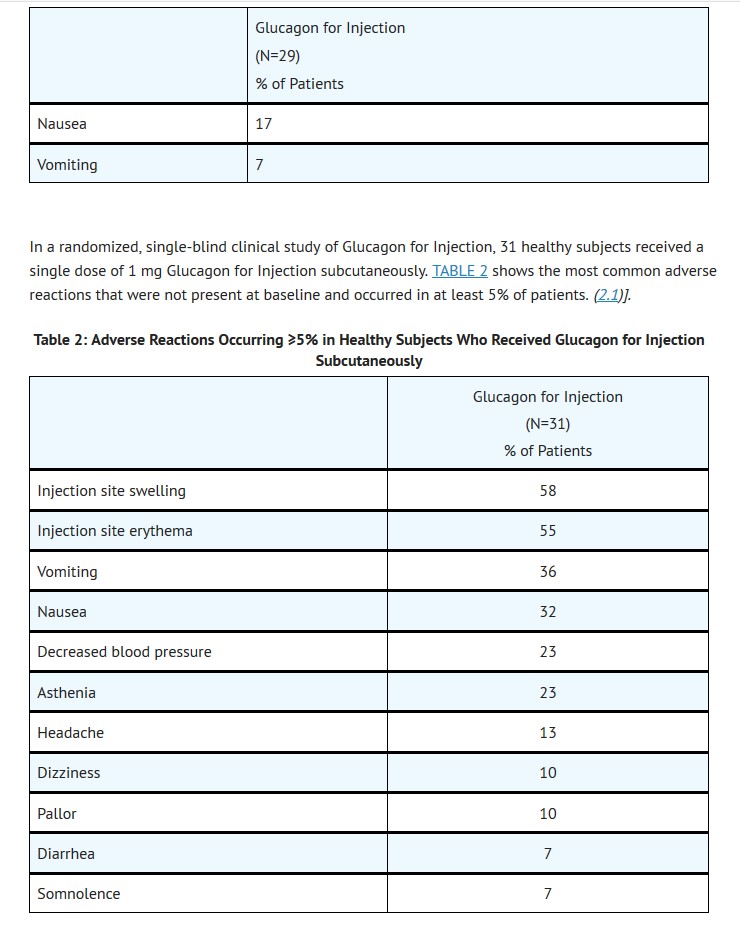
Most common adverse reactions ( >5% or greater incidence): Injection site swelling, injection site erythema, vomiting, nausea, decreased blood pressure, asthenia, headache, dizziness, pallor, diarrhea, and somnolence. ( 6)
To report SUSPECTED ADVERSE REACTIONS, contact Fresenius Kabi USA, LLC at 1-800-551-7176 or FDA at 1-800-FDA-1088 or www.fda.gov/medwatch. ( 6)
DRUG INTERACTIONS
Beta-blockers: Patients taking beta-blockers may have a transient increase in pulse and blood pressure. (
7-7.1)
Indomethacin: In patients taking indomethacin Glucagon for Injection may lose its ability to raise glucose or may produce hypoglycemia. (
7-7.2)
Anticholinergic drugs: Concomitant use of anticholinergic drugs with Glucagon for Injection for use as a diagnostic aid is not recommended. (
7-7.3)
Warfarin: Glucagon for Injection may increase the anticoagulant effect of warfarin. (
7-7.4)
Insulin: Monitor blood glucose when Glucagon for Injection is used as a diagnostic aid in patients receiving insulin. (
7-7.5)
See 17 for PATIENT COUNSELING INFORMATION and FDA-approved patient labeling.
Revised: 9/2019