Limitations of Use
Safety and effectiveness have not been established in other surgical procedures, including soft tissue surgical procedures, other orthopedic procedures, including for intra-articular administration, and boney procedures, or when used for neuraxial or peripheral nerve blockade.
Shoulder surgical procedures
There were three studies evaluating the safety of POSIMIR administered during shoulder surgery.
In Study 1, one of three treatments was administered into the subacromial space at the end of surgery: POSIMIR, vehicle placebo, or bupivacaine HCl. Table 1 presents commonly-reported adverse reactions from Study 1.
Table 1. Commonly Reported Adverse Reactions from Study 1 (Incidence ≥ 2% and More Frequent than Bupivacaine HCl or Vehicle Placebo).
| Preferred Term, n (%) | Posimir
(N=53) | Bupivacaine HCl
(n=29) | Vehicle Placebo
(N=25) |
| Headache
| 3 (5.7%)
| 1 (3.4%)
| 1 (4.0%)
|
| Electrocardiogram T wave inversion
| 2 (3.8%)
| 0
| 0
|
| Hypoesthesia
| 2 (3.8%)
| 1 (3.4%)
| 1 (4.0%)
|
| Pruritus generalized
| 2 (3.8%)
| 0
| 0
|
In Study 2 and Study 3, patients were administered either POSIMIR or vehicle placebo into the subacromial space at the end of surgery. Table 2 presents commonly-reported adverse reactions from Studies 2 and 3.
Table 2. Commonly Reported Adverse Reactions Pooled from Study 2 and Study 3 (Incidence ≥ 2% and More Frequent than Vehicle Placebo).
| Preferred Term, n (%)* | Posimir
(N=75) | Vehicle Placebo
(N=44) |
|---|
|
| Dizziness
| 30 (40.3%)
| 17 (38.3%)
|
| Vomiting
| 22 (29.0%)
| 12 (26.6%)
|
| Headache
| 17 (23.3%)
| 7 (16.3%)
|
| Paresthesia
| 14 (18.4%)
| 7 (15.4%)
|
| Dysgeusia
| 13 (17.6%)
| 7 (14.9%)
|
| Hypoesthesia
| 13 (17.3%)
| 7 (15.8%)
|
| Tinnitus
| 10 (13.2%)
| 3 (6.7%)
|
| Dysuria
| 8 (10.1%)
| 4 (10.1%)
|
| Pyrexia
| 7 (9.3%)
| 2 (4.6%)
|
| Insomnia
| 5 (7.1%)
| 0
|
| Dyspnea
| 3 (3.8%)
| 0
|
| Muscle twitching
| 3 (3.8%)
| 0
|
| Peripheral swelling
| 3 (3.9%)
| 0
|
| Urinary retention
| 2 (2.7%)
| 1 (2.1%)
|
| Contusion
| 2 (2.5%)
| 0
|
| Dysmenorrhea
| 2 (2.7%)
| 0
|
| Incision site pruritus
| 2 (2.7%)
| 0
|
| Nasal congestion
| 2 (2.5%)
| 0
|
| Pruritus generalized
| 2 (2.5%)
| 0
|
Less common adverse reactions (incidence less than 2% and more frequent than either bupivacaine HCl or vehicle placebo) following POSIMIR administration in shoulder surgical procedures were angina pectoris, blepharospasm, electrocardiogram T wave amplitude decreased, fatigue, osteoarthritis, procedural nausea, procedural pain, and pulmonary arterial hypertension.
Additional follow-up safety data consisting of shoulder MRI, physical examination of the shoulder, and assessments of wound healing were collected at 6 months in Study 1 and at 18 months in Study 2. There were no specific long-term follow-up evaluations for patients treated in Study 3; however, study investigators did not report any cases of chondrolysis in follow-up surveys. All surgical incisions were found to have healed as expected in all three studies. Table 3 presents the results of the MRI and physical examinations for Study 1. Table 4 presents the results of the MRI and physical examinations for Study 2.
Table 3. 6-Month Follow-up Safety Data from Subacromial Decompression Study 1.
| Safety Evaluation | Posimir | Vehicle Placebo | Bupivacaine HCl |
|---|
|
| Number enrolled
| 53
| 25
| 29
|
| Shoulder MRI
| | | |
| Number at 6-month follow-up
| 51
| 25
| 25
|
| Improved [1], n (%)
| 6 (11.8%)
| 2 (8.0%)
| 6 (24.0%)
|
| No change [1], n (%)
| 31 (60.8%)
| 14 (56.0%)
| 9 (36.0%)
|
| Worsened [1], n (%)
| 14 (27.4%)
| 9 (36%)
| 10 (40%)
|
| Constant-Murley score
| | | |
| Number at 6-month follow-up
| 52
| 25
| 26
|
| Pre-surgery, mean (SD)
| 44.7 (12.5%)
| 41.7 (11.7%)
| 42 (11.3%)
|
| Follow-up, mean (SD)
| 61.6 (15.2%)
| 63.2 (12.4%)
| 65.6 (6.8%)
|
| Decreased from baseline. n (%)
| 5 (9.6%)
| 2 (8.0%)
| 0 (0%)
|
Table 4. 18-Month Follow-up Safety Data from Subacromial Decompression Study 2.
| Safety Evaluation | Posimir | Vehicle Placebo |
|---|
|
|
|
|
| Number enrolled
| 40
| 20
|
| Shoulder MRI
| | |
| Number at 18-month follow-up
| 27
| 14
|
| Overall assessment
| | |
Unexpected injuries or findings compared with
pre-surgical MRI, n (%)
| 0
| 0
|
New-onset cartilage or bone lesions of concern
(not present at baseline and unrelated to surgery or
natural disease progression), n (%)
| 0
| 0
|
| Glenohumeral joint and humeral head
| | |
| Presence of cartilage thinning - humeral head, n (%)
| | |
| Grade 0: normal/none
| 26 (96.3%)
| 14 (100%)
|
| Grade 1: mild
| 0
| 0
|
| Grade 2: moderate
| 1 (3.7%) [1] | 0
|
| Grade 3: severe
| 0
| 0
|
| Rotator cuff and labrum
| | |
| Supraspinatus tendon tear, n (%)
| | |
| No tear
| 16 (59.3%)
| 5 (35.7%)
|
| Partial
| 7 (25.9%)
| 7 (50.0%)
|
| Full thickness
| 1 (3.7%)
| 0
|
| Other findings
| 3 (11.1%)
| 2 (14.3%)
|
| Supraspinatus - other findings, n (%)
| | |
| Interstitial tear
| 0
| 0
|
| Tendinosis
| 2 (7.4%)
| 1 (7.1%)
|
| Surgically repaired tendon
| 0
| 1 (7.1%)
|
| Interstitial tear/tendinosis
| 1 (3.7%)
| 0
|
| (blank)
| 24 (88.9%)
| 12 (85.7%)
|
| Subacromial space - acromion
| | |
| Acromion bony spur, n (%)
| | |
| Yes
| 1 (3.7%)
| 0
|
| No
| 26 (96.3%)
| 14 (100%)
|
| Acromion bone resection, n (%)
| | |
| Yes
| 18 (66.7%)
| 9 (64.3%)
|
| No
| 9 (33.3%)
| 5 (35.7%)
|
| Acromion signal abnormality (edema, fibrosis), n (%)
| | |
| Yes
| 2 (7.4%) [2] | 2 (14.3%) [2] |
| No
| 25 (92.6%) [2] | 12 (85.7%) [2] |
| Acromioclavicular joint
| | |
| Bone resection at acromioclavicular joint/postoperative changes, n (%)
| | |
| Yes
| 10 (37.0%)
| 4 (28.6%)
|
| No
| 16 (59.3%)
| 10 (71.4%)
|
| Not evaluable
| 1 (3.7%)
| 0
|
| Joint effusion/synovitis, n (%)
| | |
| Grade 0: normal/none
| 9 (33.3%)
| 2 (14.3%)
|
| Grade 1: mild
| 9 (33.3%) [3] | 7 (50.0%)
|
| Grade 2: moderate
| 3 (11.1%) [3] | 3 (21.4%) [3] |
| Grade 3: severe
| 0
| 1 (7.1%) [3] |
| Not evaluable
| 6 (22.2%)
| 1 (7.1%)
|
| Bursa and Soft Tissue
| | |
| Subacromial bursa - bursitis/excess fluid, n (%)
| | |
| Grade 0: normal/none
| 18 (66.7%)
| 5 (35.7%)
|
| Grade 1: mild
| 6 (22.2%)
| 9 (64.3%) [4] |
| Grade 2: moderate
| 3 (11.1%)
| 0
|
| Grade 3: severe
| 0
| 0
|
| Physical Exam
| | |
| Number at 18-month follow-up
| 31
| 16
|
| Clinical assessment, n (%)
| | |
| Normal
| 27 (87.1%)
| 13 (81.3%)
|
| Abnormal
| 4 (12.9%)
| 3 (18.8%)
|
| Pain intensity, 0-10 scale
| | |
| Mean (SE)
| 0.9 (0.4%)
| 1.2 (0.6%)
|
| Positive impingement sign, n (%)
| | |
| Yes
| 3 (9.7%)
| 3 (18.8%)
|
| No
| 28 (90.3%)
| 13 (81.3%)
|
| Full passive range of motion, n (%)
| | |
| Yes
| 27 (87.1%)
| 13 (81.3%)
|
| No
| 4 (12.9%)
| 3 (18.8%)
|
Soft tissue surgical procedures
There were two studies evaluating the safety of POSIMIR in patients undergoing inguinal hernia repair (hernioplasty). Patients in these studies were administered either POSIMIR 5 mL or vehicle placebo; 2.5 mL administered into the floor of the inguinal canal and 2.5 mL administered into the subcutaneous space. Table 5 presents commonly-reported adverse reactions from these studies.
Table 5. Commonly Reported Adverse Reactions Pooled from Studies in Inguinal Hernia Repair (Incidence ≥ 2% and More Frequent than Placebo)
| Preferred Term, n (%)* | Posimir
(N=69) | Vehicle Placebo
(N=53) |
|---|
|
|
| Bradycardia
| 16 (22.9%)
| 7 (14.2%)
|
| Pruritus†
| 15 (21.6%)
| 9 (17.5%)
|
| Post procedural contusion (bruising)
| 10 (14.0%)
| 5 (10.1%)
|
| Vomiting
| 6 (9.4%)
| 4 (7.4%)
|
| Incision site swelling
| 4 (6.0%)
| 3 (5.7%)
|
| Dyspepsia
| 4 (5.7%)
| 2 (3.7%)
|
| Pyrexia
| 4 (6.0%)
| 2 (4.0%)
|
| Contusion
| 4 (5.7%)
| 0
|
| Back pain
| 3 (4.1%)
| 2 (3.4%)
|
| Viral infection
| 3 (4.1%)
| 2 (4.0%)
|
| Incision site erythema
| 3 (4.1%)
| 0
|
| Oropharyngeal pain
| 3 (4.6%)
| 0
|
| Tachycardia
| 3 (4.6%)
| 0
|
| Upper respiratory tract infection
| 2 (3.0%)
| 1 (2.0%)
|
| Dry throat
| 2 (3.2%)
| 0
|
| Hyperhidrosis
| 2 (3.0%)
| 0
|
| Hypertension
| 2 (2.8%)
| 0
|
| Local swelling
| 2 (3.0%)
| 0
|
| Testicular swelling
| 2 (3.2%)
| 0
|
There were five studies evaluating the safety of POSIMIR in laparoscopic, laparoscopically-assisted, or open abdominal surgeries.
In two studies in patients undergoing laparoscopic cholecystectomy, POSIMIR or bupivacaine HCl was administered into the laparoscopic port incisions at the end of surgery. In one of these studies, a subset of patients received either POSIMIR or saline placebo. In a study of patients undergoing laparoscopically-assisted colectomy, POSIMIR or vehicle placebo was administered predominantly into the hand port incision at the end of surgery. In a study of patients undergoing laparotomy, POSIMIR or bupivacaine HCl was administered into the full length of the surgical incision at the end of surgery. Table 6 presents commonly-reported adverse reactions from these four studies. Table 7 and Table 8 present, respectively, surgical-site adverse reactions and early-occurring central nervous system (CNS)-related adverse reactions from the laparoscopic cholecystectomy study that included a saline placebo control arm.
Table 6. Commonly Reported Adverse Reactions Pooled from Laparoscopic, Laparoscopically-Assisted, and Open Abdominal Surgery Studies (Incidence ≥ 2% and More Frequent than Bupivacaine HCl or Placebo).
| Preferred Term, n (%)* | Posimir
(N=337) | Bupivacaine HCl
(N=186) | Vehicle Placebo
(N=78) |
|---|
|
|
| Post procedural contusion (bruising)
| 231 (71.2%)
| 119 (61.8%)
| 41 (52.6%)
|
| Nausea
| 189 (55.8%)
| 111 (59.6%)
| 40 (51.3%)
|
| Constipation
| 112 (35.2%)
| 80 (41.8%)
| 8 (10.3%)
|
| Somnolence
| 92 (30.4%)
| 80 (41.0%)
| 3 (3.8%)
|
| Headache
| 86 (27.2%)
| 63 (32.3%)
| 12 (15.4%)
|
| Dizziness
| 75 (23.5%)
| 58 (30.1%)
| 6 (7.7%)
|
| Vomiting
| 66 (19.4%)
| 39 (21.0%)
| 6 (7.7%)
|
| Dysgeusia
| 50 (16.2%)
| 33 (16.9%)
| 2 (2.6%)
|
| Pruritus†
| 45 (14.3%)
| 36 (18.7%)
| 5 (6.4%)
|
| Procedural pain
| 35 (11.4%)
| 35 (17.8%)
| 0
|
| Diarrhea
| 34 (9.8%)
| 10 (5.5%)
| 10 (12.8%)
|
| Incision site hemorrhage
| 30 (8.7%)
| 6 (3.0%)
| 3 (3.8%)
|
| Pyrexia
| 29 (8.2%)
| 10 (5.7%)
| 11 (14.1%)
|
| Abdominal distension
| 29 (8.2%)
| 8 (4.8%)
| 12 (15.4%)
|
| Incision site erythema
| 29 (8.1%)
| 5 (2.7%)
| 10 (12.8%)
|
| Post procedural discharge
| 26 (7.5%)
| 8 (4.4%)
| 7 (9.0%)
|
| Paresthesia
| 23 (7.5%)
| 25 (13.1%)
| 2 (2.6%)
|
| Hypokalemia
| 22 (5.9%)
| 2 (1.4%)
| 10 (12.8%)
|
| Incision site hematoma
| 18 (5.2%)
| 3 (1.7%)
| 4 (5.1%)
|
| Anemia
| 17 (4.5%)
| 1 (0.7%)
| 7 (9.0%)
|
| Flatulence
| 16 (4.6%)
| 7 (4.0%)
| 8 (10.3%)
|
| Hypertension
| 16 (4.6%)
| 7 (3.6%)
| 1 (1.3%)
|
| Incision site infection
| 16 (4.5%)
| 4 (2.5%)
| 2 (2.6%)
|
| Musculoskeletal pain
| 15 (4.2%)
| 8 (4.9%)
| 0
|
| Abdominal pain
| 15 (4.4%)
| 1 (0.5%)
| 1 (1.3%)
|
| Insomnia
| 14 (3.9%)
| 5 (2.9%)
| 7 (9.0%)
|
| Dyspepsia
| 13 (3.8%)
| 3 (1.9%)
| 4 (5.1%)
|
| Wound dehiscence
| 13 (3.6%)
| 3 (1.5%)
| 5 (6.4%)
|
| Cough
| 12 (3.6%)
| 3 (1.8%)
| 1 (1.3%)
|
| Oropharyngeal pain
| 12 (3.5%)
| 2 (1.0%)
| 0
|
| Urinary retention
| 10 (2.8%)
| 2 (1.2%)
| 4 (5.1%)
|
| Chest pain
| 10 (2.9%)
| 1 (0.5%)
| 1 (1.3%)
|
| Ileus
| 10 (2.7%)
| 1 (0.7%)
| 3 (3.8%)
|
| Body temperature increased
| 9 (2.4%)
| 0
| 2 (2.6%)
|
| Abdominal pain upper
| 8 (2.5%)
| 2 (1.0%)
| 0
|
| Rash
| 7 (2.1%)
| 7 (3.8%)
| 1 (1.3%)
|
| Pain in extremity
| 7 (2.1%)
| 5 (2.8%)
| 1 (1.3%)
|
| Dry mouth
| 7 (2.2%)
| 2 (1.0%)
| 1 (1.3%)
|
| Nasopharyngitis
| 7 (2.1%)
| 0
| 0
|
Table 7. Incidence of Surgical Site Adverse Reactions from Laparoscopic Cholecystectomy Study with Saline Placebo and Bupivacaine HCl Controls.
|
| Saline Placebo Control | Bupivacaine HCl Control |
| Prespecified Term*, n (%) | Posimir
(N=45) | Saline Placebo
(N=47) | Posimir
(N=148) | Bupivacaine HCl
(N=148) |
| Visible bruising
| 41 (91.1%)
| 33 (70.2%)
| 142 (95.9%)
| 105 (70.9%)
|
| Surgical site bleeding
| 22 (48.9%)
| 20 (42.6%)
| 19 (12.8%)
| 24 (16.2%)
|
| Drainage from surgical incision(s)
| 2 (4.4%)
| 3 (6.4%)
| 11 (7.4%)
| 6 (4.1%)
|
| Wound hematoma
| 0
| 0
| 6 (4.1%)
| 2 (1.4%)
|
| Wound dehiscence
| 0
| 0
| 2 (1.4%)
| 3 (2.0%)
|
| Surgical site infection
| 0
| 0
| 2 (1.4%)
| 1 (0.7%)
|
Table 8. CNS-related Adverse Reactions Solicited from Subjects at 6 Hours Post-surgery in Laparoscopic Cholecystectomy Study with Saline Placebo and Bupivacaine HCl Controls.
|
| Saline Placebo Control | Bupivacaine HCl Control |
| Dictionary-Derived Term (Symptom)* | Posimir
(N=45) | Saline Placebo
(N=47) | Posimir
(N=148) | Bupivacaine HCl
(N=148) |
| Entire study, n (%) | | | | |
| Somnolence (Drowsiness)
| 18 (40.0%)
| 16 (34.0%)
| 60 (40.5%)
| 48 (32.4%)
|
| Nausea (Nausea)
| 9 (20.0%)
| 13 (27.7%)
| 48 (32.4%)
| 57 (38.5%)
|
| Dizziness (Dizziness)
| 3 (6.7%)
| 3 (6.4%)
| 28 (18.9%)
| 31 (20.9%)
|
| Headache (Headache)
| 5 (11.1%)
| 4 (8.5%)
| 23 (15.5%)
| 18 (12.2%)
|
| Vomiting (Vomiting)
| 2 (4.4%)
| 3 (6.4%)
| 10 (6.8%)
| 15 (10.1%)
|
| Constipation (Constipation)
| 0 (0.0%)
| 4 (8.5%)
| 9 (6.1%)
| 10 (6.8%)
|
| Pruritus (Itching)
| 1 (2.2%)
| 1 (2.1%)
| 6 (4.1%)
| 5 (3.4%)
|
| Subset of study, n (%) | N=23 | N=22 | | |
| Dysgeusia (Metallic taste in mouth)
| 3 (13.0%)
| 2 (9.1%)
| 26 (17.6%)
| 22 (14.9%)
|
| Paresthesia (Tingling)
| 0
| 0
| 2 (1.4%)
| 6 (4.1%)
|
| Hypoesthesia (Numbness)
| 0
| 0
| 1 (0.7%)
| 1 (0.7%)
|
In a study of patients undergoing total abdominal hysterectomy, POSIMIR, vehicle placebo, or bupivacaine HCl was administered into the surgical incision at the end of surgery. Table 9 presents commonly-reported adverse reactions from this study.
Table 9. Commonly Reported Adverse Reactions from Total Abdominal Hysterectomy Study (Incidence ≥ 2% and More Frequent than Bupivacaine HCl).
| Preferred Term | Posimir
(N=60) | Bupivacaine HCl
(N=27) | Vehicle Placebo
(N=27) |
|---|
| Post procedural contusion (bruising)
| 36 (60.0%)
| 0
| 9 (33.3%)
|
| Anemia
| 10 (16.7%)
| 3 (11.1%)
| 4 (14.8%)
|
| Dizziness
| 9 (15.0%)
| 4 (14.8%)
| 3 (11.1%)
|
| Vomiting
| 9 (15.0%)
| 4 (14.8%)
| 8 (29.6%)
|
| C-reactive protein increased
| 7 (11.7%)
| 1 (3.7%)
| 0
|
| Pyrexia
| 7 (11.7%)
| 7 (25.9%)
| 3 (11.1%)
|
| Somnolence
| 5 (8.3%)
| 2 (7.4%)
| 0
|
| Blood potassium decreased
| 4 (6.7%)
| 0
| 1 (3.7%)
|
| Hypertension
| 4 (6.7%)
| 2 (7.4%)
| 1 (3.7%)
|
| Incision site hematoma
| 3 (5.0%)
| 0
| 0
|
| Electrocardiogram change
| 2 (3.3%)
| 0
| 0
|
| Procedural hemorrhage
| 2 (3.3%)
| 0
| 0
|
| Vaginal hematoma
| 2 (3.3%)
| 0
| 0
|
Less common adverse reactions (incidence less than 2% and more frequent than either bupivacaine HCl or placebo) following POSIMIR administration in soft tissue surgical procedures were: application site irritation, atrial fibrillation, drug eruption, electrocardiogram QT prolonged, eructation, erythema, excessive granulation tissue, fatigue, genital pain, heart rate increased, hiccups, hypoesthesia, hypogeusia, incision site cellulitis, incision site erosion, incision site hypoesthesia, incision site inflammation, incision site edema, incision site pain, incision site rash, mean arterial pressure increased, micturition urgency, night sweats, overdose, palpitations, procedural hypertension, pruritus generalized, rash generalized, seroma, sinus tachycardia, skin discoloration, tinnitus, and wound hemorrhage.
Risk Summary
There are no studies conducted with POSIMIR in pregnant women. In animal studies, embryo-fetal lethality was noted when bupivacaine was administered subcutaneously to pregnant rabbits during organogenesis at 0.6 times the maximum recommended human dose of POSIMIR at 660 mg bupivacaine. Decreased pup survival was observed in a rat pre- and post-natal development study (dosing from implantation through weaning) at 0.6 times the maximum recommended human dose of POSIMIR at 660 mg bupivacaine. Based on animal data, advise pregnant women of the potential risks to a fetus. [see Data]
The background risk of major birth defects and miscarriage for the indicated population is unknown. However, the background risk in the U.S. general population of major birth defects is 2%-4% and of miscarriage is 15%-20% of clinically recognized pregnancies.
Clinical Considerations
Labor or Delivery
Bupivacaine is contraindicated for obstetrical paracervical block anesthesia. While POSIMIR has not been studied with this technique, the use of bupivacaine for obstetrical paracervical block anesthesia has resulted in fetal bradycardia and death. Bupivacaine can rapidly cross the placenta, and when used for epidural, caudal, or pudendal block anesthesia, can cause varying degrees of maternal, fetal, and neonatal toxicity (POSIMIR is not indicated for these uses). The incidence and degree of toxicity depend upon the procedure performed, the type, and amount of drug used, and the technique of drug administration. Adverse reactions in the parturient, fetus, and neonate involve alterations of the central nervous system, peripheral vascular tone, and cardiac function.
Data
Animal Data
Bupivacaine hydrochloride produced developmental toxicity when administered subcutaneously to pregnant rats and rabbits at clinically relevant doses.
Bupivacaine hydrochloride was administered subcutaneously to rats at doses of 4.4, 13.3, & 40 mg/kg and to rabbits at doses of 1.3, 5.8, & 22.2 mg/kg during the period of organogenesis (implantation to closure of the hard palate). The high doses are approximately 0.6 times the daily maximum recommended human dose (MRHD) of 660 mg/day on a mg/m2 body surface area (BSA) basis. No embryo-fetal effects were observed in rats at the high dose which caused increased maternal lethality. An increase in embryo-fetal deaths was observed in rabbits at the high dose in the absence of maternal toxicity with the fetal No Observed Adverse Effect Level representing approximately 0.2 times the MRHD on a BSA basis.
In a rat pre- and post-natal developmental study (dosing from implantation through weaning) conducted at subcutaneous doses of 4.4, 13.3, & 40 mg/kg, decreased pup survival was observed at the high dose. The high dose is approximately 0.6 times the daily MRHD of 660 mg/day on a BSA basis.
Risk Summary
POSIMIR has not been studied in nursing mothers. Bupivacaine can persist in plasma for up to 168 hours [see Clinical Pharmacology (12)] and benzyl alcohol, a POSIMIR excipient, for up to 12 hours after POSIMIR administration. Both bupivacaine and benzyl alcohol have been reported to be excreted in human milk. The developmental and health benefits of breastfeeding should be considered along with the mother's clinical need for POSIMIR and any potential adverse effects on the breastfed infant from POSIMIR or from the underlying maternal condition.
Absorption
The rate of systemic absorption of bupivacaine is dependent upon the total dose of drug administered, the route of administration, and the vascularity of the administration site.
Pharmacokinetic parameters of bupivacaine are shown in Table 10 after single-dose infiltration of POSIMIR in arthroscopic subacromial decompression surgical procedure.
Table 10. Summary of Pharmacokinetic Parameters for Bupivacaine after Administration of a Single Dose of POSIMIR 5 mL (660 mg)
|
|
|
| Surgical Procedure
| | Cmax
(ng/mL)
| AUC0-t# (h·ng/mL)
| Tmax
(h)^ | T1/2
(h)
|
Arthroscopic subacromial decompression
Study 1*
| N
| 36
| 36
| 36
| 36
|
| Mean
| 593
| 19395
| 5.9^ | 16.4
|
| SD
| 299
| 12056
| 1.0-24.0^ | 5.1
|
Arthroscopic subacromial decompression
Study 3
| N
| 18
| 18
| 18
| 18
|
| Mean
| 1006
| 47015
| 8.0^ | 26.1
|
| SD
| 454
| 20040
| 2.1-26.9^ | 8.2
|
Distribution
Depending upon the route of administration, bupivacaine is distributed to some extent to all body tissues, with high concentrations found in highly perfused organs such as the liver, lungs, heart, and brain.
Bupivacaine appears to cross the placenta by passive diffusion. The rate and degree of diffusion is governed by (1) the degree of plasma protein binding, (2) the degree of ionization, and (3) the degree of lipid solubility. Fetal/maternal ratios of local anesthetics appear to be inversely related to the degree of plasma protein binding, because only the free, unbound drug is available for placental transfer. Bupivacaine with a high protein binding capacity (95%) has a low fetal/maternal ratio (0.2 to 0.4). The extent of placental transfer is also determined by the degree of ionization and lipid solubility of the drug. Lipid soluble, non-ionized drugs such as bupivacaine readily enter the fetal blood from the maternal circulation.
Elimination
The mean half-life of bupivacaine after POSIMIR administration in adults who underwent arthroscopic subacromial decompression range from 16.4 to 26.1 hours.
Metabolism
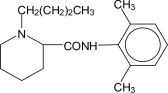
Amide-type local anesthetics such as bupivacaine are metabolized primarily in the liver via conjugation with glucuronic acid. Pipecoloxylidine is the major metabolite of bupivacaine. The elimination of drug from tissue distribution depends largely upon the availability of binding sites in the circulation to carry it to the liver where it is metabolized.
Excretion
The kidney is the main excretory organ for most local anesthetics and their metabolites. Urinary excretion is affected by urinary perfusion and factors affecting urinary pH. Only 6% of bupivacaine is excreted unchanged in the urine.
Specific Populations
Hepatic Impairment
Pharmacokinetics of POSIMIR have not been evaluated in patients with hepatic impairment. [see Warnings and Precautions (5) and Use in Specific Populations (8.6)].
Renal Impairment
Pharmacokinetics of POSIMIR have not been evaluated in patients with renal impairment. [see Use in Specific Populations (8.7)].
Geriatric Patients
Pharmacokinetics of POSIMIR have not been evaluated in geriatric patients.
Elderly patients have exhibited higher peak plasma concentrations than younger patients following administration of bupivacaine HCl. The total plasma clearance was decreased in these patients [see Use in Specific Populations (8.5)].
Carcinogenesis
Long-term studies in animals to evaluate the carcinogenic potential of bupivacaine hydrochloride have not been conducted.
Mutagenesis
Bupivacaine was negative in the in vitro bacterial reverse mutation assay (Ames assay), the in vitro chromosomal aberration assay (human peripheral blood lymphocytes), and the in vivo rat micronucleus assay.
Impairment of Fertility
The effect of bupivacaine on fertility has not been determined.
Study 1
Study 1 was a randomized, multicenter, assessor blinded, placebo-controlled (vehicle) clinical trial in 107 patients undergoing arthroscopic subacromial decompression surgery with an intact rotator cuff. Associated procedures included inspection of the glenohumeral joint, distal clavicle excision, bursectomy, synovectomy, removal of loose body, resection of coracoacromial ligament and subacromial spurs, rotator cuff debridement, and minor debridement of articular cartilage. There were no open surgical procedures performed during this study. The mean age was 50 years (range 21 to 70 years), 60% of treated patients were female, 96% were White, 2% were Hispanic, 1% were Asian, and 1% were Other.
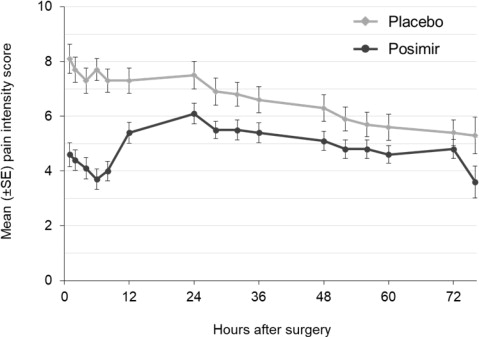
Patients were randomized 2:1:1 to receive POSIMIR, vehicle placebo, or bupivacaine HCl 50 mg, and all patients received general anesthesia. No analgesic pre-medication or local anesthetics were administered. POSIMIR and vehicle placebo were administered under direct arthroscopic visualization as single injections into the subacromial space through one of the arthroscopic portals at the end of the surgery. Bupivacaine HCl 50 mg was administered subacromially as a single dose. Post-operatively, patients received acetaminophen 500 mg or 1000 mg every six hours, depending on body weight, through 72 hours, and were allowed morphine rescue medication as needed, either 2 mg IV or 10 mg orally. Pain intensity was rated by the patients using a 0 to 10 numerical rating scale (NRS) at multiple time points up to 72 hours.
The primary outcome measures were the normalized area under the curve (nAUC) of mean pain intensity on movement scores collected at specified intervals over the first 72 hours after surgery and total opioid rescue analgesia (IV morphine-equivalent dose) through 72 hours. In this clinical study, POSIMIR 5 mL demonstrated a significant reduction in mean pain intensity compared with placebo of 1.3 points on a 0 to 10 NRS scale over 72 hours (Figure 1).
Figure 1. Mean Pain Intensity on Movement Through 72 Hours After Surgery,
Subacromial Decompression Study 1
The median total use of opioid rescue analgesia (IV morphine equivalent dose) from 0 to 72 hours for the POSIMIR treatment group (4 mg) was statistically lower than for the placebo treatment group (12 mg). The median use of opioid rescue analgesia in the bupivacaine treatment group was 8 mg.
Study 2
Study 2 was a randomized, double-blind, placebo-controlled (vehicle) clinical trial in 60 patients undergoing arthroscopic subacromial decompression, inspection of glenohumeral joint, synovectomy, removal of loose body, minor debridement of articular cartilage, minor debridement or minor repair of rotator cuff, open distal clavicle excision, bursectomy, and resection of coracoacromial ligament and subacromial spurs. The mean age was 48 years (range 27 to 68 years), 55% of treated patients were female, 95% were White, 2% were Asian, and 2% were Other.
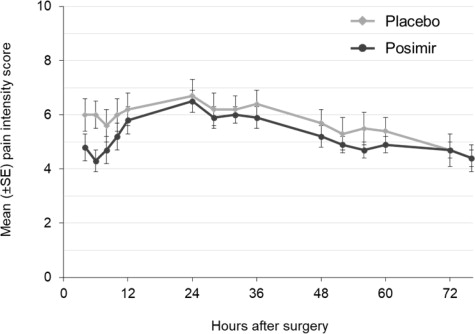
Patients were randomized 2:1 to receive POSIMIR or vehicle placebo, and all patients received general anesthesia. Post-operatively, patients were allowed morphine rescue medication as needed, either 3 mg IV or 10 mg to 15 mg orally, or acetaminophen. Pain intensity was rated by the patients using a 0 to 10 numerical rating scale (NRS) at multiple time points up to 72 hours.
The primary outcome measures were mean pain intensity on movement AUC through 72 hours and total opioid rescue analgesia (IV morphine-equivalent dose) through 72 hours. There was no statistically significant difference in either primary endpoint between the POSIMIR and vehicle placebo treatment groups (Figure 2).
Figure 2: Mean Pain Intensity on Movement Through 72 Hours After Surgery,
Subacromial Decompression Study 2
Study 3
Study 3 was a randomized, double-blind, placebo-controlled (vehicle) and open-label PK clinical trial in 92 patients undergoing a variety of shoulder surgical procedures, including rotator cuff repair, subacromial decompression, glenoid labrum repair or debridement, and biceps tendon repair. The majority of patients underwent arthroscopic procedures; however, six patients underwent a combination of arthroscopic and open procedures. The mean age was 54 years (range 20 to 82 years), 59% of treated patients were male, 87% were White, 8% were African American, 3% were Other, and 2% were Asian.
An equal number of patients were randomized to two cohorts. The routes of POSIMIR or vehicle placebo administration in Cohort 1 were subacromial or subcutaneous injection or a combination. In Cohort 2, POSIMIR or vehicle placebo was administered via injection under direct arthroscopic visualization into the subacromial space. Surgical procedures were completed either under local or general anesthesia. Post-operatively, patients were allowed morphine IV, oxycodone orally, or acetaminophen orally as needed.
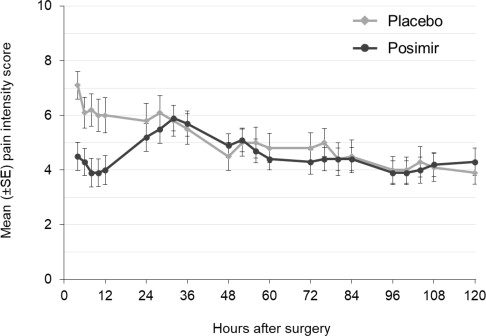
The primary outcome measures were mean pain intensity on movement and at rest through 120 hours and pain control through day seven. There was no statistically significant difference in either primary endpoint between POSIMIR and vehicle placebo treatment groups (Figure 3).
Figure 3: Mean Pain Intensity on Movement Through 120 Hours After Surgery,
Subacromial Decompression Study 3
Handling
- Do not administer any solution which contains particulate matter.
- Do not autoclave.
- Do not dilute.
- Discard any unused portion in an appropriate manner.
| NDC No. | Container | Size | Quantity |
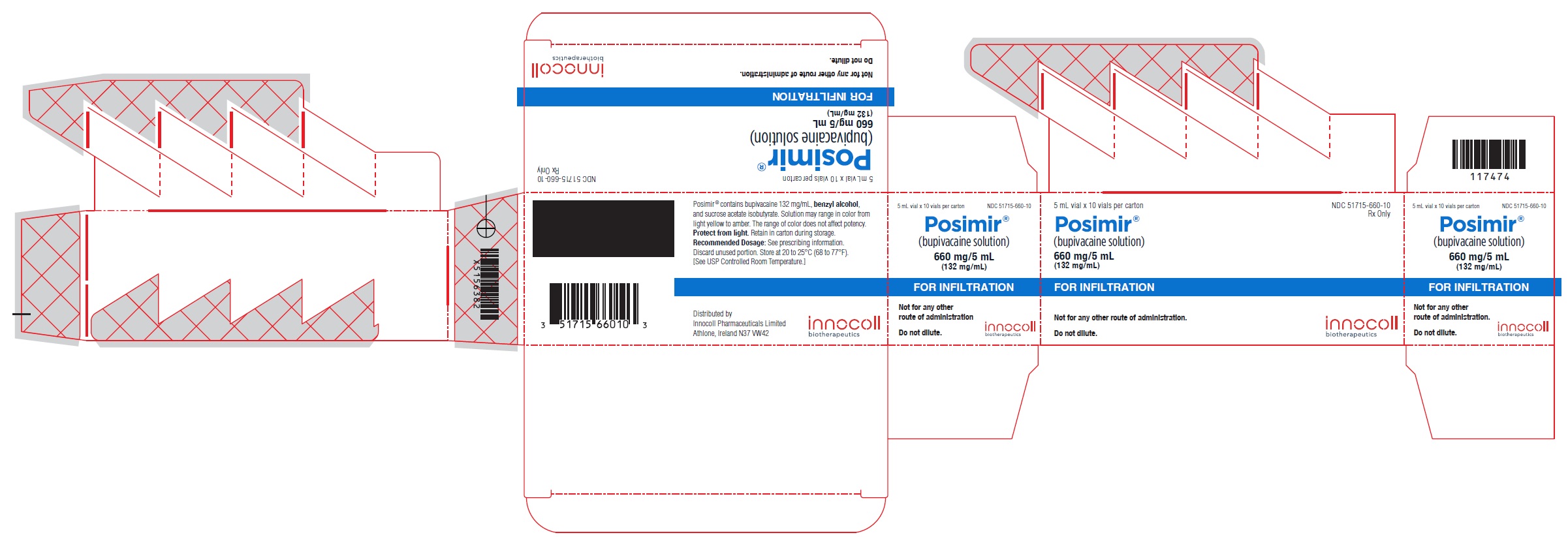
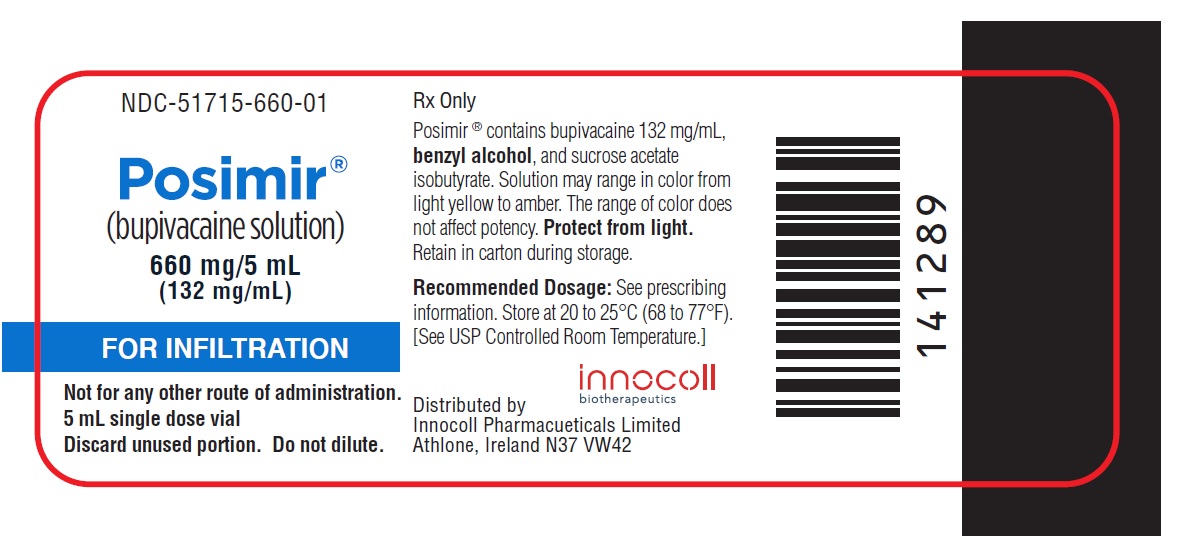
| NDC 51715-660-10 | Single-dose vials | 5 mL | Box of 10 |