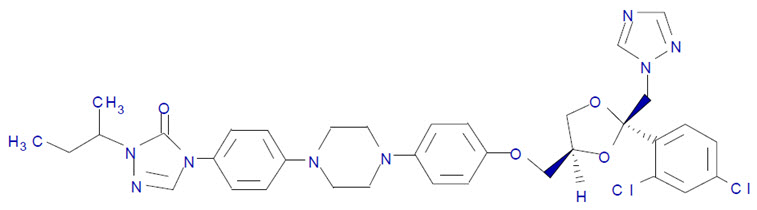
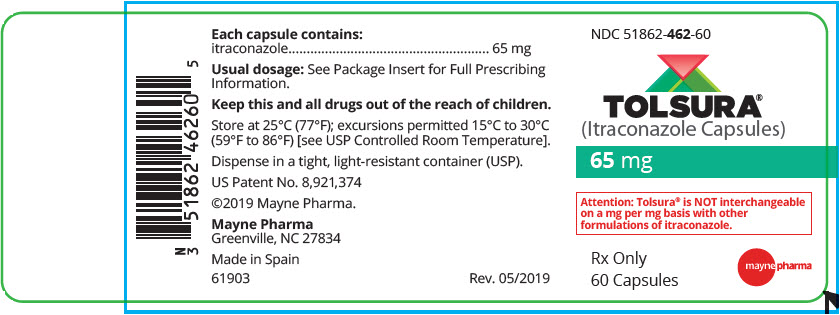
Other
- Congestive Heart Failure
TOLSURA can cause or exacerbate congestive heart failure (CHF). When itraconazole was administered intravenously to healthy human volunteers and dogs, negative inotropic effects were seen. If signs or symptoms of congestive heart failure occur or worsen during administration of TOLSURA, reassess the benefit and risk of continuing treatment [see Warnings and Precautions (5.1) and Adverse Reactions (6.1)]. - Drug Interactions
- Co-administration of certain drugs that are metabolized by human CYP3A4 enzymes are contraindicated with TOLSURA because plasma concentrations of such drugs are increased, which may also increase or prolong both the pharmacologic effects and/or adverse reactions to these drugs [see Contraindications (4.1) and Drug Interactions (7.1)]
- Co-administration with colchicine, fesoterodine and solifenacin is contraindicated in subjects with varying degrees of renal or hepatic impairment, and
- Co-administration with eliglustat is contraindicated in subjects that are poor or intermediate metabolizers of CYP2D6 and in subjects taking strong or moderate CYP2D6 inhibitors.
- Increased plasma concentrations of some of these drugs caused by co-administration with TOLSURA can lead to QT prolongation and/or ventricular tachyarrhythmias, including occurrences of torsades de pointes, a potentially fatal arrhythmia [see Contraindications (4.1), Warnings and Precautions (5.4) and Drug Interactions (7.1)].
- Cannot be interchanged or substituted with other itraconazole products.
- Must be swallowed whole and administered with food.
Limitations of Use:
TOLSURA is not indicated for the treatment of onychomycosis.
TOLSURA is NOT interchangeable or substitutable with other itraconazole products due to the differences in the dosing between TOLSURA and other itraconazole products. Therefore, follow the specific dosage recommendations for TOLSURA [see Dosage and Administration (2)].
Adverse Reactions in the Treatment of Systemic Fungal Infections
Safety data with itraconazole capsules were derived from 602 patients treated for systemic fungal disease in U.S. clinical trials who were immunocompromised or receiving multiple concomitant medications. Treatment was discontinued in 10.5% of patients due to adverse events. The median duration before discontinuation of therapy was 81 days (range: 2 to 776 days). Table 2 lists adverse reactions reported by at least 1% of patients.
| Body System/Adverse Reaction | Incidence (%) (N=602) |
|---|---|
| Gastrointestinal | |
| Nausea | 11 |
| Vomiting | 5 |
| Diarrhea | 3 |
| Abdominal Pain | 2 |
| Anorexia | 1 |
| Body as a Whole | |
| Edema | 4 |
| Fatigue | 3 |
| Fever | 3 |
| Malaise | 1 |
| Skin and Appendages | |
| Rash Rash tends to occur more frequently in immunocompromised patients receiving immunosuppressive medications. | 9 |
| Pruritus | 3 |
| Central/Peripheral Nervous System | |
| Headache | 4 |
| Dizziness | 2 |
| Psychiatric | |
| Libido Decreased | 1 |
| Somnolence | 1 |
| Cardiovascular | |
| Hypertension | 3 |
| Metabolic/Nutritional | |
| Hypokalemia | 2 |
| Urinary System | |
| Albuminuria | 1 |
| Liver and Biliary System | |
| Hepatic Function Abnormal | 3 |
| Reproductive System, Male | |
| Impotence | 1 |
Adverse reactions reported at a rate of <1% included: constipation, gastritis, depression, insomnia, tinnitus, menstrual disorder, adrenal insufficiency, gynecomastia, and male breast pain.
Adverse Reactions Reported from Other Clinical Trials
In addition, the following adverse reactions were reported in itraconazole-treated patients who participated in clinical trials:
Hepatobiliary Disorders: hyperbilirubinemia;
Cardiac Disorders: cardiac failure, left ventricular failure, tachycardia;
General Disorders and Administration Site Conditions: face edema, chest pain, chills;
Hepatobiliary Disorders: hepatic failure, jaundice;
Investigations: alanine aminotransferase increased, aspartate aminotransferase increased, blood alkaline phosphatase increased, blood lactate dehydrogenase increased, blood urea increased, gammaglutamyltransferase increased, urine analysis abnormal;
Metabolism and Nutrition Disorders: hyperglycemia, hyperkalemia, hypomagnesemia;
Psychiatric Disorders: confusional state;
Renal and Urinary Disorders: renal impairment;
Respiratory, Thoracic and Mediastinal Disorders: dysphonia, cough;
Skin and Subcutaneous Tissue Disorders: hyperhidrosis;
Vascular Disorders: hypotension
Risk Summary
There are no data on exposure to itraconazole during pregnancy for the approved indications. Published epidemiologic studies of women exposed to short courses of treatment with itraconazole in the first trimester of pregnancy have reported no risk of major birth defects overall and inconclusive findings on the risk of miscarriage (see Data).
In animal reproduction studies, itraconazole was found to cause a dose-related increase in maternal toxicity, embryotoxicity, and teratogenicity in rats at dosage levels of approximately (6-25 times the maximum recommended human dose [MRHD] of 390 mg/day based on mg/kg comparisons), and in mice at dosage levels of approximately 80 mg/kg/day (12 times the MRHD).
All pregnancies have a background risk of birth defect, loss, or other adverse outcomes. The estimated background risk of major birth defects and miscarriage for the indicated populations is unknown. In the U.S. general population, the estimated background risk of major birth defects and miscarriage in clinically recognized pregnancies is 2 to 4% and 15 to 20%, respectively.
Data
Human Data
Published prospective and retrospective cohort studies of women exposed to short courses of treatment with itraconazole in the first trimester of pregnancy (sample size 198-687) have reported no increase in the rate of major birth defects. The most important methodological limitation of these studies is the short duration of exposure in pregnancy (mean duration 6.9 to 8.5 days), or the lack of information on treatment duration. The risk of prolonged exposure in pregnancy is not known.
Published prospective and retrospective cohort studies of pregnant women exposed to itraconazole (sample size 131-198) have reported inconsistent findings on the risk of miscarriage. Available data are inconclusive and limited by possible bias due to earlier enrollment and possible residual confounding in the exposed group compared to the unexposed group.
Animal Data
Itraconazole has been shown to cross the placenta in a rat model. In animal reproduction studies, itraconazole administration to rats and mice during organogenesis resulted in maternal toxicity, embryotoxicity and teratogenicity at and above 40 and 80 mg/kg respectively (doses equivalent to 6- and 12-times the MRHD of 390 mg/day, based on mg/kg comparisons). In rats, the teratogenicity consisted of major skeletal defects; in mice, it consisted of encephaloceles and/or macroglossia.
Risk Summary
Itraconazole is excreted in human milk; however, there are no data on the amount of itraconazole in human milk, the effects on the breastfed child, or the effects on milk production. The developmental and health benefits of breastfeeding should be considered along with the mother's clinical need for TOLSURA and any potential adverse effects on the breastfed child from TOLSURA or from the underlying maternal condition.
General Pharmacokinetic Characteristics
The steady-state pharmacokinetics of itraconazole following administration of a 130 mg twice daily dose regimen of TOLSURA (2 × 65 mg) was compared with a 200 mg twice daily dose regimen of itraconazole capsules (2 × 100 mg) immediately after a meal for 14.5 days in 16 healthy volunteers; the results from this study are presented in Table 6 below
| Parameter Geometric means ± standard deviation ,Tmax presented as median (range) | TOLSURA 130 mg twice daily (2 × 65 mg Capsules) | Itraconazole 200 mg twice daily (2 × 100 mg Capsules) |
|---|---|---|
| AUC0-tau (hr*mcg/ml) | 15.6 ± 3.7 | 14.9 ±3.8 |
| Ctrough (mcg/ml) | 1.2 ±0.4 | 1.0±0.3 |
| Cmax,ss (mcg/ml) | 1.6 ±0.4 | 1.5 ±0.4 |
| Tmax,ss (h) | 7.0 (1-10) | 5.0 (1-8) |
Peak plasma concentrations of itraconazole after administration of a single dose of TOLSURA are reached within 2 to 6 hours following oral administration in either the fasted or fed states. As a consequence of non-linear pharmacokinetics, itraconazole accumulates in plasma during multiple dosing of TOLSURA. Steady-state concentrations are generally reached within about 15 days, with mean Cmax values of 0.6 mcg/ml and 1.7 mcg/ml after oral administration of 130 mg once daily and 130 mg twice daily, respectively
Absorption
Effect of Food
The effect of food on the steady-state pharmacokinetics of itraconazole following administration of a 130 mg twice daily dose regimen of TOLSURA (2 × 65 mg) for 14.5 days under fed and fasted conditions was evaluated in 20 healthy volunteers. A high-fat meal with total caloric content of 919 calories (526 fat calories, 260 carbohydrate calories and 133 protein calories) was used in the study. The results are shown in Table 7 below.
| Parameter | Treatment | Geometric Mean | Fed/Fasted Ratio (%) | 90% Confidence Interval |
| Cmax_ss (mcg/mL) | Fed | 1.4 ± 0.6 | 73.7 | 69.0, 77.3 |
| Fasted | 1.9 ± 0.9 | |||
| Ctrough,ss (mcg/mL) | Fed | 1.0 ± 0.3 | 90.0 | 86.4, 97.0 |
| Fasted | 1.1 ± 0.6 | |||
| AUCtau (hr*mcg/mL) | Fed | 13.4 ± 5.0 | 78.4 | 74.5, 81.9 |
| Fasted | 17.1 ± 8.0 | |||
| Median | Range | |||
| Tmax (hr) | Fed | 4.00 | 0.5 to 10 | |
| Fasted | 3.50 | 0.5 to 5 | ||
Distribution
Most of the itraconazole in plasma is bound to protein (99.8%), with albumin being the main binding component (99.6% for the hydroxy-metabolite). It has also a marked affinity for lipids. Only 0.2% of the itraconazole in plasma is present as free drug. Itraconazole is distributed in a large apparent volume in the body (>700 L), suggesting extensive distribution into tissues. Concentrations in lung, kidney, liver, bone, stomach, spleen and muscle were found to be two to three times higher than corresponding concentrations in plasma, and the uptake into keratinous tissues, skin in particular, up to four times higher. Concentrations in the cerebrospinal fluid are much lower than in plasma.
Elimination
The terminal half-life of itraconazole following repeated dose administration of TOLSURA ranges between 34 to 42 hours under fed conditions.
Metabolism
Itraconazole is extensively metabolized by the liver into a large number of metabolites. In vitro studies have shown that CYP3A4 is the major enzyme involved in the metabolism of itraconazole. The main metabolite is hydroxy-itraconazole, which has in vitro antifungal activity comparable to itraconazole; trough plasma concentrations of this metabolite are about twice those of itraconazole.
Excretion
Itraconazole is excreted mainly as inactive metabolites in urine (35%) and in feces (54%) within one week of an oral solution dose. Renal excretion of itraconazole and the active metabolite hydroxyitraconazole account for less than 1% of an intravenous dose. Based on an oral radiolabeled dose, fecal excretion of unchanged drug ranges from 3% to 18% of the dose.
As re-distribution of itraconazole from keratinous tissues appears to be negligible, elimination of itraconazole from these tissues is related to epidermal regeneration. Contrary to plasma, the concentration in skin persists for 2 to 4 weeks after discontinuation of a 4-week treatment and in nail keratin - where itraconazole can be detected as early as 1 week after start of treatment - for at least six months after the end of a 3-month treatment period.
Specific Populations
Patients with Renal Impairment
Limited data are available on the use of oral itraconazole in patients with renal impairment. A pharmacokinetic study using a single 200-mg oral dose of itraconazole was conducted in three groups of patients with renal impairment (uremia: n=7; hemodialysis: n=7; and continuous ambulatory peritoneal dialysis: n=5). In uremic subjects with a mean creatinine clearance of 13 mL/min. × 1.73 m2, the exposure, based on AUC, was slightly reduced compared with normal population parameters. This study did not demonstrate any significant effect of hemodialysis or continuous ambulatory peritoneal dialysis on the pharmacokinetics of itraconazole (tmax, Cmax, and AUC0-8h). Plasma concentration versus-time profiles showed wide intersubject variation in all three groups. After a single intravenous versus-time profiles showed wide intersubject variation in all three groups.
After a single intravenous dose, the mean terminal half-lives of itraconazole in patients with mild (defined in this study as CrCl 50-79 ml/min), moderate (defined in this study as CrCl 20-49 ml/min), and severe renal impairment (defined in this study as CrCl <20 ml/min) were similar to that in healthy subjects (range of means 42-49 hours vs 48 hours in renally impaired patients and healthy subjects, respectively). Overall exposure to itraconazole, based on AUC, was decreased in patients with moderate and severe renal impairment by approximately 30% and 40%, respectively, as compared with subjects with normal renal function. Data are not available in renally impaired patients during long-term use of itraconazole. Dialysis has no effect on the half-life or clearance of itraconazole or hydroxy-itraconazole.
Patients with Hepatic Impairment
Itraconazole is predominantly metabolized in the liver. A pharmacokinetic study was conducted in 6 healthy and 12 cirrhotic subjects who were administered a single 100-mg dose of itraconazole capsules. A statistically significant reduction in mean Cmax (47%) and a twofold increase in the elimination half-life (37 ± 17 hours vs. 16 ± 5 hours) of itraconazole were noted in cirrhotic subjects compared with healthy subjects. However, overall exposure to itraconazole, based on AUC, was similar in cirrhotic patients and in healthy subjects. Data are not available in cirrhotic patients during long-term use of itraconazole.
Drug Interaction Studies
Omeprazole
The effect of multiple daily oral 40 mg doses (steady-state conditions) of the proton pump inhibitor, omeprazole, on the exposure to itraconazole from a single 130 mg dose of TOLSURA (2 × 65 mg capsules) when dosed under fasted conditions was evaluated in 30 healthy adult subjects. As illustrated in Table 8 below, the mean itraconazole AUC∞ was 22% higher and mean Cmax 31% higher when TOLSURA was co-administered with omeprazole.
| Parameter | Treatment A Treatment A: TOLSURA Mean ±SD | Treatment A + B Treatment B: Omeprazole Mean ±SD | Treatment A+B vs Treatment A Ratio % | 90% Confidence Interval |
|---|---|---|---|---|
| AUC∞ (h∙ng/mL) | 2846.3 ±1644.4 | 3477.9 ± 1572.6 | 122.2 | 108.7, 137.3 |
| Cmax (ng/mL) | 212.9 ± 119.1 | 278.8 ±106.8 | 130.9 | 111.4, 153.8 |
| Tmax Tmax is given as median (Range) (h) | 3.5 (2.0 -5.0) | 3.3 (1.5 – 5.0) | - | - |
Mechanism of Action
In vitro studies have demonstrated that itraconazole inhibits the cytochrome P450-dependent, 14C-demethylation of ergosterol, which is a vital component of fungal cell membranes.
Resistance
Isolates from several fungal species with decreased susceptibility to itraconazole have been isolated in vitro and from patients receiving prolonged therapy. Several in vitro studies have reported that some fungal clinical isolates with reduced susceptibility to one azole antifungal agent may also be less susceptible to other azole derivatives. The finding of cross-resistance is dependent on a number of factors, including the species evaluated, its clinical history, the particular azole compounds compared, and the type of susceptibility test performed.
Itraconazole is not active against Zygomycetes (e.g., Rhizopus spp., Rhizomucor spp., Mucor spp. and Absidia spp.), Fusarium spp., Scedosporium spp. and Scopulariopsis spp.
Interaction with Other Antimicrobials
Studies (both in vitro and in vivo) suggest that the activity of amphotericin B may be suppressed by prior azole antifungal therapy. Ergosterol is the active site for amphotericin B. In one study, the antifungal activity of amphotericin B against Aspergillus fumigatus infections in mice was inhibited by ketoconazole therapy. The clinical significance of this finding is unknown.
Antifungal Activity
Itraconazole exhibits in vitro activity against Blastomyces dermatitidis, Histoplasma capsulatum, Histoplasma duboisii, Aspergillus flavus, Aspergillus fumigatus, and Trichophyton species [see Indications and Usage (1)]. Correlation between minimum inhibitory concentration (MIC) results in vitro and clinical outcome has yet to be established for azole antifungal agents.
Carcinogenesis
Itraconazole showed no evidence of carcinogenicity potential in mice treated orally for 23 months at dosage levels up to 80 mg/kg/day (approximately 12×MRHD, based on mg/kg comparisons). Male rats treated with 25 mg/kg/day (4×MRHD) had a slightly increased incidence of soft tissue sarcoma. These sarcomas may have been a consequence of hypercholesterolemia, which is a response of rats, but not dogs or humans, to chronic itraconazole administration. Female rats treated with 50 mg/kg/day (8×MRHD) had an increased incidence of squamous cell carcinoma of the lung (2/50) as compared to the untreated group. Although the occurrence of squamous cell carcinoma in the lung is extremely uncommon in untreated rats, the increase in this study was not statistically significant.
Mutagenesis
Itraconazole produced no mutagenic effects when assayed in DNA repair test (unscheduled DNA synthesis) in primary rat hepatocytes, in Ames tests with Salmonella typhimurium (6 strains) and Escherichia coli, in the mouse lymphoma gene mutation tests, in a sex-linked recessive lethal mutation (Drosophila melanogaster) test, in chromosome aberration tests in human lymphocytes, in a cell transformation test with C3H/10T½ C18 mouse embryo fibroblasts cells, in a dominant lethal mutation test in male and female mice, and in micronucleus tests in mice and rats.
Impairment of Fertility
Itraconazole did not affect the fertility of male or female rats treated orally with dosage levels of up to 40 mg/kg/day (6×MRHD, based on mg/kg comparisons), even though parental toxicity was present at this dosage level.
Overview of the Clinical Studies
Clinical studies in invasive mycoses listed in this section were conducted with itraconazole 100 mg capsules. Dosage for TOLSURA is different from that of other itraconazole formulations. TOLSURA is not interchangeable or substitutable with other itraconazole products [see Indications and Usage (1), Dosage and Administration (2) and Clinical Pharmacology (12.3)]
Important Administration Instructions
Instruct the patients that TOLSURA:
Congestive Heart Failure
Inform patients about the signs and symptoms of congestive heart failure. Instruct them to discontinue TOLSURA and contact their healthcare provider immediately, if these signs or symptoms occur during TOLSURA administration [see Warnings and Precautions (5.1)].
Hepatoxicity
Instruct patients to stop TOLSURA treatment immediately and contact their healthcare provider if any signs and symptoms suggestive of liver dysfunction develop. Such signs and symptoms may include unusual fatigue, anorexia, nausea and/or vomiting, jaundice, dark urine, or pale stools [see Warnings and Precautions (5.2)].
Use with Proton Pump Inhibitors and Potential Drug Interactions
Advise patients to discuss with their physician the use of TOLSURA with proton pump inhibitors, such as omeprazole. Instruct patients to contact their physician before taking any other concomitant medications with TOLSURA to ensure there are no potential drug interactions [see Contraindications (4.1, 4.2), Warnings and Precautions (5.4) and Drug interactions (7.2)].
Hearing Loss
Instruct patients that hearing loss can occur with the use of TOLSURA. The hearing loss usually resolves when treatment is stopped but can persist in some patients. Advise patients to inform their healthcare provider if any hearing loss symptoms occur [see Warnings and Precautions (5.6)].
Vision Problem
Instruct patients that dizziness or blurred/double vision can sometimes occur with TOLSURA. Advise patients that if they experience these dizziness or blurred/double vision, they should contact their healthcare provider, and instruct the patient not to drive or use machines [see Adverse Reactions (6.1)].
Pregnancy
Advise patients to notify their physician if they become pregnant or intend to become pregnant during therapy [see Use in Specific Populations (8.1)].
Mayne Pharma
Greenville, NC 27834
Made in Spain
© Mayne Pharma International Pty Ltd