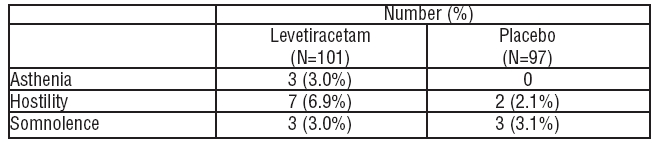
In adults experiencing partial onset seizures, levetiracetam use is associated with the occurrence of central nervous system adverse events that can be classified into the following categories: 1) somnolence and fatigue, 2) coordination difficulties, and 3) behavioral abnormalities.
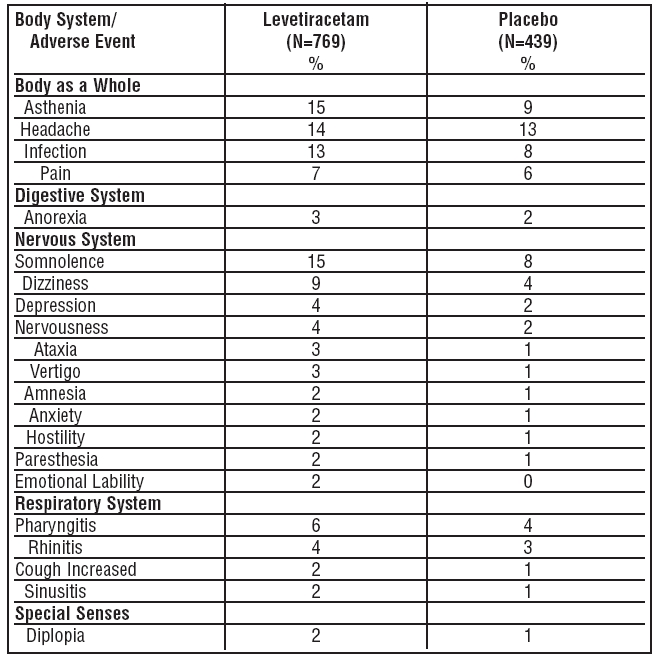
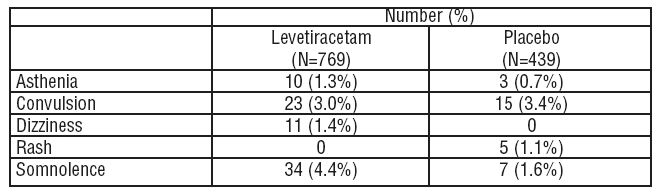
In controlled trials of adult patients with epilepsy experiencing partial onset seizures, 14.8% of levetiracetam-treated patients reported somnolence, compared to 8.4% of placebo patients. There was no clear dose response up to 3000 mg/day. In a study where there was no titration, about 45% of patients receiving 4000 mg/day reported somnolence. The somnolence was considered serious in 0.3% of the treated patients, compared to 0% in the placebo group. About 3% of levetiracetam-treated patients discontinued treatment due to somnolence, compared to 0.7% of placebo patients. In 1.4% of treated patients and in 0.9% of placebo patients the dose was reduced, while 0.3% of the treated patients were hospitalized due to somnolence.
In controlled trials of adult patients with epilepsy experiencing partial onset seizures, 14.7% of treated patients reported asthenia, compared to 9.1% of placebo patients. Treatment was discontinued in 0.8% of treated patients as compared to 0.5% of placebo patients. In 0.5% of treated patients and in 0.2% of placebo patients the dose was reduced.
A total of 3.4% of levetiracetam-treated patients experienced coordination difficulties, (reported as either ataxia, abnormal gait, or incoordination) compared to 1.6% of placebo patients. A total of 0.4% of patients in controlled trials discontinued levetiracetam treatment due to ataxia, compared to 0% of placebo patients. In 0.7% of treated patients and in 0.2% of placebo patients the dose was reduced due to coordination difficulties, while one of thetreated patients was hospitalized due to worsening of pre-existing ataxia.
Somnolence, asthenia and coordination difficulties occurred most frequently within the first 4 weeks of treatment.
In controlled trials of patients with epilepsy experiencing partial onset seizures, 5 (0.7%) of levetiracetam-treated patients experienced psychotic symptoms compared to 1 (0.2%) placebo patient. Two (0.3%) levetiracetam-treated patients were hospitalized and their treatment was discontinued. Both events, reported as psychosis, developed within the first week of treatment and resolved within 1 to 2 weeks following treatment discontinuation. Two other events, reported as hallucinations, occurred after 1-5 months and resolved within 2-7 days while the patients remained on treatment. In one patient experiencing psychotic depression occurring within a month, symptoms resolved within 45 days while the patient continued treatment.
A total of 13.3% of levetiracetam patients experienced other behavioral symptoms (reported as aggression, agitation, anger, anxiety, apathy, depersonalization, depression, emotional lability, hostility, irritability, etc.) compared to 6.2% of placebo patients. Approximately half of these patients reported these events within the first 4 weeks. A total of 1.7% of treated patients discontinued treatment due to these events, compared to 0.2% of placebo patients. The treatment dose was reduced in 0.8% of treated patients and in 0.5% of placebo patients. A total of 0.8% of treated patients had a serious behavioral event (compared to 0.2% of placebo patients) and were hospitalized.
In addition, 4 (0.5%) of treated patients attempted suicide compared to 0% of placebo patients. One of these patients completed suicide. In the other 3 patients, the events did not lead to discontinuation or dose reduction. The events occurred after patients had been treated for between 4 weeks and 6 months (see PRECAUTIONS: Information for patients).
Minor, but statistically significant, decreases compared to placebo in total mean RBC count (0.03 x 10⁶/mm3), mean hemoglobin (0.09 g/dL), and mean hematocrit (0.38%), were seen in levetiracetam-treated patients in controlled trials.
A total of 3.2% of treated and 1.8% of placebo patients had at least one possibly significant (≤2.8 x 10⁹/L) decreased WBC, and 2.4% of treated and 1.4% of placebo patients had at least one possibly significant (≤1.0 x 10⁹/L) decreased neutrophil count. Of the treated patients with a low neutrophil count, all but one rose towards or to baseline with continued treatment. No patient was discontinued secondary to low neutrophil counts.