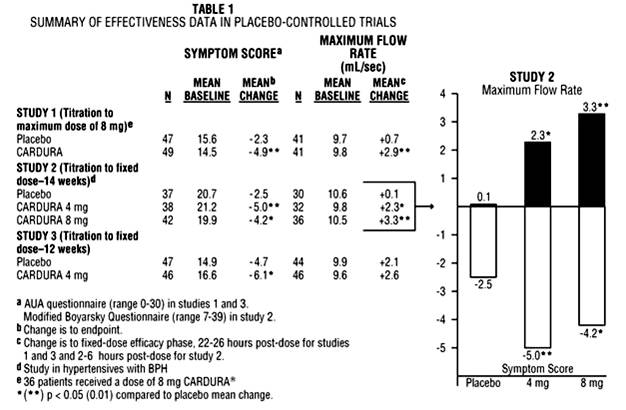
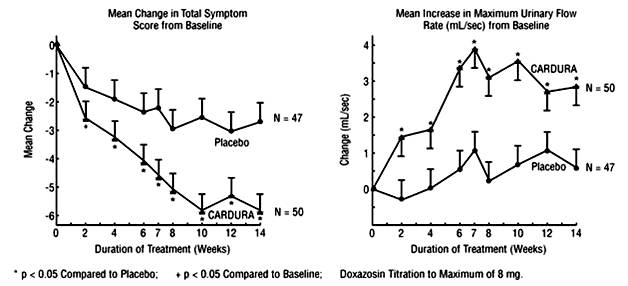
The mechanism of action of Doxazosin mesylate is selective blockade of the alpha1 (postjunctional) subtype of adrenergic receptors. Studies in normal human subjects have shown that doxazosin competitively antagonized the pressor effects of phenylephrine (an alpha1 agonist) and the systolic pressor effect of norepinephrine. Doxazosin and prazosin have similar abilities to antagonize phenylephrine. The antihypertensive effect of Doxazosin mesylate results from a decrease in systemic vascular resistance. The parent compound doxazosin is primarily responsible for the antihypertensive activity. The low plasma concentrations of known active and inactive metabolites of doxazosin (2-piperazinyl, 6'- and 7'-hydroxy and 6- and 7-O-desmethyl compounds) compared to parent drug indicate that the contribution of even the most potent compound (6'-hydroxy) to the antihypertensive effect of doxazosin in man is probably small. The 6'- and 7'-hydroxy metabolites have demonstrated antioxidant properties at concentrations of 5 µM, in vitro.
Administration of Doxazosin mesylate results in a reduction in systemic vascular resistance. In patients with hypertension, there is little change in cardiac output. Maximum reductions in blood pressure usually occur 2–6 hours after dosing and are associated with a small increase in standing heart rate. Like other alpha1-adrenergic blocking agents, doxazosin has a greater effect on blood pressure and heart rate in the standing position.
In a pooled analysis of placebo-controlled hypertension studies with about 300 hypertensive patients per treatment group, doxazosin, at doses of 1–16 mg given once daily, lowered blood pressure at 24 hours by about 10/8 mmHg compared to placebo in the standing position and about 9/5 mmHg in the supine position. Peak blood pressure effects (1–6 hours) were larger by about 50–75% (i.e., trough values were about 55–70% of peak effect), with the larger peak-trough differences seen in systolic pressures. There was no apparent difference in the blood pressure response of Caucasians and blacks or of patients above and below age 65. In these predominantly normocholesterolemic patients, doxazosin produced small reductions in total serum cholesterol (2–3%), LDL cholesterol (4%), and a similarly small increase in HDL/total cholesterol ratio (4%). The clinical significance of these findings is uncertain. In the same patient population, patients receiving Doxazosin mesylate gained a mean of 0.6 kg compared to a mean loss of 0.1 kg for placebo patients.
Doxazosin mesylate is also indicated for the treatment of hypertension. Doxazosin mesylate may be used alone or in combination with diuretics, beta-adrenergic blocking agents, calcium channel blockers, or angiotensin-converting enzyme inhibitors.
Doxazosin mesylate has been administered to approximately 4000 hypertensive patients, of whom 1679 were included in the hypertension clinical development program. In that program, minor adverse effects were frequent, but led to discontinuation of treatment in only 7% of patients. In placebo-controlled studies, adverse effects occurred in 49% and 40% of patients in the doxazosin and placebo groups, respectively, and led to discontinuation in 2% of patients in each group. The major reasons for discontinuation were postural effects (2%), edema, malaise/fatigue, and some heart rate disturbance, each about 0.7%.
In controlled hypertension clinical trials directly comparing Doxazosin mesylate to placebo, there was no significant difference in the incidence of side effects, except for dizziness (including postural), weight gain, somnolence, and fatigue/malaise. Postural effects and edema appeared to be dose-related. The prevalence rates presented below are based on combined data from placebo-controlled studies involving once-daily administration of doxazosin at doses ranging from 1–16 mg. Table 4 summarizes those adverse experiences (possibly/probably related) reported for patients in these hypertension studies where the prevalence rate in the doxazosin group was at least 0.5% or where the reaction is of particular interest.
TABLE 4 ADVERSE REACTIONS DURING PLACEBO-CONTROLLED STUDIES | HYPERTENSION |
| DOXAZOSIN | PLACEBO |
| (N=339) | (N=336) |
| CARDIOVASCULAR SYSTEM | | |
| Dizziness | 19% | 9% |
| Vertigo | 2% | 1% |
| Postural Hypotension | 0.3% | 0% |
| Edema | 4% | 3% |
| Palpitation | 2% | 3% |
| Arrhythmia | 1% | 0% |
| Hypotension | 1% | 0% |
| Tachycardia | 0.3% | 1% |
| Peripheral Ischemia | 0.3% | 0% |
| SKIN & APPENDAGES | | |
| Rash | 1% | 1% |
| Pruritus | 1% | 1% |
| MUSCULOSKELETAL SYSTEM | | |
| Arthralgia/Arthritis | 1% | 0% |
| Muscle Weakness | 1% | 0% |
| Myalgia | 1% | 0% |
| CENTRAL & PERIPHERAL N.S. | | |
| Headache | 14% | 16% |
| Paresthesia | 1% | 1% |
| Kinetic Disorders | 1% | 0% |
| Ataxia | 1% | 0% |
| Hypertonia | 1% | 0% |
| Muscle Cramps | 1% | 0% |
| AUTONOMIC | | |
| Mouth Dry | 2% | 2% |
| Flushing | 1% | 0% |
| SPECIAL SENSES | | |
| Vision Abnormal | 2% | 1% |
| Conjunctivitis/Eye Pain | 1% | 1% |
| Tinnitus | 1% | 0.3% |
| PSYCHIATRIC | | |
| Somnolence | 5% | 1% |
| Nervousness | 2% | 2% |
| Depression | 1% | 1% |
| Insomnia | 1% | 1% |
| Sexual Dysfunction | 2% | 1% |
| GASTROINTESTINAL | | |
| Nausea | 3% | 4% |
| Diarrhea | 2% | 3% |
| Constipation | 1% | 1% |
| Dyspepsia | 1% | 1% |
| Flatulence | 1% | 1% |
| Abdominal Pain | 0% | 2% |
| Vomiting | 0% | 1% |
| RESPIRATORY | | |
| Rhinitis | 3% | 1% |
| Dyspnea | 1% | 1% |
| Epistaxis | 1% | 0% |
| URINARY | | |
| Polyuria | 2% | 0% |
| Urinary Incontinence | 1% | 0% |
| Micturition Frequency | 0% | 2% |
| GENERAL | | |
| Fatigue/Malaise | 12% | 6% |
| Chest Pain | 2% | 2% |
| Asthenia | 1% | 1% |
| Face Edema | 1% | 0% |
| Pain | 2% | 2% |
Additional adverse reactions have been reported, but these are, in general, not distinguishable from symptoms that might have occurred in the absence of exposure to doxazosin. The following adverse reactions occurred with a frequency of between 0.5% and 1%: syncope, hypoesthesia, increased sweating, agitation, increased weight. The following additional adverse reactions were reported by <0.5% of 3960 patients who received doxazosin in controlled or open, short- or long-term clinical studies, including international studies. Cardiovascular System: angina pectoris, myocardial infarction, cerebrovascular accident; Autonomic Nervous System: pallor; Metabolic: thirst, gout, hypokalemia; Hematopoietic: lymphadenopathy, purpura; Reproductive System: breast pain; Skin Disorders: alopecia, dry skin, eczema; Central Nervous System: paresis, tremor, twitching, confusion, migraine, impaired concentration; Psychiatric: paroniria, amnesia, emotional lability, abnormal thinking, depersonalization; Special Senses: parosmia, earache, taste perversion, photophobia, abnormal lacrimation; Gastrointestinal System: increased appetite, anorexia, fecal incontinence, gastroenteritis; Respiratory System: bronchospasm, sinusitis, coughing, pharyngitis; Urinary System: renal calculus; General Body System: hot flushes, back pain, infection, fever/rigors, decreased weight, influenza-like symptoms.
Doxazosin mesylate has not been associated with any clinically significant changes in routine biochemical tests. No clinically relevant adverse effects were noted on serum potassium, serum glucose, uric acid, blood urea nitrogen, creatinine or liver function tests. Doxazosin mesylate has been associated with decreases in white blood cell counts (see PRECAUTIONS, Leukopenia/Neutropenia).
In post-marketing experience, the following additional adverse reactions have been reported: Autonomic Nervous System: priapism; Central Nervous System: hypoesthesia; Endocrine System: gynecomastia; Gastrointestinal System: vomiting; General Body System: allergic reaction; Heart Rate/Rhythm: bradycardia; Hematopoietic: leukopenia, thrombocytopenia; Liver/Biliary System: hepatitis, hepatitis cholestatic; Respiratory System: bronchospasm aggravated; Skin Disorders: urticaria; Special Senses: Intraoperative Floppy Iris Syndrome (see PRECAUTIONS, Cataract Surgery); Urinary System: hematuria, micturition disorder, micturition frequency, nocturia.