Dosage Adjustments in Patients with Severe Chronic Neutropenia
Chronic daily administration is required to maintain clinical benefit. Individualize the dosage based on the patient's clinical course as well as ANC. In the SCN postmarketing surveillance study, the reported median daily doses of NEUPOGEN were: 6 mcg/kg (congenital neutropenia), 2.1 mcg/kg (cyclic neutropenia), and 1.2 mcg/kg (idiopathic neutropenia). In rare instances, patients with congenital neutropenia have required doses of NEUPOGEN greater than or equal to 100 mcg/kg/day.
Monitor CBCs for Dosage Adjustments
During the initial 4 weeks of NEUPOGEN therapy and during the 2 weeks following any dosage adjustment, monitor CBCs with differential and platelet counts. Once a patient is clinically stable, monitor CBCs with differential and platelet counts monthly during the first year of treatment. Thereafter, if the patient is clinically stable, less frequent routine monitoring is recommended.
Administration Instructions for Subcutaneous Injection
Inject NEUPOGEN subcutaneously in the outer area of upper arms, abdomen, thighs, or upper outer areas of the buttock. If patients or caregivers are to administer NEUPOGEN, instruct them in appropriate injection technique and ask them to follow the subcutaneous injection procedures in the Instructions for Use for the vial or prefilled syringe [see Patient Counseling Information (17)].
If the patient or caregiver misses a dose of NEUPOGEN, instruct them to contact their healthcare provider.
Patients who will self-administer and caregivers who will administer to the patient may benefit from training by a healthcare professional. Training should aim to demonstrate to those patients and caregivers how to measure the dose of NEUPOGEN, and the focus should be on ensuring that a patient or caregiver can successfully perform all of the steps in the Instructions for Use for the vial or prefilled syringe.
If a patient or caregiver is not able to demonstrate that they can measure the dose and administer the product successfully, you should consider whether the patient is an appropriate candidate for self-administration of NEUPOGEN prefilled syringe or whether the patient would benefit from the NEUPOGEN vial presentation. If a patient or caregiver experiences difficulty measuring the required dose, especially if it is other than the entire content of the NEUPOGEN prefilled syringe, use of the NEUPOGEN vial may be considered [see Instructions for Use].
Instructions for the Vial
Prior to use, remove the vial from the refrigerator and allow NEUPOGEN to reach room temperature 20°C to 25°C (68°F to 77°F) , for a minimum of 30 minutes and a maximum of 24 hours. Discard any vial left at room temperature for greater than 24 hours. Parenteral drug products should be inspected visually for particulate matter and discoloration prior to administration, whenever solution and container permit (the solution is clear and colorless). Do not administer NEUPOGEN if particulates or discoloration are observed.
Discard unused portion of NEUPOGEN in vial; do not re-enter the vial. Do not save unused drug for later administration.
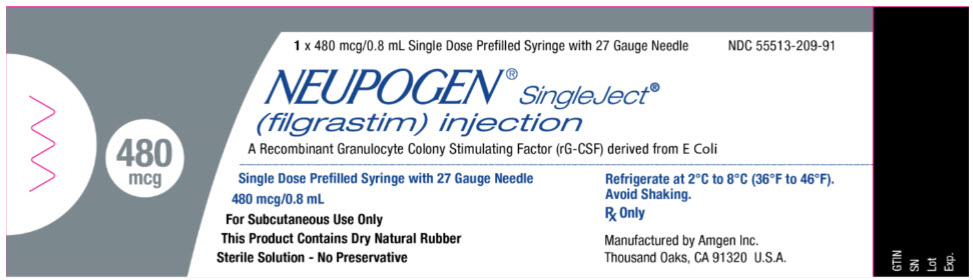
Instructions for the Prefilled Syringe
Persons with latex allergies should not administer the NEUPOGEN prefilled syringe, because the needle cap contains dry natural rubber (derived from latex).
Prior to use, remove the prefilled syringe from the refrigerator and allow NEUPOGEN to reach room temperature 20°C to 25°C (68°F to 77°F) , for a minimum of 30 minutes and a maximum of 24 hours. Discard any prefilled syringe left at room temperature for greater than 24 hours. Parenteral drug products should be inspected visually for particulate matter and discoloration prior to administration, whenever solution and container permit (the solution is clear and colorless). Do not administer NEUPOGEN if particulates or discoloration are observed.
Discard unused portion of NEUPOGEN in prefilled syringe. Do not save unused drug for later administration,
Administration Instructions for Dilution
If required for intravenous administration, NEUPOGEN may be diluted in 5% Dextrose Injection, USP to concentrations between 5 mcg/mL to 15 mcg/mL. NEUPOGEN diluted to concentrations from 5 mcg/mL to 15 mcg/mL should be protected from adsorption to plastic materials by the addition of Albumin (Human) to a final concentration of 2 mg/mL. When diluted in 5% Dextrose Injection, USP or 5% Dextrose plus Albumin (Human), NEUPOGEN is compatible with glass bottles, polyvinyl chloride (PVC) and polyolefin intravenous bags, and polypropylene syringes.
Do not dilute with Sodium Chloride Injection at any time because the product may precipitate.
Diluted NEUPOGEN solution can be stored at room temperature for up to 24 hours. This 24-hour time period includes the time during room temperature storage of the infusion solution and the duration of the infusion.
Adverse Reactions in Patients with Cancer Receiving Myelosuppressive Chemotherapy
The following adverse reaction data in Table 2 are from three randomized, placebo-controlled studies in patients with:
- small cell lung cancer receiving standard dose chemotherapy with cyclophosphamide, doxorubicin, and etoposide (Study 1)
- small cell lung cancer receiving ifosfamide, doxorubicin, and etoposide (Study 2), and
- non-Hodgkin's lymphoma (NHL) receiving doxorubicin, cyclophosphamide, vindesine, bleomycin, methylprednisolone, and methotrexate ("ACVBP") or mitoxantrone, ifosfamide, mitoguazone, teniposide, methotrexate, folinic acid, methylprednisolone, and methotrexate ("VIM3") (Study 3).
A total of 451 patients were randomized to receive subcutaneous NEUPOGEN 230 mcg/m2 (Study 1), 240 mcg/m2 (Study 2) or 4 or 5 mcg/kg/day (Study 3) (n = 294) or placebo (n = 157). The patients in these studies were median age 61 (range 29 to 78) years and 64% were male. The ethnicity was 95% Caucasian, 4% African American, and 1% Asian.
Table 2. Adverse Reactions in Patients with Cancer Receiving Myelosuppressive Chemotherapy (With ≥ 5% Higher Incidence in NEUPOGEN Compared to Placebo)Body System
Adverse Reactions | NEUPOGEN
(N = 294) | Placebo
(N = 157) |
|---|
| Blood and lymphatic system disorders |
| Thrombocytopenia | 38% | 29% |
| Gastrointestinal disorders |
| Nausea | 43% | 32% |
| General disorders and administration site conditions |
| Pyrexia | 48% | 29% |
| Chest pain | 13% | 6% |
| Pain | 12% | 6% |
| Fatigue | 20% | 10% |
| Musculoskeletal and connective tissue disorders |
| Back pain | 15% | 8% |
| Arthralgia | 9% | 2% |
| Bone pain | 11% | 6% |
| Pain in extremity Percent difference (NEUPOGEN – Placebo) was 4%. | 7% | 3% |
| Nervous system disorders |
| Dizziness | 14% | 3% |
| Respiratory, thoracic and mediastinal disorders |
| Cough | 14% | 8% |
| Dyspnea | 13% | 8% |
| Skin and subcutaneous tissue disorders |
| Rash | 14% | 5% |
| Investigations |
| Blood lactate dehydrogenase increased | 6% | 1% |
| Blood alkaline phosphatase increased | 6% | 1% |
Adverse reactions with ≥ 5% higher incidence in NEUPOGEN patients compared to placebo and associated with the sequelae of the underlying malignancy or chemotherapy delivered included anemia, constipation, diarrhea, oral pain, vomiting, asthenia, malaise, edema peripheral, hemoglobin decreased, decreased appetite, oropharyngeal pain, and alopecia.
Adverse Reactions in Patients with Acute Myeloid Leukemia
Adverse reaction data below are from a randomized, double-blind, placebo-controlled study in patients with AML (Study 4) who received an induction chemotherapy regimen of intravenous daunorubicin days 1, 2, and 3; cytosine arabinoside days 1 to 7; and etoposide days 1 to 5 and up to 3 additional courses of therapy (induction 2, and consolidation 1, 2) of intravenous daunorubicin, cytosine arabinoside, and etoposide. The safety population included 518 patients randomized to receive either 5 mcg/kg/day NEUPOGEN (n = 257) or placebo (n = 261). The median age was 54 (range 16 to 89) years and 54% were male.
Adverse reactions with ≥ 2% higher incidence in NEUPOGEN patients compared to placebo included epistaxis, back pain, pain in extremity, erythema, and rash maculo-papular.
Adverse events with ≥ 2% higher incidence in NEUPOGEN patients compared to placebo and associated with the sequelae of the underlying malignancy or chemotherapy included diarrhea, constipation, and transfusion reaction.
Adverse Reactions in Patients with Cancer Undergoing Bone Marrow Transplantation
The following adverse reaction data are from one randomized, no treatment-controlled study in patients with acute lymphoblastic leukemia or lymphoblastic lymphoma receiving high-dose chemotherapy (cyclophosphamide or cytarabine, and melphalan) and total body irradiation (Study 5) and one randomized, no treatment-controlled study in patients with Hodgkin's disease (HD) and NHL undergoing high-dose chemotherapy and autologous bone marrow transplantation (Study 6). Patients receiving autologous bone marrow transplantation only were included in the analysis. A total of 100 patients received either 30 mcg/kg/day as a 4-hour infusion (Study 5) or 10 mcg/kg/day or 30 mcg/kg/day as a 24-hour infusion (Study 6) NEUPOGEN (n = 72), no treatment control or placebo (n = 28). The median age was 30 (range 15 to 57) years, 57% were male.
Adverse reactions with ≥ 5% higher incidence in NEUPOGEN patients compared to patients receiving no NEUPOGEN included rash and hypersensitivity.
Adverse reactions in patients receiving intensive chemotherapy followed by autologous BMT with ≥ 5% higher incidence in NEUPOGEN patients compared to patients receiving no NEUPOGEN included thrombocytopenia, anemia, hypertension, sepsis, bronchitis, and insomnia.
Adverse Reactions in Patients with Cancer Undergoing Autologous Peripheral Blood Progenitor Cell Collection
The adverse reaction data in Table 3 are from a series of 7 trials in patients with cancer undergoing mobilization of autologous peripheral blood progenitor cells for collection by leukapheresis. Patients (n = 166) in all these trials underwent a similar mobilization/collection regimen: NEUPOGEN was administered for 6 to 8 days, in most cases the apheresis procedure occurred on days 5, 6, and 7. The dosage of NEUPOGEN ranged between 5 to 30 mcg/kg/day and was administered subcutaneously by injection or continuous infusion. The median age was 39 (range 15 to 67) years, and 48% were male.
Table 3. Adverse Reactions in Patients with Cancer Undergoing Autologous PBPC in the Mobilization Phase (≥ 5% Incidence in NEUPOGEN Patients)Body System
Adverse Reactions | Mobilization Phase
(N = 166) |
|---|
| Musculoskeletal and connective tissue disorders |
| Bone pain | 30% |
| General disorders and administration site conditions |
| Pyrexia | 16% |
| Investigations |
| Blood alkaline phosphatase increased | 11% |
| Nervous system disorders |
| Headache | 10% |
Adverse Reactions in Patients with Severe Chronic Neutropenia
The following adverse reaction data were identified in a randomized, controlled study in patients with SCN receiving NEUPOGEN (Study 7). 123 patients were randomized to a 4-month observation period followed by subcutaneous NEUPOGEN treatment or immediate subcutaneous NEUPOGEN treatment. The median age was 12 years (range 7 months to 76 years) and 46% were male. The dosage of NEUPOGEN was determined by the category of neutropenia. Initial dosage of NEUPOGEN:
- Idiopathic neutropenia: 3.6 mcg/kg/day
- Cyclic neutropenia: 6 mcg/kg/day
- Congenital neutropenia: 6 mcg/kg/day divided 2 times per day
The dosage was increased incrementally to 12 mcg/kg/day divided 2 times per day if there was no response.
Adverse reactions with ≥ 5% higher incidence in NEUPOGEN patients compared to patients receiving no NEUPOGEN included arthralgia, bone pain, back pain, muscle spasms, musculoskeletal pain, pain in extremity, splenomegaly, anemia, upper respiratory tract infection, and urinary tract infection (upper respiratory tract infection and urinary tract infection were higher in the NEUPOGEN arm, total infection related events were lower in NEUPOGEN-treated patients), epistaxis, chest pain, diarrhea, hypoesthesia, and alopecia.
NEUPOGEN® (filgrastim)
Manufactured by:
Amgen Inc.
One Amgen Center Drive
Thousand Oaks, California 91320-1799
U.S. License Number 1080
Patent: http://pat.amgen.com/neupogen/
© 1991-2026 Amgen Inc. All rights reserved.
www.NEUPOGEN.com
1-800-77-AMGEN (1-800-772-6436)
1xxxxxx
V38