Other
Alfuzosin HCl extended-release tablets are indicated for the treatment of signs and symptoms of benign prostatic hyperplasia.
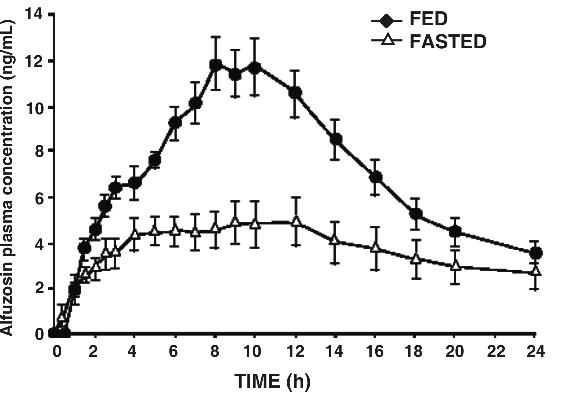
The recommended dosage is one 10 mg alfuzosin HCl extended-release tablet once daily. The extent of absorption of alfuzosin is 50% lower under fasting conditions. Therefore, alfuzosin HCl extended-release tablets should be taken with food and with the same meal each day. The tablets should not be chewed or crushed.
Alfuzosin HCl extended-release tablets 10 mg are available as white and yellow colored bi-layered circular shaped standard convex tablets, debossed with ‘W738’ on yellow layer.
Alfuzosin HCl extended-release tablets are contraindicated for use:
- in patients with moderate or severe hepatic impairment (Childs-Pugh categories B and C), since alfuzosin blood levels are increased in these patients [see Use in Specific Populations (8.7) and Clinical Pharmacology (12.3)].
- with potent CYP3A4 inhibitors such as ketoconazole, itraconazole, and ritonavir, since alfuzosin blood levels are increased [see Drug Interactions (7.1) and Clinical Pharmacology (12.3)].
- in patients with known hypersensitivity, such as urticaria and angioedema, to alfuzosin hydrochloride or any component of alfuzosin HCl extended-release tablets [see Adverse Reactions (6.2)]
- Your risk of having this problem may be increased if you take alfuzosin HCl extended-release tablets with certain other medicine that lowers blood pressure:
- medicines for high blood pressure
- a nitrate medicine for angina
- Do not drive, operate machinery, or do any dangerous activities until you know how alfuzosin HCl extended-release tablets affects you. This is especially important if you already have a problem with low blood pressure or take medicines to treat high blood pressure.
- If you begin to feel dizzy or lightheaded, lie down with your legs and feet up. If your symptoms do not improve call your doctor.
- have certain liver problems
- take antifungal medicines like ketoconazole (Nizarol) or itraconazole (Sporanox)
- take anti-HIV medicines like ritonavir (Norvir, Kaletra)
- are allergic to alfuzosin hydrochloride or any of the ingredients in alfuzosin HCl extended-release tablets. See the end of this leaflet for a complete list of ingredients in alfuzosin HCl extended-release tablets.
- have liver problems
- have kidney problems
- have had low blood pressure, especially after taking another medicine. Signs of low blood pressure are fainting, dizziness, and lightheadedness.
- have a heart problem called angina
- or any family members have a rare heart condition known as congenital prolongation of the QT interval.
- another alpha blocker medicine
- a medicine to treat high blood pressure
- a medicine to treat angina
- a medicine to treat erectile dysfunction (ED)
- the antifungal medicines like ketoconazole (Nizoral) or itraconazole (Sporanox)
- the anti-HIV medicine like, ritonavir (Norvir, Kaletra)
- If you have an eye surgery for cataract (clouding of the eye) planned, tell your ophthalmologist that you are using alfuzosin HCl extended-release tablets or have previously been treated with an alpha-blocker.
- Take alfuzosin HCl extended-release tablets exactly as your doctor prescribes it.
- Take alfuzosin HCl extended-release tablets after the same meal each day. Do not take it on an empty stomach.
- Swallow the alfuzosin HCl extended-release tablet whole. Do not crush, split, or chew alfuzosin HCl extended-release tablets.
- If you take too much alfuzosin HCl extended-release tablets call your local poison control center or emergency room right away.
- See "What is the most important information I should know about alfuzosin HCl extended-release tablets?"
- A painful erection that will not go away. Alfuzosin HCl extended-release tablets can cause a painful erection (priapism), which cannot be relieved by having sex. If this happens, get medical help right away. If priapism is not treated, you may not be able to get an erection in the future.
- dizziness
- headache
- tiredness
- Store alfuzosin HCl extended-release tablets at 20°-25°C (68°-77°F), [See USP Controlled Room Temperature].
- Protect form light and moisture.
Should overdose of alfuzosin HCl extended-release tablets lead to hypotension, support of the cardiovascular system is of first importance. Restoration of blood pressure and normalization of heart rate may be accomplished by keeping the patient in the supine position. If this measure is inadequate, then the administration of intravenous fluids should be considered. If necessary, vasopressors should then be used, and the renal function should be monitored and supported as needed. Alfuzosin is 82% to 90% protein bound; therefore, dialysis may not be of benefit.
Each alfuzosin HCl extended-release tablet contains 10 mg alfuzosin hydrochloride as the active ingredient. Alfuzosin hydrochloride, USP is a white or almost white powder. It is soluble in methanol.
Alfuzosin hydrochloride is (R,S)-N-[3-[(4-amino-6,7-dimethoxy-2-quinazolinyl) methylamino] propyl] tetrahydro-2-furancarboxamide hydrochloride. The molecular formula of alfuzosin hydrochloride is C19H27N5O4•HCl. The molecular weight of alfuzosin hydrochloride is 425.9. Its structural formula is:

Structure (Alfuzosintablets M Figure 03)
The tablet also contains the following inactive ingredients: colloidal silicon dioxide, lactose monohydrate, hypromellose, hydroxypropyl cellulose, magnesium stearate, microcrystalline cellulose, povidone, talc and yellow ferric oxide.
Three randomized placebo-controlled, double-blind, parallel-arm, 12-week trials were conducted with the 10 mg daily dose of alfuzosin. In these three trials, 1,608 patients [mean age 64.2 years, range 49-92 years; Caucasian (96.1%), Black (1.6%), Asian (1.1%), Other (1.2%)] were randomized and 473 patients received alfuzosin HCl extended-release tablets 10 mg daily. Table 4 provides the results of the three trials that evaluated the 10 mg dose.
There were two primary efficacy variables in these three studies. The International Prostate Symptom Score (IPSS, or AUA Symptom Score) consists of seven questions that assess the severity of both irritative (frequency, urgency, nocturia) and obstructive (incomplete emptying, stopping and starting, weak stream, and pushing or straining) symptoms, with possible scores ranging from 0 to 35 with higher numerical scores on the IPSS total symptom score representing greater severity of symptoms. The second efficacy variable was peak urinary flow rate. The peak flow rate was measured just prior to the next dose in study 2 and on average at 16 hours post-dosing in trials 1 and 3.
There was a statistically significant reduction from baseline to last assessment (Week 12) in the IPSS total symptom score versus placebo in all three studies, indicating a reduction in symptom severity (Table 5 and Figures 2, 3, and 4)
ªDifference between baseline and week 12. | ||||||
| Symptom Score | Trial 1 | Trial 2 | Trial 3 | |||
| Placebo (n=167) | Alfuzosin HCl Extended-Release Tablets 10 mg (n=170) | Placebo (n=152) | Alfuzosin HCl Extended-Release Tablets 10 mg (n=137) | Placebo (n=150) | Alfuzosin HCl Extended-Release Tablets 10 mg (n=151) | |
| Total symptom score | ||||||
| Baseline | 18.2 (6.4) | 18.2 (6.3) | 17.7 (4.1) | 17.3 (3.5) | 17.7 (5.0) | 18.0 (5.4) |
| Changea | -1.6 (5.8) | -3.6 (4.8) | -4.9 (5.9) | -6.9 (4.9) | -4.6 (5.8) | -6.5 (5.2) |
| p-value | 0.001 | 0.002 | 0.007 | |||

Figure 2 (Alfuzosintablets M Figure 05)
Figure 2 — Mean Change from Baseline in IPSS Total Symptom Score: Trial 1

Figure 3 (Alfuzosintablets M Figure 06)
Figure 3 — Mean Change from Baseline in IPSS Total Symptom Score: Trial 2
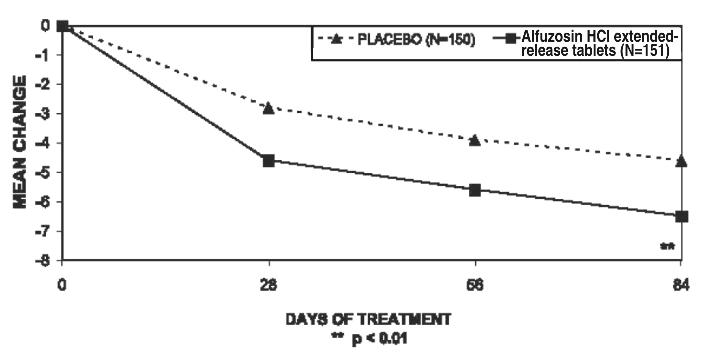
Figure 4 (Alfuzosintablets M Figure 07)
Figure 4 — Mean Change from Baseline in IPSS Total Symptom Score: Trial 3
Peak urinary flow rate was increased statistically significantly from baseline to last assessment (Week 12) versus placebo in trials 1 and 2 (Table 5 and Figures 5, 6, and 7).
ªDifference between baseline and week 12. | ||||||
| Trial 1 | Trial 2 | Trial 3 | ||||
| Placebo (n=167) | Alfuzosin HCl Extended-Release Tablets 10 mg (n=170) | Placebo (n=147) | Alfuzosin HCl Extended-Release Tablets 10 mg (n=136) | Placebo (n=150) | Alfuzosin HCl Extended-Release Tablets 10 mg (n=151) | |
| Mean Peak flow rate | ||||||
| Baseline | 10.2 (4.0) | 9.9 (3.9) | 9.2 (2.0) | 9.4 (1.9) | 9.3 (2.6) | 9.5 (3.0) |
| Changea | 0.2 (3.5) | 1.7 (4.2) | 1.4 (3.2) | 2.3 (3.6) | 0.9 (3.0) | 1.5 (3.3) |
| p-value | 0.0004 | 0.03 | 0.22 | |||

Figure 5 (Alfuzosintablets M Figure 08)
Figure 5 — Mean Change from Baseline in Peak Urine Flow Rate (mL/s): Trial 1

Figure 6 (Alfuzosintablets M Figure 09)
Figure 6 — Mean Change from Baseline in Peak Urine Flow Rate (mL/s): Trial 2

Figure 7 (Alfuzosintablets M Figure 10)
Figure 7 — Mean Change from Baseline in Peak Urine Flow Rate (mL/s): Trial 3
Mean total IPSS decreased at the first scheduled observation at Day 28 and mean peak flow rate increased starting at the first scheduled observation at Day 14 in trials 2 and 3 and Day 28 in trial 1.
Alfuzosin HCl extended-release tablets are supplied as follows:
| Package | NDC Number |
| Bottles of 30 | 64679-738-01 |
| Bottles of 100 | 64679-738-02 |
| Bottles of 500 | 64679-738-03 |
| Unit Dose (blister packs containing 10 cards of 10 tablets each) | 64679-738-05 |
Alfuzosin HCl extended-release tablets 10 mg are available as white and yellow colored bi-layered circular shaped standard convex tablets, debossed with ‘W738’ on yellow layer.
Store at 20°-25°C (68°-77°F), [See USP Controlled Room Temperature].
Protect from light and moisture.
Keep alfuzosin HCl extended-release tablets out of reach of children.
Manufactured by:
Wockhardt Limited,
Mumbai, India
Distributed by:
Wockhardt USA LLC.
20 Waterview Blvd.
Parsippany, NJ 07054
USA
Iss.190112
PATIENT INFORMATION
Alfuzosin Hydrochloride Extended-Release Tablets
Read the Patient Information that comes with alfuzosin HCl extended-release tablets before you start using it and each time you get a refill. There may be new information. This leaflet does not take the place of talking with your doctor about your condition or your treatment. You and your doctor should talk about all your medicines, including alfuzosin HCl extended-release tablets, now and at your regular checkups.
What is the most important information I should know about alfuzosin HCl extended-release tablets?
Alfuzosin HCl extended-release tablets can cause serious side effects, including a sudden drop in blood pressure, especially when you start treatment. This may cause you to faint, or to feel dizzy or lightheaded.
Ask your doctor if you are not sure if you are taking one of these medicines.
See the section "What are the possible side effects of alfuzosin HCl extended-release tablets?" for more information about side effects.
What is alfuzosin HCl extended-release tablets?
Alfuzosin HCl extended-release tablets are a prescription medicine that is called an "alpha-blocker". Alfuzosin HCl extended-release tablets are used in adult men to treat the symptoms of benign prostatic hyperplasia (BPH). Alfuzosin HCl extended-release tablets may help to relax the muscles in the prostate and the bladder which may lessen the symptoms of BPH and improve urine flow.
Before prescribing alfuzosin HCl extended-release tablets, your doctor may examine your prostate gland and do a blood test called a prostate specific antigen (PSA) test to check for prostate cancer. Prostate cancer and BPH can cause the same symptoms. Prostate cancer needs a different treatment.
Alfuzosin HCl extended-release tablets are not for use in women or children.
Some medicines called "alpha-blockers" are used to treat high blood pressure. Alfuzosin HCl extended-release tablets are not for the treatment of high blood pressure.
Who should not take alfuzosin HCl extended-release tablets?
Do not take alfuzosin HCl extended-release tablets if you:
Before taking alfuzosin HCl extended-release tablets, tell your doctor if you:
Tell your doctor about all the medicines you take, including prescription and non-prescription medicines, vitamins and herbal supplements. Some of your other medicines may affect the way alfuzosin HCl extended-release tablets works and cause serious side effects. See "What is the most important information I should know about alfuzosin HCl extended-release tablets?"
Especially tell your doctor if you take:
Ask your doctor or pharmacist if you are not sure if your medicine is one of those listed above.
What you need to know while taking alfuzosin HCl extended-release tablets
How do I take alfuzosin HCl extended-release tablets?
What are the possible side effects of alfuzosin HCl extended-release tablets?
Alfuzosin HCl extended-release tablets can cause serious side effects, including:
The most common side effects with alfuzosin HCl extended-release tablets are:
Call your doctor if you get any side effect that bothers you.
These are not all the side effects of alfuzosin HCl extended-release tablets. For more information ask your doctor or pharmacist.
Call your doctor for medical advice about side effects. You may report side effects to FDA at 1-800-FDA-1088.
How do I store alfuzosin HCl extended-release tablets?
Keep alfuzosin HCl extended-release tablets and all medicines out of the reach of children.
General information about alfuzosin HCl extended-release tablets:
Medicines are sometimes prescribed for conditions that are not mentioned in patient information leaflets. Do not use alfuzosin HCl extended-release tablets for a condition for which it was not prescribed. Do not give alfuzosin HCl extended-release tablets to other people, even if they have the same symptoms you have. It may harm them.
This leaflet summarizes the most important information about alfuzosin HCl extended-release tablets. If you would like more information, talk with your doctor. You can ask your doctor or pharmacist for information about alfuzosin HCl extended-release tablets that is written for health professionals.
You may also call at 1-800-346-6854.
What are the ingredients of alfuzosin HCl extended-release tablets?
Active Ingredient: alfuzosin hydrochloride, USP
Inactive Ingredients: colloidal silicon dioxide, hydroxy propyl cellulose, hypromellose, lactose monohydrate, magnesium stearate, microcrystalline cellulose, povidone, talc, and yellow ferric oxide.
Manufactured by:
Wockhardt Limited,
Mumbai, India
Distributed by:
Wockhardt USA LLC.
20 Waterview Blvd.
Parsippany, NJ 07054
USA
Iss.190112