Two identically designed, double-blind, randomized, placebo-controlled, parallel group, 24-week clinical studies (Study 1 and Study 2) at a total of 69 cystic fibrosis centers in the United States were conducted in cystic fibrosis patients with
P. aeruginosa. Subjects who were less than 6 years of age, had a baseline creatinine of >2 mg/dL, or had
Burkholderia cepacia isolated from sputum were excluded.
All subjects had baseline FEV
1 % predicted between 25% and 75%. In these clinical studies, 258 patients received tobramycin inhalation solution therapy on an outpatient basis (see Table 2) using a hand-held PARI LC PLUS* Reusable Nebulizer with a DeVilbiss* Pulmo-Aide* compressor.
Table 2: Dosing Regimens in Clinical Studies | Cycle 1 | Cycle 2 | Cycle 3 |
28 days | 28 days | 28 days | 28 days | 28 days | 28 days |
Tobramycin Inhalation Solution regimen n=258 | Tobramycin Inhalation Solution 300 mg twice daily | No drug | Tobramycin Inhalation Solution 300 mg twice daily | No drug | Tobramycin Inhalation Solution 300 mg twice daily | No drug |
Placebo regimen n=262 | placebo twice daily | No drug | placebo twice daily | No drug | placebo twice daily | No drug |
All patients received either tobramycin inhalation solution or placebo (saline with 1.25 mg quinine for flavoring) in addition to standard treatment recommended for cystic fibrosis patients, which included oral and parenteral antipseudomonal therapy, β2-agonists, cromolyn, inhaled steroids, and airway clearance techniques. In addition, approximately 77% of patients were concurrently treated with dornase alfa (PULMOZYME, Genentech).
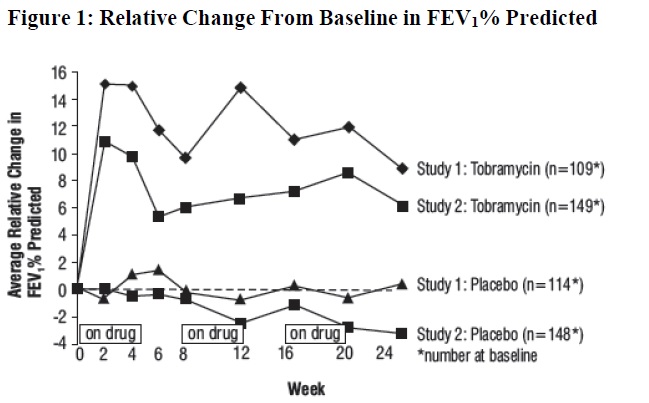
In each study, tobramycin inhalation solution-treated patients experienced significant improvement in pulmonary function. Improvement was demonstrated in the tobramycin inhalation solution group in Study 1 by an average increase in FEV
1 % predicted of about 11% relative to baseline (Week 0) during 24 weeks compared to no average change in placebo patients. In Study 2, tobramycin inhalation solution-treated patients had an average increase of about 7% compared to an average decrease of about 1% in placebo patients. Figure 1 shows the average relative change in FEV
1 % predicted over 24 weeks for both studies.

Figure 1: Relative Change From Baseline In Fev1 % Predicted (Spl Tobramycin Figure)
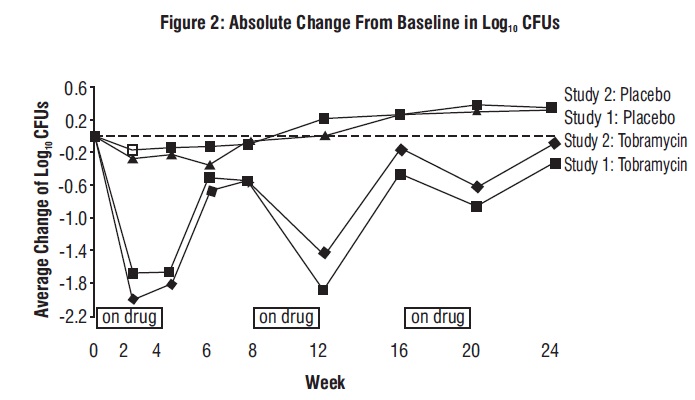
In each study, tobramycin inhalation solution therapy resulted in a significant reduction in the number of
P. aeruginosa colony forming units (CFUs) in sputum during the on-drug periods. Sputum bacterial density returned to baseline during the off-drug periods. Reductions in sputum bacterial density were smaller in each successive cycle (see Figure 2).
Figure 2: Absolute Change From Baseline In Log10 Cfus (Figure 2)
Patients treated with tobramycin inhalation solution were hospitalized for an average of 5.1 days compared to 8.1 days for placebo patients. Patients treated with tobramycin inhalation solution required an average of 9.6 days of parenteral antipseudomonal, antibacterial treatment compared to 14.1 days for placebo patients. During the 6 months of treatment, 40% of tobramycin inhalation solution patients and 53% of placebo patients were treated with parenteral antipseudomonal antibacterials.
The relationship between
in vitro susceptibility test results and clinical outcome with tobramycin inhalation solution therapy is not clear. However, four tobramycin inhalation solution patients who began the clinical trial with
P. aeruginosa isolates having MIC values ≥128 mcg/mL did not experience an improvement in FEV
1 or a decrease in sputum bacterial density.
Treatment with tobramycin inhalation solution did not affect the susceptibility of the majority of
P. aeruginosa isolates during the 6-month studies. However, some
P. aeruginosa isolates did exhibit increased tobramycin MICs. The percentage of patients with
P. aeruginosa isolates with tobramycin MICs ≥16 mcg/mL was 13% at the beginning, and 23% at the end of 6 months of the tobramycin inhalation solution regimen.