Commonly Observed (based on first year and second year data)
Gastrointestinal (GI) symptoms were the most commonly observed treatment-emergent adverse events associated with the use of ORLISTAT in the seven double-blind, placebo-controlled clinical trials and are primarily a manifestation of the mechanism of action. (Commonly observed is defined as an incidence of ≥5% and an incidence in the ORLISTAT 120 mg group that is at least twice that of placebo.)
Table 2 Commonly Observed Adverse Events| Adverse Event | Year 1 | Year 2 |
|---|
| Orlistat Treatment designates ORLISTAT three times a day plus diet or placebo plus diet % Patients
(N=1913) | Placebo % Patients
(N=1466) | Orlistat % Patients
(N=613) | Placebo % Patients
(N=524) |
|---|
| Oily Spotting Oily discharge may be clear or have a coloration such as orange or brown. | 26.6 | 1.3 | 4.4 | 0.2 |
| Flatus with Discharge | 23.9 | 1.4 | 2.1 | 0.2 |
| Fecal Urgency | 22.1 | 6.7 | 2.8 | 1.7 |
| Fatty/Oily Stool | 20.0 | 2.9 | 5.5 | 0.6 |
| Oily Evacuation | 11.9 | 0.8 | 2.3 | 0.2 |
| Increased Defecation | 10.8 | 4.1 | 2.6 | 0.8 |
| Fecal Incontinence | 7.7 | 0.9 | 1.8 | 0.2 |
In general, the first occurrence of these events was within 3 months of starting therapy. Overall, approximately 50% of all episodes of GI adverse events associated with ORLISTAT treatment lasted for less than 1 week, and a majority lasted for no more than 4 weeks. However, GI adverse events may occur in some individuals over a period of 6 months or longer.
Discontinuation of Treatment
In controlled clinical trials, 8.8% of patients treated with ORLISTAT discontinued treatment due to adverse events, compared with 5.0% of placebo-treated patients. For ORLISTAT, the most common adverse events resulting in discontinuation of treatment were gastrointestinal.
Other Adverse Clinical Events
The following table lists other treatment-emergent adverse events from seven multicenter, double-blind, placebo-controlled clinical trials that occurred at a frequency of ≥2% among patients treated with ORLISTAT 120 mg three times a day and with an incidence that was greater than placebo during year 1 and year 2, regardless of relationship to study medication.
Table 3 Other Treatment-Emergent Adverse Events From Seven Placebo-Controlled Clinical Trials| Body System/Adverse Event | Year 1 | Year 2 |
|---|
| Orlistat Treatment designates ORLISTAT 120 mg three times a day plus diet or placebo plus diet % Patients
(N=1913) | Placebo % Patients
(N=1466) | Orlistat % Patients
(N=613) | Placebo % Patients
(N=524) |
|---|
| – None reported at a frequency ≥2% and greater than placebo |
| Gastrointestinal System | | | | |
| Abdominal Pain/Discomfort | 25.5 | 21.4 | – | – |
| Nausea | 8.1 | 7.3 | 3.6 | 2.7 |
| Infectious Diarrhea | 5.3 | 4.4 | – | – |
| Rectal Pain/Discomfort | 5.2 | 4.0 | 3.3 | 1.9 |
| Tooth Disorder | 4.3 | 3.1 | 2.9 | 2.3 |
| Gingival Disorder | 4.1 | 2.9 | 2.0 | 1.5 |
| Vomiting | 3.8 | 3.5 | – | – |
| Respiratory System | | | | |
| Influenza | 39.7 | 36.2 | – | – |
| Upper Respiratory Infection | 38.1 | 32.8 | 26.1 | 25.8 |
| Lower Respiratory Infection | 7.8 | 6.6 | – | – |
| Ear, Nose & Throat Symptoms | 2.0 | 1.6 | – | – |
| Musculoskeletal System | | | | |
| Back Pain | 13.9 | 12.1 | – | – |
| Pain Lower Extremities | – | – | 10.8 | 10.3 |
| Arthritis | 5.4 | 4.8 | – | – |
| Myalgia | 4.2 | 3.3 | – | – |
| Joint Disorder | 2.3 | 2.2 | – | – |
| Tendonitis | – | – | 2.0 | 1.9 |
| Central Nervous System | | | | |
| Headache | 30.6 | 27.6 | – | – |
| Dizziness | 5.2 | 5.0 | – | – |
| Body as a Whole | | | | |
| Fatigue | 7.2 | 6.4 | 3.1 | 1.7 |
| Sleep Disorder | 3.9 | 3.3 | – | – |
| Skin & Appendages | | | | |
| Rash | 4.3 | 4.0 | – | – |
| Dry Skin | 2.1 | 1.4 | – | – |
| Reproductive, Female | | | | |
| Menstrual Irregularity | 9.8 | 7.5 | – | – |
| Vaginitis | 3.8 | 3.6 | 2.6 | 1.9 |
| Urinary System | | | | |
| Urinary Tract Infection | 7.5 | 7.3 | 5.9 | 4.8 |
| Psychiatric Disorder | | | | |
| Psychiatric Anxiety | 4.7 | 2.9 | 2.8 | 2.1 |
| Depression | – | – | 3.4 | 2.5 |
| Hearing & Vestibular Disorders | | | | |
| Otitis | 4.3 | 3.4 | 2.9 | 2.5 |
| Cardiovascular Disorders | | | | |
| Pedal Edema | – | – | 2.8 | 1.9 |
Table 4 illustrates the percentage of adult patients on ORLISTAT and placebo who developed a low vitamin level on two or more consecutive visits during 1 and 2 years of therapy in studies in which patients were not previously receiving vitamin supplementation.
Table 4 Incidence of Low Vitamin Values on Two or More Consecutive Visits (Nonsupplemented Adult Patients With Normal Baseline Values - First and Second Year) | Placebo Treatment designates placebo plus diet or ORLISTAT plus diet | Orlistat |
|---|
| Vitamin A | 1.0% | 2.2% |
| Vitamin D | 6.6% | 12.0% |
| Vitamin E | 1.0% | 5.8% |
| Beta-carotene | 1.7% | 6.1% |
Table 5 illustrates the percentage of adolescent patients on ORLISTAT and placebo who developed a low vitamin level on two or more consecutive visits during the 1-year study.
Table 5 Incidence of Low Vitamin Values on Two or More Consecutive Visits (Pediatric Patients With Normal Baseline Values All patients were treated with vitamin supplementation throughout the course of the study
) | Placebo Treatment designates placebo plus diet or ORLISTAT plus diet | Orlistat |
|---|
| Vitamin A | 0.0% | 0.0% |
| Vitamin D | 0.7% | 1.4% |
| Vitamin E | 0.0% | 0.0% |
| Beta-carotene | 0.8% | 1.5% |
In the 4-year XENDOS study, the general pattern of adverse events was similar to that reported for the 1- and 2-year studies with the total incidence of gastrointestinal-related adverse events occurring in year 1 decreasing each year over the 4-year period.
In clinical trials in obese diabetic patients, hypoglycemia and abdominal distension were also observed.
Pediatric Patients
In clinical trials with ORLISTAT in adolescent patients ages 12 to 16 years, the profile of adverse reactions was generally similar to that observed in adults.
Animal Data
Reproduction studies were conducted in rats and rabbits at doses up to 800 mg/kg/day. Neither study showed embryotoxicity or teratogenicity. This dose is 23 and 47 times the daily human dose calculated on a body surface area (mg/m 2) basis for rats and rabbits, respectively.
Dose-response Relationship
The dose-response relationship for orlistat in human volunteers is shown in Figure 1. The effect is the percentage of ingested fat excreted, referred to as fecal fat excretion percentage. Both individual data (open circles) and the curve predicted for the population with the maximum-effect model (continuous line) are shown in Figure 1.
Figure 1 Dose-Response Relationship for Orlistat in Human Volunteers
At the recommended therapeutic dose of 120 mg three times a day, orlistat inhibits dietary fat absorption by approximately 30%.
Ethanol does not affect orlistat's effect on preventing the absorption of fat.
Other Short-term Studies
Adults
In several studies of up to 6-weeks duration, the effects of therapeutic doses of ORLISTAT on gastrointestinal and systemic physiological processes were assessed in normal weight and obese subjects. Postprandial cholecystokinin plasma concentrations were lowered after multiple doses of ORLISTAT in two studies but not significantly different from placebo in two other experiments. There were no clinically significant changes observed in gallbladder motility, bile composition or lithogenicity, or colonic cell proliferation rate, and no clinically significant reduction of gastric emptying time or gastric acidity. In addition, no effects on plasma triglyceride levels or systemic lipases were observed with the administration of ORLISTAT in these studies. In a 3-week study of 28 healthy male volunteers, ORLISTAT (120 mg three times a day) did not significantly affect the balance of calcium, magnesium, phosphorus, zinc, copper, and iron.
Pediatrics
In a 3-week study of 32 obese adolescents aged 12 to 16 years, ORLISTAT (120 mg three times a day) did not significantly affect the balance of calcium, magnesium, phosphorus, zinc, or copper. The iron balance was decreased by 64.7 µmole/24 hours and 40.4 µmole/24 hours in ORLISTAT and placebo treatment groups, respectively.
Absorption
Systemic exposure to orlistat is minimal. Following oral dosing with 360 mg 14C-orlistat, plasma radioactivity peaked at approximately 8 hours; plasma concentrations of intact orlistat were near the limits of detection (<5 ng/mL). In therapeutic studies involving monitoring of plasma samples, detection of intact orlistat in plasma was sporadic and concentrations were low (<10 ng/mL or 0.02 µM), without evidence of accumulation, and consistent with minimal absorption.
Distribution
In vitro orlistat was >99% bound to plasma proteins (lipoproteins and albumin were major binding proteins). Orlistat minimally partitioned into erythrocytes.
Metabolism
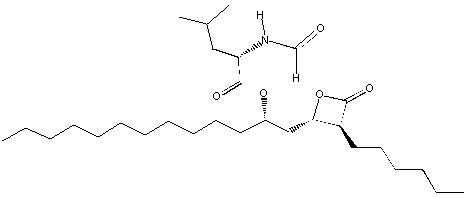
Based on an oral 14C-orlistat mass balance study in obese patients, two metabolites, M1 ((the hydrolyzed β-lactone ring product of orlistat) and M3 (sequential metabolite after M1's cleavage of the N-formyl leucine side-chain), accounted for approximately 42% of total radioactivity in plasma. M1 and M3 have an open β-lactone ring and extremely weak lipase inhibitory activity (1000- and 2500-fold less than orlistat, respectively). In view of this low inhibitory activity and the low plasma levels at the therapeutic dose (average of 26 ng/mL and 108 ng/mL for M1 and M3, respectively, 2 to 4 hours after a dose), these metabolites are considered pharmacologically inconsequential. The primary metabolite M1 had a short half-life (approximately 3 hours) whereas the secondary metabolite M3 eliminated at a slower rate (half-life approximately 13.5 hours).
Elimination
Following a single oral dose of 360 mg 14C-orlistat in both normal weight and obese subjects, fecal excretion of the unabsorbed drug was found to be the major route of elimination. Orlistat and its M1 and M3 metabolites were also subject to biliary excretion. Approximately 97% of the administered radioactivity was excreted in feces; 83% of that was found to be unchanged orlistat. The cumulative renal excretion of total radioactivity was <2% of the given dose of 360 mg 14C-orlistat. The time to reach complete excretion (fecal plus urinary) was 3 to 5 days. The disposition of orlistat appeared to be similar between normal weight and obese subjects. Based on limited data, the half-life of the absorbed orlistat is in the range of 1 to 2 hours.
Specific Populations
No pharmacokinetic study was conducted for specific populations such as geriatric, different races, and patients with renal and hepatic impairment.
Drug Interactions
Alcohol
In a multiple-dose study in 30 normal-weight subjects, coadministration of ORLISTAT and 40 grams of alcohol (e.g., approximately 3 glasses of wine) did not result in alteration of alcohol pharmacokinetics, orlistat pharmacodynamics (fecal fat excretion), or systemic exposure to orlistat.
Amiodarone
In a pharmacokinetic study conducted in healthy volunteers who received 120 mg orlistat three times daily for 13 days and a single dose of 120 mg orlistat on the morning of Day 14 co-administered with a single dose of 1200 mg amiodarone on Day 4, a 23 – 27% reduction in the systemic exposure to amiodarone and desethylamiodarone was observed [see Drug Interactions (7.5)] . The effect of commencing orlistat treatment in patients on stable amiodarone therapy has not been studied.
Cyclosporine
In a multiple-dose study, coadministration of 50 mg cyclosporine twice daily with 120 mg ORLISTAT three times daily decreased cyclosporine AUC and C max by 31% and 25%, respectively. In the same study, administration of 50 mg cyclosporine twice daily three hours after the administration of 120 mg ORLISTAT three times daily decreased cyclosporine AUC and C max by 17% and 4%, respectively.
Digoxin
In 12 normal-weight subjects receiving ORLISTAT 120 mg three times a day for 6 days, ORLISTAT did not alter the pharmacokinetics of a single dose of digoxin.
Fat-soluble Vitamin Supplements and Analogues
A pharmacokinetic interaction study showed a 30% reduction in beta-carotene supplement absorption when concomitantly administered with ORLISTAT. ORLISTAT inhibited absorption of a vitamin E acetate supplement by approximately 60%. The effect of ORLISTAT on the absorption of supplemental vitamin D, vitamin A, and nutritionally-derived vitamin K is not known at this time.
Glyburide
In 12 normal-weight subjects receiving orlistat 80 mg three times a day for 5 days, orlistat did not alter the pharmacokinetics or pharmacodynamics (blood glucose-lowering) of glyburide.
Nifedipine (extended-release tablets)
In 17 normal-weight subjects receiving ORLISTAT 120 mg three times a day for 6 days, ORLISTAT did not alter the bioavailability of nifedipine (extended-release tablets).
Oral Contraceptives
In 20 normal-weight female subjects, the treatment of ORLISTAT 120 mg three times a day for 23 days resulted in no changes in the ovulation-suppressing action of oral contraceptives.
Phenytoin
In 12 normal-weight subjects receiving ORLISTAT 120 mg three times a day for 7 days, ORLISTAT did not alter the pharmacokinetics of a single 300-mg dose of phenytoin.
Pravastatin
In a 2-way crossover study of 24 normal-weight, mildly hypercholesterolemic patients receiving ORLISTAT 120 mg three times a day for 6 days, ORLISTAT did not affect the pharmacokinetics of pravastatin.
Warfarin
In 12 normal-weight subjects, administration of ORLISTAT 120 mg three times a day for 16 days did not result in any change in either warfarin pharmacokinetics (both R- and S-enantiomers) or pharmacodynamics (prothrombin time and serum Factor VII). Although undercarboxylated osteocalcin, a marker of vitamin K nutritional status, was unaltered with ORLISTAT administration, vitamin K levels tended to decline in subjects taking ORLISTAT. Therefore, as vitamin K absorption may be decreased with ORLISTAT, patients on chronic stable doses of warfarin who are prescribed ORLISTAT should be monitored closely for changes in coagulation parameters.
Population as a Whole
The changes in metabolic, cardiovascular and anthropometric risk factors associated with obesity based on pooled data for five clinical studies, regardless of the patient's risk factor status at randomization, are presented in Table 7. One year of therapy with ORLISTAT resulted in relative improvement in several risk factors.
Table 7 Mean Change in Risk Factors From Randomization Following 1-Year Treatment Treatment designates ORLISTAT 120 mg three times a day plus diet or placebo plus diet
Population as a Whole | Risk Factor | Orlistat 120 mg Intent-to-treat population at week 52, observed data based on pooled data from 5 studies | Placebo |
|---|
| Metabolic: | | |
| Total Cholesterol | -2.0% | +5.0% |
| LDL-Cholesterol | -4.0% | +5.0% |
| HDL-Cholesterol | +9.3% | +12.8% |
| LDL/HDL | -0.37 | -0.20 |
| Triglycerides | +1.34% | +2.9% |
| Fasting Glucose, mmol/L | -0.04 | +0.0 |
| Fasting Insulin, pmol/L | -6.7 | +5.2 |
| Cardiovascular: | | |
| Systolic Blood Pressure, mm Hg | -1.01 | +0.58 |
| Diastolic Blood Pressure, mm Hg | -1.19 | +0.46 |
| Anthropometric: | | |
| Waist Circumference, cm | -6.45 | -4.04 |
| Hip Circumference, cm | -5.31 | -2.96 |
Population With Abnormal Risk Factors at Randomization
The changes from randomization following 1-year treatment in the population with abnormal lipid levels (LDL ≥130 mg/dL, LDL/HDL ≥3.5, HDL <35 mg/dL) were greater for ORLISTAT compared to placebo with respect to LDL-cholesterol (-7.83% vs +1.14%) and the LDL/HDL ratio (-0.64 vs -0.46). HDL increased in the placebo group by 20.1% and in the ORLISTAT group by 18.8%. In the population with abnormal blood pressure at baseline (systolic BP ≥140 mm Hg), the change in SBP from randomization to 1 year was greater for ORLISTAT (-10.89 mm Hg) than placebo (-5.07 mm Hg). For patients with a diastolic blood pressure ≥90 mm Hg, ORLISTAT patients decreased by -7.9 mm Hg while the placebo patients decreased by -5.5 mm Hg. Fasting insulin decreased more for ORLISTAT than placebo (-39 vs -16 pmol/L) from randomization to 1 year in the population with abnormal baseline values (≥120 pmol/L). A greater reduction in waist circumference for ORLISTAT vs placebo (-7.29 vs -4.53 cm) was observed in the population with abnormal baseline values (≥100 cm).
Population as a Whole
The relative differences in risk factors between treatment with ORLISTAT and placebo were similar to the results following 1 year of therapy for total cholesterol, LDL-cholesterol, LDL/HDL ratio, triglycerides, fasting glucose, fasting insulin, diastolic blood pressure, waist circumference, and hip circumference. The relative differences between treatment groups for HDL cholesterol and systolic blood pressure were less than that observed in the year one results.
Population With Abnormal Risk Factors at Randomization
The relative differences in risk factors between treatment with ORLISTAT and placebo were similar to the results following 1 year of therapy for LDL- and HDL-cholesterol, triglycerides, fasting insulin, diastolic blood pressure, and waist circumference. The relative differences between treatment groups for LDL/HDL ratio and isolated systolic blood pressure were less than that observed in the year one results.
Onset of Type 2 Diabetes in Obese Patients
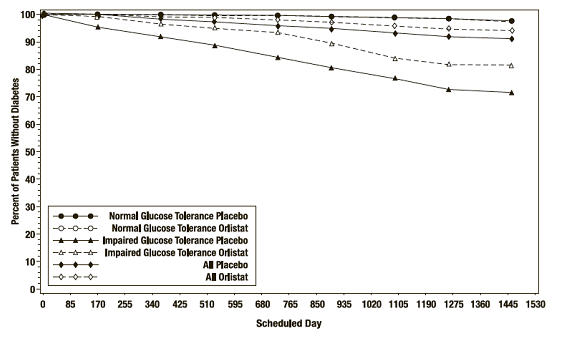
In the XENDOS trial, in the overall population, ORLISTAT delayed the onset of type 2 diabetes such that at the end of four years of treatment the cumulative incidence rate of diabetes was 8.3% for the placebo group compared to 5.5% for the ORLISTAT group, p=0.01 (see Table 10). This finding was driven by a statistically-significant reduction in the incidence of developing type 2 diabetes in those patients who had impaired glucose tolerance at baseline ( Table 10 and Figure 3). ORLISTAT did not reduce the risk for the development of diabetes in patients with normal glucose tolerance at baseline.
The effect of ORLISTAT to delay the onset of type 2 diabetes in obese patients with IGT is presumably due to weight loss, and not to any independent effects of the drug on glucose or insulin metabolism. The effect of ORLISTAT on weight loss is adjunctive to diet and exercise.
Table 10 Incidence Rate of Diabetes at Year 4 by OGTT Status at Baseline Based on patients with a baseline and at least one follow-up OGTT measurement, ITT LOCF study population.
| OGTT at Baseline | Normal | Impaired | All |
|---|
| Treatment | Placebo | Orlistat | Placebo | Orlistat | Placebo | Orlistat |
|---|
| Number of patients | 1148 | 1235 | 324 | 337 | 1472 | 1572 |
| # pts developing diabetes | 16 | 21 | 62 | 48 | 78 | 69 |
| Life table rate Rate adjusted for dropouts | 2.1% | 1.7% | 27.2% | 18.7% | 8.3% | 5.5% |
| Observed percent | 1.4% | 1.7% | 19.1% | 14.2% | 5.3% | 4.4% |
| Absolute risk reduction | | | |
| Life table | 0.4% | 8.5% | 2.8% |
| Observed | -0.3% | 4.9% | 0.9% |
| Relative risk reduction Computed as (1- hazard ratio) | 8% | 42% | 34% |
| p-value | 0.79 | <0.01 | 0.01 |
Figure 3 Percentage of Patients Without Diabetes Over Time
Information for Patients
Patients should not take ORLISTAT if they are pregnant, have chronic malabsorption syndrome, cholestasis or hypersensitivity to ORLISTAT or to any component of this product [see Contraindications (4)] .
Concomitant Medications
Patients should be asked if they are taking cyclosporine, beta carotene or vitamin E supplements, levothyroxine, warfarin, antiepileptic drugs, amiodarone, or antiretroviral drugs due to potential interactions [see Drug Interactions (7)] .
Commonly Observed Adverse Events
Patients should be informed of the commonly-observed adverse events associated with the use of ORLISTAT which include oily spotting, flatus with discharge, fecal urgency, fatty/oily stool, oily evacuation, increased defecation, fecal incontinence [see Adverse Reactions (6.1)] .
Potential Risks and Benefits
Patients should be informed of potential risks which include lowered absorption of fat-soluble vitamins and potential liver injury, increases in urinary oxalate, and cholelithiasis [see Warnings and Precautions (5)] . Treatment with ORLISTAT may result in weight loss and improvement in obesity-related risk factors due to weight loss [see Clinical Studies (14)] .
Dosing Instructions
Patients should be counseled to take ORLISTAT as directed with meals or up to one hour after a meal. Patients should also be advised to take multivitamin supplementation at least two hours before or after the administration of ORLISTAT, or at bedtime [see Dosage and Administration (2)] .
Licensed by:
CHEPLAPHARM Arzneimittel GmbH
Ziegelhof 24
17489 Greifswald, Germany
Distributed by:
H2-Pharma, LLC
611 Industrial Park Boulevard
Montgomery, AL 36117, USA
Representative sample of labeling (see the HOW SUPPLIED section for complete listing):