- The safety and effectiveness of EVKEEZA have not been established in patients with other causes of hypercholesterolemia, including those with heterozygous familial hypercholesterolemia (HeFH).
- The effects of EVKEEZA on cardiovascular morbidity and mortality have not been determined.
Serious Hypersensitivity Reactions
Anaphylaxis was reported in 1 (1%) patient treated with EVKEEZA and 0% in patients who received placebo.
Infusion Reactions
Infusion reactions were reported in 6 (7%) patients treated with EVKEEZA and in 2 (4%) patients who received placebo. The following infusion reactions occurred in EVKEEZA-treated patients: infusion site pruritus, pyrexia, muscular weakness, nausea, and nasal congestion.
Risk Summary
Based on data from animal reproduction studies, EVKEEZA may cause fetal harm when administered to pregnant patients. Available human data are insufficient to evaluate for a drug-associated risk of major birth defects, miscarriage or adverse maternal or fetal outcomes. Evinacumab-dgnb is a human IgG4 monoclonal antibody [see Description (11)], and human IgG is known to cross the placental barrier; therefore, evinacumab-dgnb has the potential to be transmitted from the mother to the developing fetus.
Subcutaneous administration of evinacumab-dgnb to pregnant rabbits during the period of organogenesis resulted in fetal malformations (domed head, hydrocephalus, and flexed limbs) at doses below the maximum recommended human dose (MRHD). No adverse embryofetal effects were observed with subcutaneous administration of evinacumab-dgnb to pregnant rats during the period of organogenesis at doses below the MRHD. Measurable evinacumab-dgnb serum concentrations were observed in fetal rabbit and rat sera at birth, indicating that evinacumab-dgnb, like other IgG antibodies, crosses the placental barrier (see Data). Advise pregnant women of the potential risk to a fetus.
The estimated background risk of major birth defects and miscarriage for the indicated population are unknown. In the U.S. general population, the estimated background risk of major birth defects and miscarriage in clinically recognized pregnancies is 2-4% and 15-20%, respectively.
If a patient becomes pregnant while receiving EVKEEZA, healthcare providers should report EVKEEZA exposure by calling 1-833-385-3392.
Data
Animal Data
In an embryo-fetal development study in pregnant rabbits, evinacumab-dgnb was administered subcutaneously at doses of 1, 5, 10 and 30 mg/kg every 3 days (Q3D) during the period of organogenesis from gestation day 7 to day 19. Evinacumab-dgnb was teratogenic in rabbits, causing domed head, dilation of the lateral and third ventricles of the brain, and flexed fore/hind paws at maternal evinacumab-dgnb exposures below human exposure at the MRHD of 15 mg/kg every 4 weeks, based on AUC. Other fetal malformations, consisting of irregular and abnormal ossification in the skull, palate, and metacarpal, and enlarged anterior and/or posterior fontanelles occurred and were consistent with significant maternal toxicity (including early deaths due to abortion and premature delivery at all doses, reduction in maternal body weight gains, and reduced maternal food consumption). Increased incidences of post-implantation losses, resorptions (total, early, and late), and decreased fetal body weight were also consistent with maternal toxicity. Evinacumab-dgnb was present in the sera of fetuses born from mothers at 10 and 30 mg/kg/Q3D at levels higher than in maternal serum.
In an embryo-fetal development study in pregnant rats, evinacumab-dgnb was administered subcutaneously at doses of 5, 10, 30 and 100 mg/kg/Q3D during the period of organogenesis from gestation day 6 to day 18. Maternal exposures to evinacumab-dgnb were below the human exposure measured at the MRHD. Evinacumab-dgnb resulted in unexplained maternal deaths at 100 mg/kg/Q3D. Evinacumab-dgnb crossed the placenta and was present at ratios (CFetal/CMaternal) ranging from 0.42 to 0.65. No adverse effects on embryofetal development were observed at any dose.
In a combined fertility, embryofetal, and pre- and postnatal development study, female rats were administered evinacumab-dgnb via subcutaneous injection at doses of 30 and 100 mg/kg/Q3D beginning 2 weeks prior to mating and continuing to gestation day 21 or lactation day 21. Mean maternal systemic exposures were below the human exposure at the MRHD throughout the study. No maternal or developmental toxicity was observed.
Risk Summary
There are no data on the presence of evinacumab-dgnb in human milk or animal milk, the effects on the breastfed infant, or the effects on milk production. Maternal IgG is known to be present in human milk. The effects of local gastrointestinal exposure and limited systemic exposure in the breastfed infant to evinacumab-dgnb are unknown. The developmental and health benefits of breastfeeding should be considered along with the mother's clinical need for EVKEEZA and any potential adverse effects on the breastfed infant from EVKEEZA or from the underlying maternal condition.
Pregnancy Testing
Consider pregnancy testing in patients who may become pregnant prior to starting treatment with EVKEEZA [see Warnings and Precautions (5.2) and Use in Specific Populations (8.1)].
Contraception
Females
Based on animal studies, EVKEEZA may cause fetal harm when administered to pregnant patients [see Use in Specific Populations (8.1)]. Patients who may become pregnant should use effective contraception during treatment with EVKEEZA and for at least 5 months following the last dose of EVKEEZA.
Distribution
The total volume of distribution estimated via population pharmacokinetic analysis was approximately 4.8 L.
Elimination
Evinacumab-dgnb elimination is mediated via parallel linear and non-linear pathways. At higher concentrations, evinacumab-dgnb elimination is primarily through a non-saturable proteolytic pathway, whereas at lower concentrations, the non-linear, saturable ANGPTL3 target-mediated elimination predominates. The elimination half-life is a function of serum evinacumab-dgnb concentrations and is not a constant.
Based on a population pharmacokinetic analysis, the median time for serum evinacumab-dgnb concentrations to decrease below the lower limit of quantitation (78 ng/mL) is 19 weeks after the last steady-state dose of 15 mg/kg IV every 4 weeks.
Metabolism
The exact pathway through which evinacumab-dgnb is metabolized has not been characterized. As a human monoclonal IgG4 antibody, evinacumab-dgnb is expected to be degraded into small peptides and amino acids via catabolic pathways in the same manner as endogenous IgG.
Excretion
Evinacumab-dgnb, a monoclonal antibody, is not likely to undergo renal excretion.
Specific Populations
A population PK analysis conducted on data from 183 healthy subjects and 95 patients with HoFH suggests that the following factors have no clinically significant effect on the exposure of evinacumab-dgnb: age (12 to 75 years), gender, body weight (42 to 152 kg), and race (White, Asian, Black, and Other).
Pediatric Patients
A 15-year-old patient with HoFH received evinacumab-dgnb at 15 mg/kg IV every 4 weeks. Steady-state trough and end-of-infusion concentrations were within the range observed in adult patients.
Patients with Renal Impairment
Observed trough serum evinacumab-dgnb concentrations at steady-state were comparable between patients with mild or moderate renal impairment and patients with normal renal function. No data are available in patients with severe renal impairment.
Patients with Hepatic Impairment
No data are available in patients with hepatic impairment.
Drug Interaction Studies
Drug interaction studies have not been conducted with evinacumab-dgnb. In a clinical trial, the concentrations of statins (atorvastatin, rosuvastatin, simvastatin) were not meaningfully altered in patients taking statins prior to and post administration of evinacumab-dgnb. Concentrations of evinacumab-dgnb were comparable in patients with HoFH taking or not taking background lipid-lowering therapy.
Carcinogenesis and Mutagenesis
Carcinogenicity studies have not been conducted with evinacumab-dgnb. The mutagenic potential of evinacumab-dgnb has not been evaluated; however, monoclonal antibodies are not expected to alter DNA or chromosomes.
Impairment of Fertility
There were no adverse effects on surrogate markers of fertility (estrous cyclicity, testicular volume, ejaculate volume, sperm motility, total sperm count per ejaculate, and histology of reproductive organs) in a 6-month chronic toxicology study in sexually-mature male and female monkeys subcutaneously administered 10, 30, or 100 mg/kg/week (0.2, 1, and 3-fold MRHD based on AUC, respectively) and intravenously administered 100 mg/kg/week (4-fold MRHD, based on AUC).
In a combined fertility and early embryonic and pre-and postnatal development study in female rats administered evinacumab-dgnb via subcutaneous injection at doses 30 and 100 mg/kg/Q3D beginning 2 weeks prior to mating, no adverse effect on female fertility were observed at any dose. Exposures to evinacumab-dgnb represented less than the human exposure at the MRHD, based on AUC. No effects on male fertility were observed with evinacumab-dgnb administration to male rabbits for 40 days prior to mating with treatment-naïve females. Evinacumab-dgnb was administered to male rabbits intravenously at 100 and 300 mg/kg/Q5D, representing exposures 2- and 5-times, respectively, the human exposure at the MRHD, based on AUC.
Pediatric Patients with HoFH
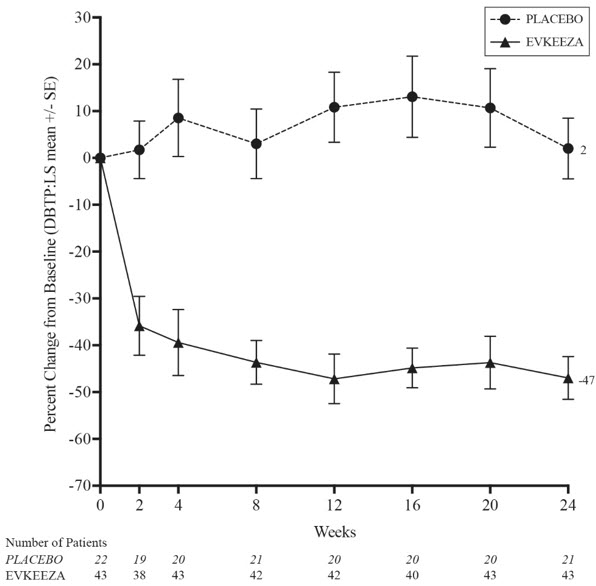
In ELIPSE-HoFH, 1 pediatric patient received 15 mg/kg IV of EVKEEZA every 4 weeks, and 1 pediatric patient received placebo, as an adjunct to other lipid-lowering therapies (e.g., statins, ezetimibe, PCSK9 inhibitor antibodies and lipoprotein apheresis). Both patients had null/null variants in the LDLR. At Week 24, the percent change in LDL-C with EVKEEZA was - 73% and with placebo was +60%.
In an open-label extension study, 13 pediatric patients with HoFH (12 to 17 years of age) received 15 mg/kg IV of EVKEEZA every 4 weeks as an adjunct to other lipid-lowering therapies (e.g., statins, ezetimibe, PCSK9 inhibitor antibodies and lipoprotein apheresis) for a median treatment duration of 33 weeks. The mean percent change from baseline in LDL-C at Week 24 was -52% in the 9 patients who completed treatment and had a lipid assessment at Week 24. Overall, the effect of evinacumab-dgnb on lipid parameters in pediatric patients with HoFH was generally similar to that seen in adults with HoFH.
Hypersensitivity Reactions
Inform patients that hypersensitivity reactions have occurred with EVKEEZA. Advise patients to contact their healthcare provider immediately if they experience signs or symptoms of a hypersensitivity reaction [see Warnings and Precautions (5.1)].
Embryofetal Toxicity
Advise pregnant patients and patients that may become pregnant of the potential risk to a fetus and to inform their healthcare provider of a known or suspected pregnancy. Advise patients who may become pregnant to use effective contraception during treatment with EVKEEZA and for 5 months after the final dose. Encourage patients who become pregnant to report their pregnancy to 1-833-385-3392 [see Warnings and Precautions (5.2) and Use in Specific Populations (8.1, 8.3)].
Manufactured by:
Regeneron Pharmaceuticals, Inc.
777 Old Saw Mill River Road
Tarrytown, NY 10591-6707
U.S. License No. 1760
EVKEEZA™ trademark is owned by Regeneron Pharmaceuticals Inc.
All rights reserved.
© 2021, Regeneron Pharmaceuticals, Inc.