Information For Patients Section
These highlights do not include all the information needed to use GABAPENTIN safely and effectively. See full prescribing information for GABAPENTIN.
GABAPENTIN capsules, for oral use
GABAPENTIN tablets, for oral use
Initial U.S. Approval: 1993
INDICATIONS AND USAGE
Gabapentin is indicated for:
Postherpetic neuralgia in adults (1)
Adjunctive therapy in the treatment of partial onset seizures, with and without secondary generalization, in adults and pediatric patients 3 years and older with epilepsy (1)
DOSAGE AND ADMINISTRATION
Postherpetic Neuralgia (2.2)
Dose can be titrated up as needed to a dose of 1,800 mg/day
Day 1: Single 300 mg dose
Day 2: 600 mg/day (i.e., 300 mg two times a day)
Day 3: 900 mg/day (i.e., 300 mg three times a day)
Epilepsy with Partial Onset Seizures (2.3)
Patients 12 years of age and older: starting dose is 300 mg three times daily; may be titrated up to 600 mg three times daily
Patients 3 to 11 years of age: starting dose range is 10 to 15 mg/kg/day, given in three divided doses; recommended dose in patients 3 to 4 years of age is 40 mg/kg/day, given in three divided doses; the recommended dose in patients 5 to 11 years of age is 25 to 35 mg/kg/day, given in three divided doses. The recommended dose is reached by upward titration over a period of approximately 3 days
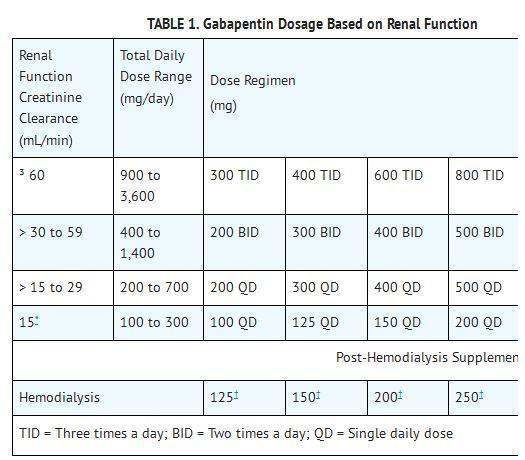
Dose should be adjusted in patients with reduced renal function (2.4, 2.5)
DOSAGE FORMS AND STRENGTHS
Capsules: 100 mg, 300 mg, and 400 mg (3)
Tablets: 600 mg, and 800 mg (3)
CONTRAINDICATIONS
Known hypersensitivity to gabapentin or its ingredients (4)
WARNINGS AND PRECAUTIONS
Drug Reaction with Eosinophilia and Systemic Symptoms (Multiorgan hypersensitivity): discontinue gabapentin if an alternative etiology cannot be established (5.1)
Driving impairment: warn patients not to drive until they have gained sufficient experience with gabapentin to assess whether it will impair their ability to drive (5.2)
Somnolence/Sedation and Dizziness: gabapentin may impair the patient’s ability to operate complex machinery (5.3)
Increased seizure frequency may occur in patients with seizure disorders if gabapentin is abruptly discontinued (5.4)
Suicidal Behavior and Ideation: monitor for suicidal thoughts and behavior (5.5)
Neuropsychiatric Adverse Reactions in Children 3 to 12 Years of Age: monitor for such events (5.6)
ADVERSE REACTIONS
Most common adverse reactions (incidence ≥8% and at least twice that for placebo) were:
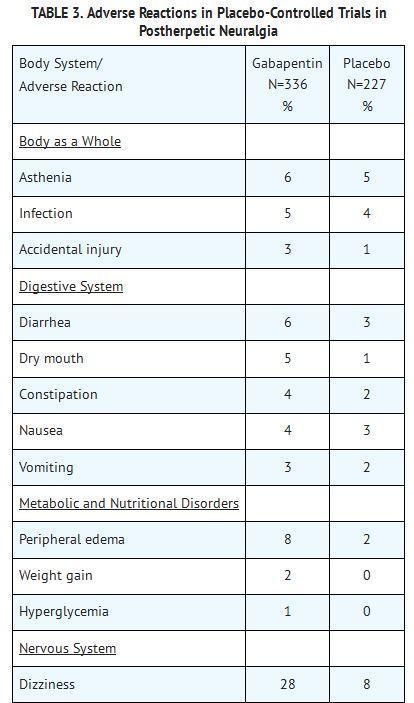
Postherpetic neuralgia: dizziness, somnolence, and peripheral edema (6.1)
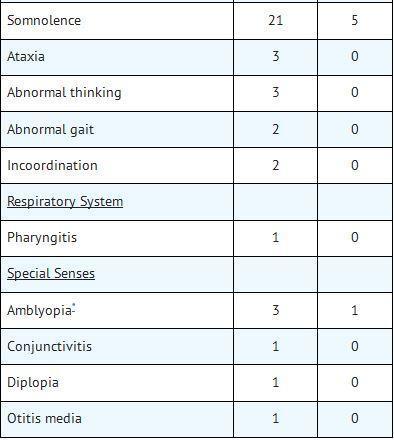
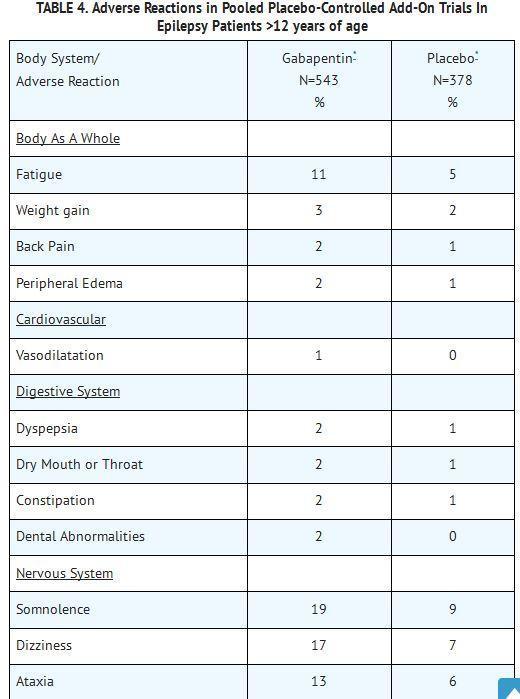
Epilepsy in patients >12 years of age: somnolence, dizziness, ataxia, fatigue, and nystagmus (6.1)
Epilepsy in patients 3 to 12 years of age: viral infection, fever, nausea and/or vomiting, somnolence, and hostility (6.1)
To report SUSPECTED ADVERSE REACTIONS, contact Sun Pharmaceutical Industries, Inc. at 1-800-818-4555 or FDA at 1-800-FDA-1088 or www.fda.gov/medwatch.
USE IN SPECIFIC POPULATIONS
Pregnancy: based on animal data, may cause fetal harm (8.1)
Pediatric Use: effectiveness as adjunctive therapy in treatment of partial seizures in pediatric patients below the age of 3 years has not been established (8.4)
See 17 for PATIENT COUNSELING INFORMATION and Medication Guide.
Revised: 6/2015
1 INDICATIONS AND USAGE
2 DOSAGE AND ADMINISTRATION
2.1 Administration Information
2.2 Dosage for Postherpetic Neuralgia
2.3 Dosage for Epilepsy with Partial Onset Seizures
2.4 Dosage Adjustment in Patients with Renal Impairment
2.5 Dosage in Elderly
3 DOSAGE FORMS AND STRENGTHS
4 CONTRAINDICATIONS
5 WARNINGS AND PRECAUTIONS
5.1 Drug Reaction with Eosinophilia and Systemic Symptoms (DRESS/Multiorgan Hypersensitivity
5.2 Effects on Driving and Operating Heavy Machinery
5.3 Somnolence/Sedation and Dizziness
5.4 Withdrawal Precipitated Seizure, Status Epilepticus
5.5 Suicidal Behavior and Ideation
5.6 Neuropsychiatric Adverse Reactions (Pediatric Patients 3 to 12 Years of Age)
5.7 Tumorigenic Potential
5.8 Sudden and Unexplained Death in Patients with Epilepsy
6 ADVERSE REACTIONS
6.1 Clinical Trials Experience
6.2 Postmarketing Experience
7 DRUG INTERACTIONS
7.1 Other Antiepileptic Drugs
7.2 Hydrocodone
7.3 Morphine
7.4 Maalox®*(aluminum hydroxide, magnesium hydroxide)
7.5 Drug/Laboratory Test Interactions
8 USE IN SPECIFIC POPULATIONS
8.1 Pregnancy
8.3 Nursing Mothers
8.4 Pediatric Use
8.5 Geriatric Use
8.6 Renal Impairment
9 DRUG ABUSE AND DEPENDENCE
9.1 Controlled Substance
9.2 Abuse
9.3 Dependence
10 OVERDOSAGE
11 DESCRIPTION
12 CLINICAL PHARMACOLOGY
12.1 Mechanism of Action
12.3 Pharmacokinetics
13 NONCLINICAL TOXICOLOGY
13.1 Carcinogenesis, Mutagenesis, Impairment of Fertility
14 CLINICAL STUDIES
14.1 Postherpetic Neuralgia
14.2 Epilepsy for Partial Onset Seizures (Adjunctive Therapy)
16 HOW SUPPLIED/STORAGE AND HANDLING
17 PATIENT COUNSELING INFORMATION
*
Sections or subsections omitted from the full prescribing information are not listed.