Combination Use with Tadalafil
The mean exposure to Letairis + tadalafil in the AMBITION study was 78.7 weeks. The adverse reactions that occurred in >5% more patients receiving Letairis + tadalafil than receiving Letairis or tadalafil monotherapy in AMBITION are shown in Table 2.
Table 2 Adverse Reactions Reported More Commonly (>5%) on Letairis + Tadalafil than on Letairis or Tadalafil Monotherapy (ITT) in AMBITION | Adverse Reactions | Letairis + Tadalafil
Combination Therapy
(N=302)
n (%) | Letairis
Monotherapy
(N=152)
n (%) | Tadalafil Monotherapy
(N=151)
n (%) |
|---|
| Peripheral edema | 135 (45%) | 58 (38%) | 43 (28%) |
| Headache | 125 (41%) | 51 (34%) | 53 (35%) |
| Nasal congestion | 58 (19%) | 25 (16%) | 17 (11%) |
| Cough | 53 (18%) | 20 (13%) | 24 (16%) |
| Anemia | 44 (15%) | 11 (7%) | 17 (11%) |
| Dyspepsia | 32 (11%) | 5 (3%) | 18 (12%) |
| Bronchitis | 31 (10%) | 6 (4%) | 13 (9%) |
Peripheral edema was more frequent on combination therapy; however, there was no notable difference observed in the incidence of peripheral edema in elderly patients (≥65 years) versus younger patients (<65 years) on combination therapy (44% vs. 45%) or Letairis monotherapy (37% vs. 39%) in AMBITION.
Treatment discontinuations due to adverse events while on randomized treatment were similar across treatment groups: 16% for Letairis + tadalafil, 14% for Letairis alone, and 13% for tadalafil alone.
Use in Patients with Prior Endothelin Receptor Antagonist (ERA) Related Serum Liver Enzyme Abnormalities
In an uncontrolled, open-label study, 36 patients who had previously discontinued endothelin receptor antagonists (ERAs: bosentan, an investigational drug, or both) due to aminotransferase elevations >3 × ULN were treated with Letairis. Prior elevations were predominantly moderate, with 64% of the ALT elevations <5 × ULN, but 9 patients had elevations >8 × ULN. Eight patients had been re-challenged with bosentan and/or the investigational ERA and all eight had a recurrence of aminotransferase abnormalities that required discontinuation of ERA therapy. All patients had to have normal aminotransferase levels on entry to this study. Twenty-five of the 36 patients were also receiving prostanoid and/or phosphodiesterase type 5 (PDE5) inhibitor therapy. Two patients discontinued early (including one of the patients with a prior 8 × ULN elevation). Of the remaining 34 patients, one patient experienced a mild aminotransferase elevation at 12 weeks on Letairis 5 mg that resolved with decreasing the dosage to 2.5 mg, and that did not recur with later escalations to 10 mg. With a median follow-up of 13 months and with 50% of patients increasing the dose of Letairis to 10 mg, no patients were discontinued for aminotransferase elevations. While the uncontrolled study design does not provide information about what would have occurred with re-administration of previously used ERAs or show that Letairis led to fewer aminotransferase elevations than would have been seen with those drugs, the study indicates that Letairis may be tried in patients who have experienced asymptomatic aminotransferase elevations on other ERAs after aminotransferase levels have returned to normal.
Risk Summary
Based on data from animal reproduction studies, Letairis may cause fetal harm, including birth defects and fetal death, when administered to a pregnant woman and is contraindicated during pregnancy. There are limited data on Letairis use in pregnant women. Available data from post-marketing reports and published literature over decades of use with endothelin receptor antagonists in the same class as Letairis have not identified an increased risk of major birth defects; however, these data are limited. Methodological limitations of these postmarketing reports and published literature include lack of a control group; limited information regarding dose, duration, and timing of drug exposure; and missing data. These limitations preclude establishing a reliable estimate of the risk of adverse fetal and neonatal outcomes with maternal endothelin receptor antagonist use. In animal reproduction studies, Letairis was teratogenic in rats and rabbits at doses which resulted in exposures of 3.5 and 1.7 times, respectively, the human dose of 10 mg per day
[see
Animal Data]. If this drug is used during pregnancy, or if the patient becomes pregnant while taking this drug, advise the patient of the potential hazard to a fetus
[see
Contraindications (4.1),
Warnings and Precautions (5.1)].
The estimated background risk of major birth defects and miscarriage for the indicated population is unknown. All pregnancies have a background risk of birth defect, loss, or other adverse outcomes. In the U.S. general population, the estimated background risk of major birth defects and miscarriage in clinically recognized pregnancies is 2-4% and 15-20%, respectively.
Data
Animal Data
Letairis was teratogenic at oral dosages of ≥15 mg/kg/day (AUC 51.7 h•µg/mL) in rats and ≥7 mg/kg/day (24.7 h•µg/mL) in rabbits; it was not studied at lower dosages. These dosages are of 3.5 and 1.7 times, respectively, the human dose of 10 mg per day (14.8 h•µg/mL) based on AUC. In both species, there were abnormalities of the lower jaw and hard and soft palate, malformation of the heart and great vessels, and failure of formation of the thymus and thyroid.
A preclinical study in rats has shown decreased survival of newborn pups (mid and high dosages) and effects on testicle size and fertility of pups (high dosage) following maternal treatment with ambrisentan from late gestation through weaning. The mid and high dosages were 51 ×, and 170 × (on a mg/m2 body surface area basis) the maximum oral human dose of 10 mg and an average adult body weight of 70 kg. These effects were absent at a maternal dosage 17 × the human dose based on mg/m2.
Risk Summary
It is not known whether ambrisentan is present in human milk. Because many drugs are present in human milk and because of the potential for serious adverse reactions in breastfed infants from Letairis, a decision should be made whether to discontinue breastfeeding or discontinue Letairis, taking into account the importance of the drug to the mother.
Based on data from animal reproductive toxicity studies, ambrisentan may cause fetal harm, including birth defects and fetal death, when administered to a pregnant patient and is contraindicated during pregnancy [see Contraindications (4.1), Use in Specific Populations (8.1)].
Pregnancy Testing
Verify that patients who can become pregnant are not pregnant prior to initiating ambrisentan. The patient should contact their physician immediately for pregnancy testing if onset of menses is delayed or pregnancy is suspected. If the pregnancy test is positive, the physician and patient should discuss the risks to the pregnancy and the fetus.
Contraception
Patients who can become pregnant who are using ambrisentan should use effective contraception prior to initiation of treatment, during treatment, and for one month after discontinuation of treatment with ambrisentan to prevent pregnancy [see Warnings and Precautions (5.1)].
Infertility
Males
In a 6-month study of another endothelin receptor antagonist, bosentan, 25 male patients with WHO functional class III and IV PAH and normal baseline sperm count were evaluated for effects on testicular function. There was a decline in sperm count of at least 50% in 25% of the patients after 3 or 6 months of treatment with bosentan. One patient developed marked oligospermia at 3 months, and the sperm count remained low with 2 follow-up measurements over the subsequent 6 weeks.
Bosentan was discontinued and after 2 months the sperm count had returned to baseline levels. In 22 patients who completed 6 months of treatment, sperm count remained within the normal range and no changes in sperm morphology, sperm motility, or hormone levels were observed. Based on these findings and preclinical data
[see
Nonclinical Toxicology (13.1)]
from endothelin receptor antagonists, it cannot be excluded that endothelin receptor antagonists such as Letairis have an adverse effect on spermatogenesis. Counsel patients about the potential effects on fertility
[see
Warnings and Precautions (5.5)].
Juvenile Animal Data
In juvenile rats administered ambrisentan orally once daily during postnatal day 7 to 26, 36, or 62, a decrease in brain weight (−3% to −8%) with no morphologic or neurobehavioral changes occurred after breathing sounds, apnea, and hypoxia were observed, at exposures approximately 1.8 to 7.0 times human pediatric exposures at 10 mg, based on AUC.
Pre-existing Hepatic Impairment
The influence of pre-existing hepatic impairment on the pharmacokinetics of ambrisentan has not been evaluated. Because there is in vitro and in vivo evidence of significant metabolic and biliary contribution to the elimination of ambrisentan, hepatic impairment might be expected to have significant effects on the pharmacokinetics of ambrisentan
[see
Clinical Pharmacology (12.3)]. Letairis is not recommended in patients with moderate or severe hepatic impairment. There is no information on the use of Letairis in patients with mild pre-existing impaired liver function; however, exposure to ambrisentan may be increased in these patients.
Elevation of Liver Transaminases
Other endothelin receptor antagonists (ERAs) have been associated with aminotransferase (AST, ALT) elevations, hepatotoxicity, and cases of liver failure
[see
Adverse Reactions (6.1,
6.2)].
In patients who develop hepatic impairment after Letairis initiation, the cause of liver injury should be fully investigated. Discontinue Letairis if elevations of liver aminotransferases are >5 × ULN or if elevations are accompanied by bilirubin >2 × ULN, or by signs or symptoms of liver dysfunction and other causes are excluded.
Cardiac Electrophysiology
In a randomized, positive- and placebo-controlled, parallel-group study, healthy subjects received either Letairis 10 mg daily followed by a single dose of 40 mg, placebo followed by a single dose of moxifloxacin 400 mg, or placebo alone. Letairis 10 mg daily had no significant effect on the QTc interval. The 40 mg dose of Letairis increased mean QTc at tmax by 5 ms with an upper 95% confidence limit of 9 ms. For patients receiving Letairis 5–10 mg daily and not taking metabolic inhibitors, no significant QT prolongation is expected.
N-terminal pro-B-type natriuretic peptide (NT-proBNP)
In AMBITION
[see
Clinical Studies (14.2)], the decrease in NT-proBNP in patients on Letairis plus tadalafil was observed early (Week 4) and was sustained, with a reduction of 63% on Letairis plus tadalafil, 50% on Letairis alone, and 41% on tadalafil alone at Week 24.
Drug Interactions
In Vitro Studies
Studies with human liver tissue indicate that ambrisentan is metabolized by CYP3A, CYP2C19, and uridine 5'-diphosphate glucuronosyltransferases (UGTs) 1A9S, 2B7S, and 1A3S. In vitro studies suggest that ambrisentan is a substrate of the Organic Anion Transporting Polypeptides OATP1B1 and OATP1B3, and P-glycoprotein (P-gp). Drug interactions might be expected because of these factors; however, a clinically relevant interaction has been demonstrated only with cyclosporine
[see
Drug Interactions (7)]. In vitro studies found ambrisentan to have little to no inhibition of human hepatic transporters. Ambrisentan demonstrated weak dose-dependent inhibition of OATP1B1, OATP1B3, and NTCP (IC50 of 47 µM, 45 µM, and approximately 100 µM, respectively) and no transporter-specific inhibition of BSEP, BRCP, P-gp, or MRP2. Ambrisentan does not inhibit or induce drug metabolizing enzymes at clinically relevant concentrations.
In Vivo Studies
The effects of other drugs on ambrisentan pharmacokinetics and the effects of ambrisentan on the exposure to other drugs are shown in Figure 2 and Figure 3, respectively.
Figure 2 Effects of Other Drugs on Ambrisentan Pharmacokinetics
* Omeprazole: based on population pharmacokinetic analysis in PAH patients
** Rifampin: AUC and Cmax were measured at steady-state. On Day 3 of coadministration a transient 2-fold increase in AUC was noted that was no longer evident by Day 7. Day 7 results are presented.
Figure 3 Effects of Ambrisentan on Other Drugs
* Active metabolite of mycophenolate mofetil
** GMR (95% CI) for INR
Submaximal Exercise Ability
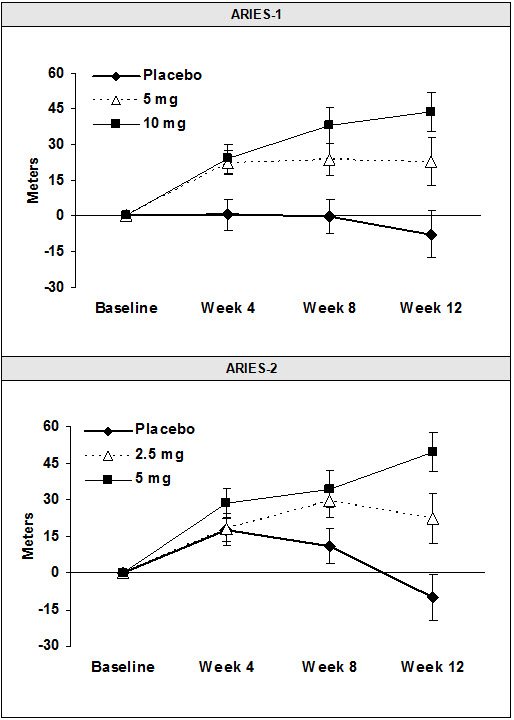
Results of the 6-minute walk distance at 12 weeks for the ARIES-1 and ARIES-2 studies are shown in Table 3 and Figure 4.
Table 3 Changes from Baseline in 6-Minute Walk Distance (meters) (ARIES-1 and ARIES-2) | ARIES-1 | ARIES-2 |
|---|
Placebo
(N=67)
| 5 mg
(N=67)
| 10 mg
(N=67)
| Placebo
(N=65)
| 2.5 mg
(N=64)
| 5 mg
(N=63)
|
|---|
| Mean ± standard deviation |
| Baseline | 342 ± 73 | 340 ± 77 | 342 ± 78 | 343 ± 86 | 347 ± 84 | 355 ± 84 |
| Mean change from baseline | -8 ± 79 | 23 ± 83 | 44 ± 63 | -10 ± 94 | 22 ± 83 | 49 ± 75 |
| Placebo-adjusted mean change from baseline | _ | 31 | 51 | _ | 32 | 59 |
| Placebo-adjusted median change from baseline | _ | 27 | 39 | _ | 30 | 45 |
| p-value p-values are Wilcoxon rank sum test comparisons of Letairis to placebo at Week 12 stratified by idiopathic or heritable PAH and non-idiopathic, non-heritable PAH patients | _ | 0.008 | <0.001 | _ | 0.022 | <0.001 |
Figure 4 Mean Change in 6-Minute Walk Distance (ARIES-1 and ARIES-2)
Mean change from baseline in 6-minute walk distance in the placebo and Letairis groups.
Values are expressed as mean ± standard error of the mean.
In both studies, treatment with Letairis resulted in a significant improvement in 6-minute walk distance for each dose of Letairis and the improvements increased with dose. An increase in 6-minute walk distance was observed after 4 weeks of treatment with Letairis, with a dose-response observed after 12 weeks of treatment. Improvements in walk distance with Letairis were smaller for elderly patients (age ≥65) than younger patients and for patients with secondary PAH than for patients with idiopathic or heritable PAH. The results of such subgroup analyses must be interpreted cautiously.
Clinical Worsening
Time to clinical worsening of PAH was defined as the first occurrence of death, lung transplantation, hospitalization for PAH, atrial septostomy, study withdrawal due to the addition of other PAH therapeutic agents, or study withdrawal due to early escape. Early escape was defined as meeting two or more of the following criteria: a 20% decrease in the 6-minute walk distance; an increase in WHO functional class; worsening right ventricular failure; rapidly progressing cardiogenic, hepatic, or renal failure; or refractory systolic hypotension. The clinical worsening events during the 12-week treatment period of the Letairis clinical trials are shown in Table 4 and Figure 5.
Table 4 Time to Clinical Worsening (ARIES-1 and ARIES-2) | ARIES-1 | ARIES-2 |
|---|
Placebo
(N=67)
| Letairis
(N=134)
| Placebo
(N=65)
| Letairis
(N=127)
|
|---|
Intention-to-treat population.
Note: Patients may have had more than one reason for clinical worsening.
Nominal p-values
|
| Clinical worsening, no. (%) | 7 (10%) | 4 (3%) | 13 (22%) | 8 (6%) |
| Hazard ratio | _ | 0.28 | _ | 0.30 |
| p-value, Log-rank test | _ | 0.030 | _ | 0.005 |
There was a significant delay in the time to clinical worsening for patients receiving Letairis compared to placebo. Results in subgroups such as the elderly were also favorable.
Figure 5 Time to Clinical Worsening (ARIES-1 and ARIES-2)
Time from randomization to clinical worsening with Kaplan-Meier estimates of the proportions of patients without events in ARIES-1 and ARIES-2.
p-values shown are the log-rank comparisons of Letairis to placebo stratified by idiopathic or heritable PAH and non-idiopathic, non-heritable PAH patients.
Exercise Ability
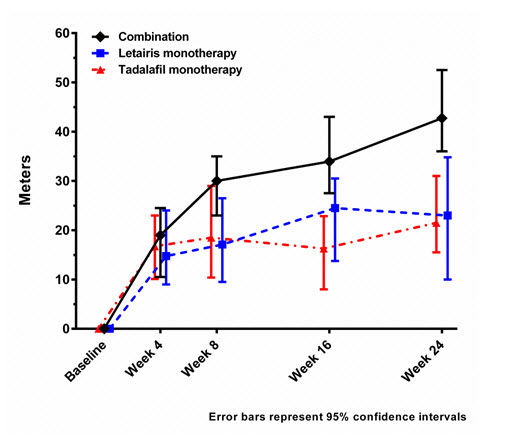
Results of the 6MWD at 24 weeks for the AMBITION study are shown in Table 5 and Figure 9.
Table 5 6-Minute Walk Distance at Week 24 (meters)Missing values at Week 24 were imputed using Worst Rank scores for patients with an adjudicated clinical failure event of death or hospitalization, and Last Observed Carried Forward otherwise.
(AMBITION) | Letairis + Tadalafil
(N=302)
| Letairis Monotherapy
(N=152)
| Tadalafil Monotherapy
(N=151)
|
|---|
| Baseline (median) | 356 | 366 | 352 |
| Change from baseline (median) | 43 | 23 | 22 |
Median difference from Letairis + Tadalafil
(95% CI)
| | 24
(11, 37)
| 20
(8, 32)
|
| P-Value | | 0.0004 | 0.0016 |
Figure 9 Median Change in 6-Minute Walk Distance (meters) in AMBITION
Embryo-fetal Toxicity
Instruct patients on the risk of fetal harm when Letairis is used in pregnancy [see Warnings and Precautions (5.1) and Use in Specific Populations (8.1)]. Instruct females of reproductive potential to immediately contact their physician if they suspect they may be pregnant.
Educate and counsel patients who can become pregnant about the need to use effective contraception prior to treatment with Letairis, during treatment, and for one month after treatment discontinuation [see Warnings and Precautions (5.1) and Use in Specific Populations (8.1, 8.3)]. Patients who can become pregnant should have a negative pregnancy test prior to treatment with Letairis [see Dosage and Administration (2.2), Contraindications (4.1), Warnings and Precautions (5.1), Use in Specific Populations (8.1, 8.3)].
Counsel patients who can become pregnant about pregnancy planning and prevention, including emergency contraception, or designate counseling by another healthcare provider trained in contraceptive counseling [see Boxed Warning].
Hepatic Effects
Advise patients of the symptoms of potential liver injury and instruct them to report any of these symptoms to their physician.
Hematological Change
Advise patients of the importance of hemoglobin testing.
Other Risks Associated with Letairis
Instruct patients that the risks associated with Letairis also include the following:
- Decreases in sperm count
- Fluid overload
Administration
Advise patients not to split, crush, or chew tablets.
Gilead Sciences, Inc., Foster City, CA 94404
Letairis is a registered trademark of Gilead Sciences, Inc. Gilead and the Gilead logo are trademarks of Gilead Sciences, Inc. Other brands noted herein are the property of their respective owners.
© 2025 Gilead Sciences, Inc.
GS22-081-018