Other
Azithromycin is a macrolide antibacterial drug indicated for the treatment of patients with mild to moderate infections caused by susceptible strains of the designated microorganisms in the specific conditions listed below. Recommended dosages and durations of therapy in adult and pediatric patient populations vary in these indications. [see Dosage and Administration (2)]
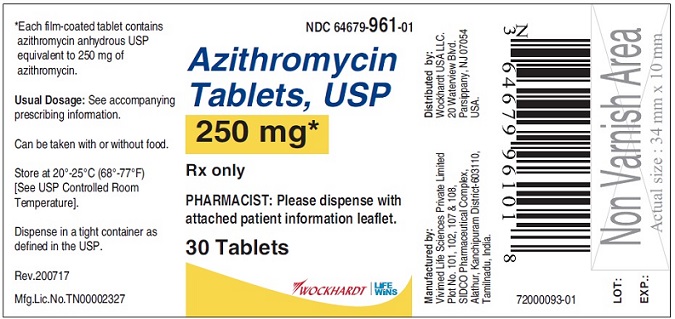
Azithromycin tablets 250 mg are supplied as white film-coated oval shaped biconvex tablets debossed with W961 on one side and other side plain containing anhydrous azithromycin 250 mg.
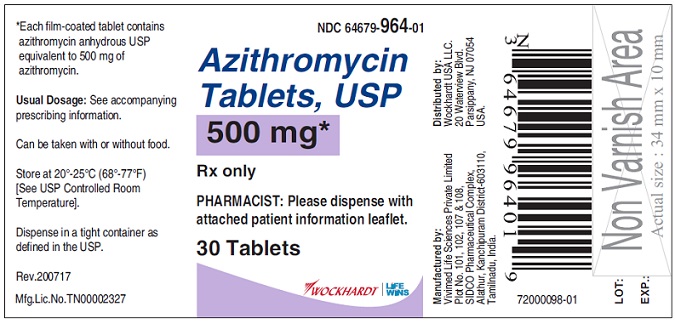
Azithromycin tablets 500 mg are supplied as white film-coated oval shaped biconvex tablets debossed with W964 on one side and other side plain containing anhydrous azithromycin 500 mg.
Azithromycin tablets, USP contain the active ingredient azithromycin, a macrolide antibacterial drug, for oral administration. Azithromycin has the chemical name (2R,3S,4R,5R,8R,10R,11R,12S,13S,14R)-13-[(2,6-dideoxy-3-C-methyl-3-O-methyl-α-L-ribo-hexopyranosyl)oxy]-2-ethyl-3,4,10-trihydroxy-3,5,6,8,10,12,14-heptamethyl-11-[[3,4,6-trideoxy-3-(dimethylamino)-β-D-xylo-hexopyranosyl]oxy]-1-oxa-6-azacyclopentadecan-15-one. Azithromycin is derived from erythromycin; however, it differs chemically from erythromycin in that a methyl-substituted nitrogen atom is incorporated into the lactone ring. Its molecular formula is C38H72N2O12, and its molecular weight is 749. Azithromycin has the following structural formula:
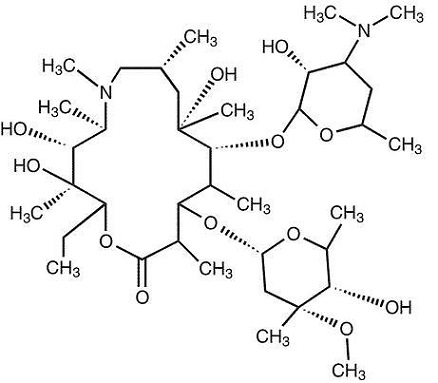
Structure (Abb76e1d A0c6 407b B70c 1d5da87f4902 01)
Anhydrous azithromycin USP is a white amorphous powder with a molecular formula of C38H72N2O12 and a molecular weight of 749.
Azithromycin tablet, USP is supplied for oral administration as white, film-coated, oval shaped biconvex tablets containing anhydrous azithromycin 250 mg or 500 mg and the following inactive ingredients: microcrystalline cellulose, corn starch, croscarmellose sodium, magnesium trisilicate, magnesium stearate, colloidal silicon dioxide, hydroxypropyl cellulose, sodium lauryl sulfate, hypromellose, titanium dioxide and polyethylene glycol.
- Clinical and Laboratory Standards Institute (CLSI). Methods for Dilution Antimicrobial Susceptibility Tests for Bacteria that Grow Aerobically; Approved Standard-Tenth Edition. CLSI document M07-A10, Clinical and Laboratory Standards Institute, 950 West Valley Road, Suite 2500, Wayne, Pennsylvania 19087, USA, 2015.
- Clinical and Laboratory Standards Institute (CLSI). Performance Standards for Antimicrobial Susceptibility Testing; Twenty-sixth Informational Supplement, CLSI document M100-S26. CLSI document M100-S26, Clinical and Laboratory Standards Institute, 950 West Valley Road, Suite 2500, Wayne, Pennsylvania 19087, USA, 2016.
- Clinical and Laboratory Standards Institute (CLSI). Performance Standards for Antimicrobial Disk Diffusion Susceptibility Tests; Approved Standard - Twelfth Edition CLSI document M02-A12, Clinical and Laboratory Standards Institute, 950 West Valley Road, Suite 2500, Wayne, Pennsylvania 19087, USA, 2015.
- Clinical and Laboratory Standards Institute (CLSI). Methods for Antimicrobial Dilution and Disk Susceptibility Testing for Infrequently Isolated or Fastidious Bacteria: Approved Guidelines - Third Edition CLSI document M45-A3, Clinical and Laboratory Standards Institute, 950 West Valley Road, Suite 2500, Wayne, Pennsylvania 19087, USA, 2016.
Manufactured by:
Vivimed Life Sciences Private Limited
Plot No. 101, 102, 107 & 108
SIDCO Pharmaceutical Complex,
Alathur, Kanchipuram District-603110,
Tamilnadu, India.
Distributed by:
Wockhardt USA LLC.
20 Waterview Blvd.
Parsippany, NJ 07054,
USA.
Rev.200717