Other
For Intrapleural Administration Only
Shake Well Immediately Before Using
1) Future procedures. The possibility of future diagnostic and therapeutic procedures involving the hemithorax to be treated must be considered prior to administering Sclerosol® Intrapleural Aerosol. Sclerosis of the pleural space may preclude subsequent diagnostic procedures of the pleura on the treated side. Talc sclerosis may complicate or preclude future ipsilateral lung resective surgery, including pneumonectomy for transplantation purposes.
2) Use in potentially curable disease. Talc has no known antineoplastic activity and should not be used for potentially curable malignancies where systemic therapy would be more appropriate, e.g., a malignant effusion secondary to a potentially curable lymphoma.
3) Potential pulmonary complications. Acute pneumonitis or acute respiratory distress syndrome (ARDS) have rarely been reported in association with intrapleural talc administration. Whether these were causally related to talc is unclear. In none of the reported cases was talc applied thoracoscopically or by insufflation. Three of four case reports of ARDS have occurred after treatment with 10 g of talc administered via intrapleural chest tube instillation. One patient died one month post treatment and two patients recovered without further sequelae.
Intravenous administration of talc is a well-recognized cause of pulmonary hypertension and pulmonary lung parenchymal disease, but these complications have not been reported after intrapleural administration. Pulmonary diseases, e.g., silicosis or asbestosis-like diseases, chronic bronchitis, bronchogenic carcinoma, and pleural plaques have been reported in association with inhaled talc.
4) Contents under pressure. The contents of the Sclerosol® Intrapleural Aerosol (sterile talc powder) canister are under pressure. The canister must not be punctured and should not be used or stored near heat or open flame.
Infections: Empyema was a rare complication of talc administration and/or the procedure. Biopsies had been obtained prior to onset in over half the reported cases.
Respiratory: Rare instances of pneumonia, ARDS, dyspnea, bronchopleural fistula, hemoptysis, and pulmonary emboli have been reported.
Cardiovascular: Tachycardia, myocardial infarction, hypotension, hypovolemia, and asystolic arrest associated with surgery and/or anesthesia have been rarely reported.
Delivery Procedure: Adverse reactions due to the delivery procedure and the chest tube may include: infection at the site of thoracostomy or thoracoscopy, localized bleeding, and subcutaneous empyema.
Chronic Toxicity: Lange et al. (Thorax 1988;43:559) reported on 114 consecutive cases of idiopathic spontaneous pneumothorax treated with talc poudrage (60 patients), or simple drainage (54 patients) via an intercostal tube. Pulmonary function tests (FEV1, VC, TLC, and RV) 22 to 35 years after treatment, showed no significant differences in the incidence of pleural changes between the two groups. Two patients treated with talc poudrage had more extensive pleural thickening with calcification. The mean total lung capacities were 89% of predicted in the talc group and 96% in the drainage only group. Fourteen patients (12 lifelong heavy smokers, 2 non-smokers) had airflow limitation (5 severe). Source and purity of the talc used was not reported. No cases of mesothelioma were reported. One case report noted the occurrence of adenocarcinoma of the chest wall two years after pleurodesis following 10 g of 1% iodized talc (administered for recurrent pneumothorax).
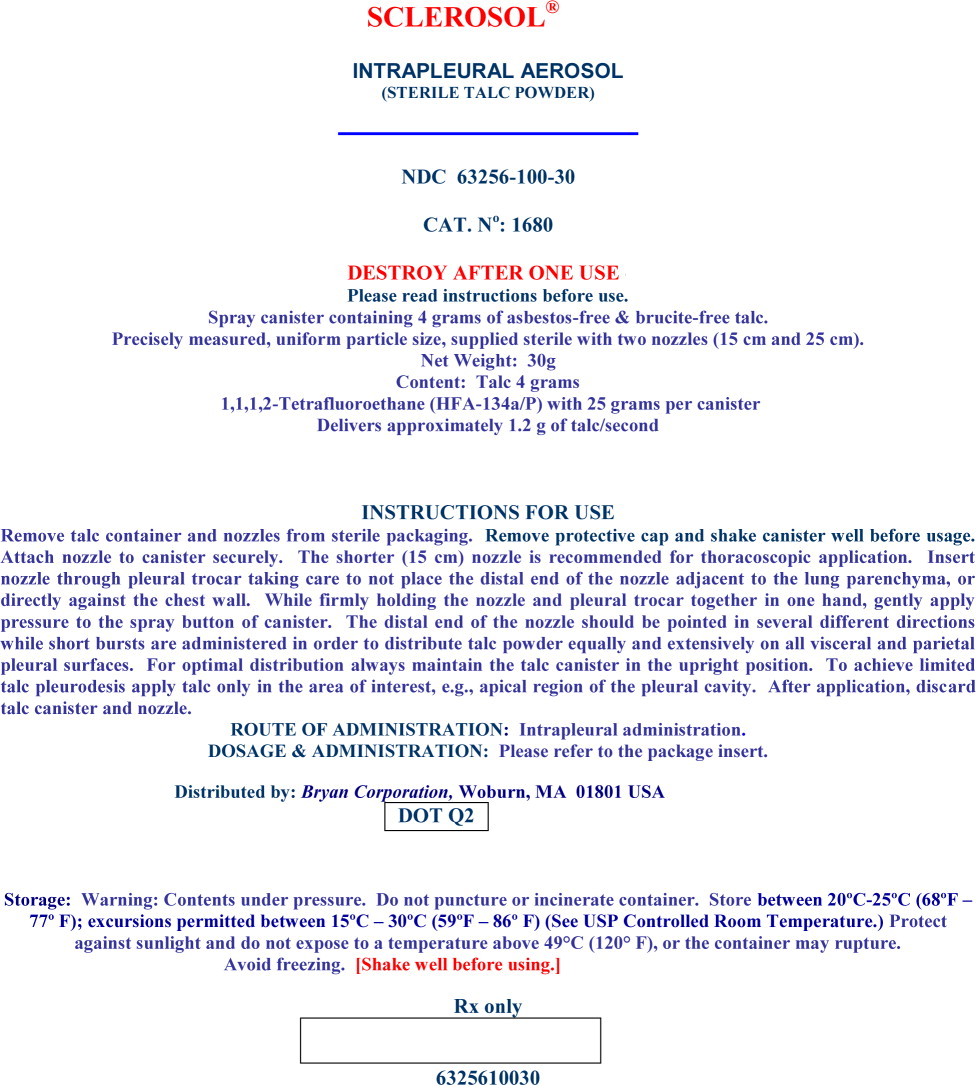
NDC 63256-100-30: Sclerosol® Intrapleural Aerosol (sterile talc powder) contains 4 g of talc suspended in 25 g of inert propellant in a single-use aluminum canister. The canister is fitted with a continuous spray valve which delivers approximately 1.2 g of talc per second. This canister, attached to an actuator button, and two delivery nozzles of 15 cm and 25 cm length, are supplied in a sterile, flexible plastic peel pack.