- 1.Place the TRULANCE tablet in a clean cup with 30 mL of room temperature water.
- 2.Mix by gently swirling the tablet and water mixture for at least 15 seconds. The TRULANCE tablet will fall apart in the water.
- 3.Flush the nasogastric or gastric feeding tube with 30 mL of water using a catheter tip syringe.
- 4.Draw up the mixture using the syringe and immediately administer via the nasogastric or gastric feeding tube. Do not reserve for future use.
- 5.If any portion of the tablet is left in the cup, add another 30 mL of water to the cup, swirl for at least 15 seconds, and using the same syringe, administer via the nasogastric or gastric feeding tube.
- 6.Using the same or a fresh syringe, flush the nasogastric or gastric feeding tube with at least 10 mL of water.
TRULANCE Tablets:
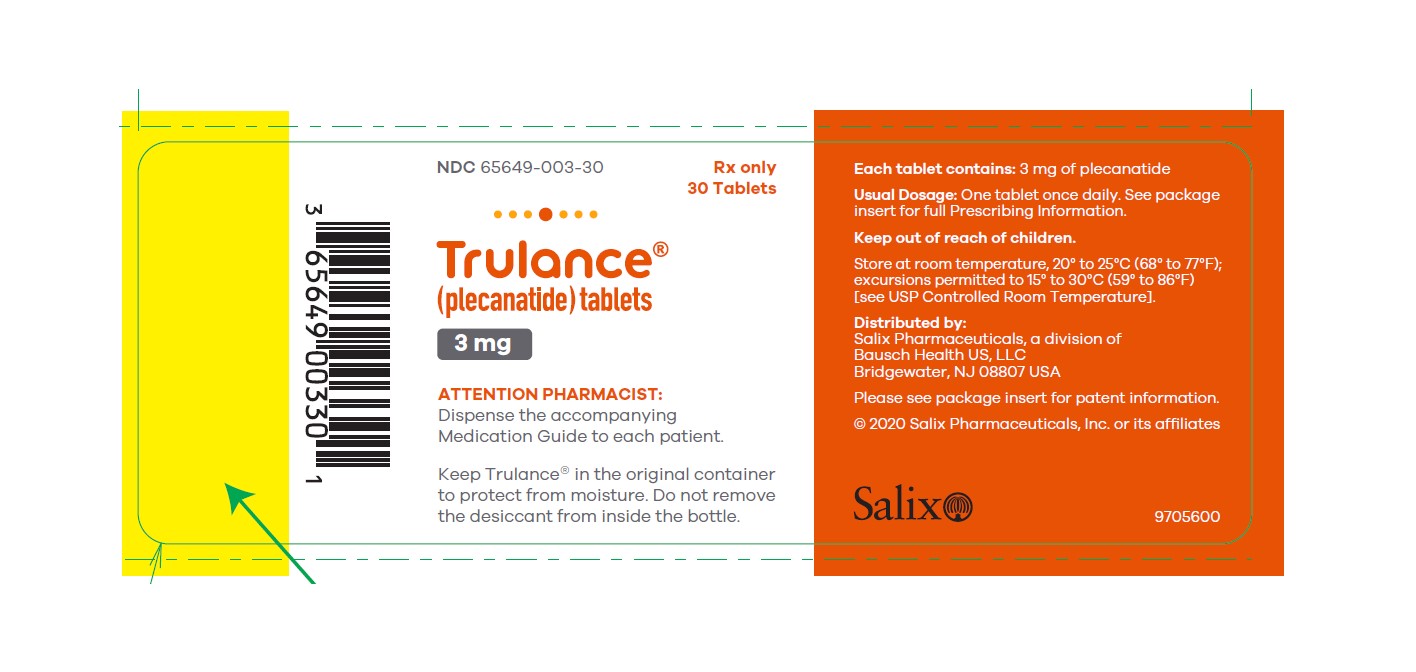
3 mg: white to off-white, plain, round tablet debossed with “SP” on one side and “3” for 3 mg on the other side.
Chronic Idiopathic Constipation (CIC)
The safety data described below reflect data from 1,733 adult patients with CIC randomized in two double-blind, placebo-controlled clinical trials (Study 1 and Study 2) to receive placebo or 3 mg of TRULANCE once daily for 12 weeks.
Most Common Adverse Reactions
Table 1 provides the incidence of adverse reactions reported in at least 2% of CIC patients in the TRULANCE-treated group and at an incidence that was greater than in the placebo group.
Table 1: Most Common Adverse Reactionsa in Two Placebo-Controlled Trials of TRULANCE [Study 1 and Study 2] in Patients with CIC| Adverse Reaction | TRULANCE, 3 mg
(N = 863)
% | Placebo
(N = 870)
% |
|---|
| a: Reported in at least 2% of TRULANCE-treated patients with CIC and at an incidence greater than placebo. |
| b: Verbatim reports of diarrhea were recorded as adverse reactions; reports of loose stools and increase in stool frequency were recorded as adverse reactions if they were also reported to be bothersome to the patient. |
Diarrheaᵇ | 5 | 1 |
Diarrhea
The majority of reported cases of diarrhea occurred within 4 weeks of treatment initiation. Severe diarrhea was reported in 0.6% of TRULANCE-treated patients compared to 0.3% of placebo-treated patients. Severe diarrhea was reported to occur within the first 3 days of treatment [see Warnings and Precautions (5.2)].
Adverse Reactions Leading to Discontinuation
Discontinuations due to adverse reactions occurred in 4% of TRULANCE-treated patients and 2% of placebo-treated patients. The most common adverse reaction leading to discontinuation was diarrhea: 2% of TRULANCE-treated patients and 0.5% of placebo-treated patients withdrew due to diarrhea.
Less Common Adverse Reactions
Adverse reactions reported in less than 2% of TRULANCE-treated patients and at an incidence greater than placebo were: sinusitis, upper respiratory tract infection, abdominal distension, flatulence, abdominal tenderness, and increased liver biochemical tests (2 patients with alanine aminotransferase (ALT) greater than 5 to 15 times the upper limit of normal and 3 patients with aspartate aminotransferase (AST) greater than 5 times the upper limit of normal).
Irritable Bowel Syndrome with Constipation (IBS-C)
The safety data described below reflect data from 1,449 adults patients with IBS-C randomized in two double-blind, placebo-controlled clinical trials (Study 3 and Study 4) to receive placebo or 3 mg TRULANCE once daily for 12 weeks.
Most Common Adverse Reactions
Table 2 provides the incidence of adverse reactions reported in at least 2% of IBS-C patients treated with TRULANCE and at an incidence that was greater than in the placebo group.
Table 2: Most Common Adverse Reactionsa in Two Placebo-Controlled Trials of TRULANCE [Study 3 and Study 4] in Patients with IBS-C| Adverse Reaction | TRULANCE, 3 mg
(N = 723)
% | Placebo
(N = 726)
% |
|---|
| a: Reported in at least 2% of TRULANCE-treated patients with IBS-C and at an incidence greater than placebo. |
| b: Verbatim reports of diarrhea were recorded as adverse reactions; reports of loose stools and increase in stool frequency were recorded as adverse reactions if they were also reported to be bothersome to the patient. |
Diarrheab | 4.3 | 1 |
Diarrhea
The majority of reported cases of diarrhea occurred within 4 weeks of treatment initiation. Severe diarrhea was reported in 1% of TRULANCE-treated patients compared to 0.1% of placebo-treated patients [see Warnings and Precautions (5.2)]. Severe diarrhea was reported to occur within the first day of treatment.
Adverse Reactions Leading to Discontinuation
Discontinuations due to adverse reactions occurred in 2.5% of TRULANCE-treated patients and 0.4% of placebo-treated patients. The most common adverse reaction leading to discontinuation was diarrhea: 1.2% of TRULANCE-treated patients and 0% of placebo-treated patients withdrew due to diarrhea.
Less Common Adverse Reactions
Adverse reactions reported in 1% or more but less than 2% of TRULANCE-treated patients and at an incidence greater than placebo were: nausea, nasopharyngitis, upper respiratory tract infection, urinary tract infection, and dizziness. Two patients reported increased liver biochemical tests (alanine aminotransferase (ALT) greater than 5 to 15 times the upper limit of normal).
Risk Summary
Plecanatide and its active metabolite are negligibly absorbed systemically following oral administration [see Clinical Pharmacology (12.3)] and maternal use is not expected to result in fetal exposure to the drug. The available data on TRULANCE use in pregnant women are not sufficient to inform any drug-associated risks for major birth defects and miscarriage. In animal developmental studies, no effects on embryo-fetal development were observed with oral administration of plecanatide in mice and rabbits during organogenesis at doses much higher than the recommended human dosage.
The estimated background risk of major birth defects and miscarriage for the indicated population is unknown. All pregnancies have a background risk of birth defect, loss, or other adverse outcomes. In the United States general population, the estimated background risk of major birth defects and miscarriage in clinically recognized pregnancies is 2% to 4% and 15% to 20%, respectively.
Data
Animal data
Pregnant mice and rabbits were administered plecanatide during the period of organogenesis. There was no evidence of harm to embryo-fetal development at oral doses up to 800 mg/kg/day in mice and 250 mg/kg/day in rabbits. Oral administration of up to 600 mg/kg/day in mice during organogenesis through lactation produced no developmental abnormalities or effects on growth, learning and memory, or fertility in the offspring through maturation.
- The maximum recommended human dose is approximately 0.05 mg/kg/day, based on a 60-kg body weight. Limited systemic exposure to plecanatide was achieved in animals during organogenesis (area under the plasma concentration-time curve (AUCt) = 449 ng●h/mL in rabbits given 250 mg/kg/day). Plecanatide and its active metabolite are not measurable in human plasma following administration of the recommended clinical dosage. Therefore, animal and human doses should not be compared directly for evaluating relative exposure.
Risk Summary
After administration of multiple doses of TRULANCE 3 mg once daily for 2 weeks to nursing mothers, plecanatide and its active metabolite were not measurable in breast milk collected at 2 hours, 6 hours, and 12 hours post-dosing. In adults, concentrations of plecanatide and its active metabolite were mostly unmeasurable in plasma following multiple doses of TRULANCE 3 mg once daily for up to 12 weeks [see Clinical Pharmacology (12.3)].
Maternal use of TRULANCE is not expected to result in clinically relevant exposure to plecanatide or its active metabolite in breastfed infants. The developmental and health benefits of breastfeeding should be considered along with the mother’s clinical need for TRULANCE and any potential adverse effects on the breastfed infant from TRULANCE or from the underlying maternal condition.
Juvenile Animal Toxicity Data
Single oral doses of plecanatide at 0.5 mg/kg and 10 mg/kg caused mortality in young juvenile mice on postnatal days 7 and 14, respectively (human age equivalent of approximately 1 month to less than 2 years). Treatment-related increases in the weight of intestinal contents were observed in juvenile mice following single doses of plecanatide on postnatal day 14 (human age equivalent of approximately less than 2 years), consistent with increased fluid in the intestinal lumen. Although the recommended human dose is approximately 0.05 mg/kg/day, based on a 60-kg body weight, plecanatide and its active metabolite are not measurable in adult human plasma, whereas systemic absorption was demonstrated in the juvenile animal toxicity studies. Animal and human doses should not be compared directly for evaluating relative exposure.
Chronic Idiopathic Constipation (CIC)
Of 2,601 subjects in placebo-controlled clinical trials of TRULANCE, 273 (10%) were 65 years of age and over, and 47 (2%) were 75 years and over. Clinical studies of TRULANCE did not include sufficient numbers of patients aged 65 and over to determine whether they respond differently from patients 18 years to less than 65 years of age.
Irritable Bowel Syndrome with Constipation (IBS-C)
Of 1,621 subjects in the placebo-controlled clinical studies of TRULANCE, 134 (8.3%) were 65 years of age and over, and 25 (1.5%) were 75 years and over. Clinical studies of TRULANCE did not include sufficient numbers of patients aged 65 and over to determine whether they respond differently from patients 18 years to less than 65 years of age.
Food Effect
Subjects who received either a low-fat, low calorie (LF-LC) meal or a high fat, high calorie (HF-HC) meal reported looser stools than fasted subjects up to 24 hours after a single dose of TRULANCE 9 mg (3 times the recommended dose). In clinical studies, TRULANCE was administered with or without food [see Dosage and Administration (2.2)].
Absorption
Plecanatide was minimally absorbed with negligible systemic availability following oral administration. Concentrations of plecanatide and its active metabolite in plasma were below the limit of quantitation in the majority of analyzed plasma samples after an oral TRULANCE dose of 3 mg. Therefore, standard pharmacokinetic parameters such as AUC, maximum concentration (Cmax), and half-life (t½) could not be calculated.
Food Effect
In a crossover study, 24 healthy subjects were given a single dose of TRULANCE 9 mg (3 times the recommended dose) in 3 different states: fasted; following a low-fat, low-calorie meal (LF-LC; approximately 350 calories: 17% from fat, 66% from carbohydrate, and 17% from protein); and following a high-fat, high-calorie meal (HF-HC; approximately 1,000 calories: 60% from fat, 25% from carbohydrate, and 15% from protein). Plecanatide was detected in 1 subject (fasted state) at 0.5 and 1 hour post dose. Plecanatide concentrations were below the limit of quantitation for all other time points and for all other subjects. The active metabolite was not detected in any subject.
Distribution
Given that plecanatide concentrations following clinically relevant oral doses were not measurable, plecanatide is expected to be minimally distributed in tissues. Oral plecanatide was localized to the GI tract where it exerted its effects as a GC-C agonist with negligible systemic exposure. Plecanatide exhibited little to no binding to human serum albumin or human α-1-acid glycoprotein.
Elimination
Metabolism
Plecanatide was metabolized in the GI tract to an active metabolite by loss of the terminal leucine moiety. Both plecanatide and the metabolite were proteolytically degraded within the intestinal lumen to smaller peptides and naturally occurring amino acids.
Excretion
No excretion studies have been conducted in humans. Plecanatide and its active metabolite were not measurable in plasma following administration of the recommended clinical doses.
Drug Interaction Studies
Neither plecanatide nor its active metabolite inhibited the cytochrome P450 (CYP) enzymes 2C9 and 3A4, and they did not induce CYP3A4 in vitro.
Plecanatide and its active metabolite were neither substrates nor inhibitors of the transporters P-glycoprotein (P-gp) or breast cancer resistance protein (BCRP) in vitro.
Carcinogenesis
The carcinogenic potential of plecanatide was assessed in 2-year carcinogenicity studies in mice and rats. Plecanatide was not tumorigenic in mice at oral doses up to 90 mg/kg/day or in rats at oral doses up to 100 mg/kg/day. Limited systemic exposure to plecanatide was achieved at the tested dose levels in animals, whereas no detectable exposure occurred in humans. Therefore, animal and human doses should not be compared directly for evaluating relative exposure.
Mutagenesis
Plecanatide was not genotoxic in the in vitro bacterial reverse mutation (Ames) assay, in vitro mouse lymphoma mutation assay, or the in vivo mouse bone marrow micronucleus assay.
Impairment of Fertility
Plecanatide had no effect on fertility or reproductive function in male or female mice at oral doses of up to 600 mg/kg/day.
Diarrhea
To stop TRULANCE and contact their healthcare provider if they experience severe diarrhea [see Warnings and Precautions (5.2)].
Accidental Ingestion
Accidental ingestion of TRULANCE in children, especially in children less than 6 years of age, may result in severe diarrhea and dehydration. Instruct patients to take steps to store TRULANCE securely and out of reach of children and to dispose of unused TRULANCE [see Contraindications (4), Warnings and Precautions (5.2)].
Administration and Handling Instructions
- To take TRULANCE once daily with or without food [see Dosage and Administration (2.2)].
- If a dose is missed, skip the missed dose and take the next dose at the regular time. Do not take two doses at the same time.
- To swallow TRULANCE tablets whole.
- If adult patients have swallowing difficulties, TRULANCE tablets can be crushed and administered orally in either applesauce or with water, or administered with water via a nasogastric or gastric feeding tube, as described in the Medication Guide.
- To keep TRULANCE in a dry place. Protect from moisture. For bottles, keep TRULANCE in the original bottle. Do not remove desiccant from the bottle. Do not subdivide or repackage. Remove and discard polyester coil after opening. Keep bottles closed tightly [see How Supplied/Storage and Handling (16)].
Distributed by:
Salix Pharmaceuticals, a division of
Bausch Health US, LLC
Bridgewater, NJ 08807 USA
U.S. Patent Numbers: 7,041,786; 7,799,897; 8,637,451; 9,610,321; 9,616,097; 9,919,024; 9,925,231 and 10,011,637
TRULANCE is a trademark of Salix Pharmaceuticals, Inc. or its affiliates.
© 2021 Salix Pharmaceuticals, Inc. or its affiliates
9705703