Bleeding
GUSTO severe bleeding was defined as fatal, intracranial, or bleeding with hemodynamic compromise requiring intervention; GUSTO moderate bleeding was defined as bleeding requiring transfusion of whole blood or packed red blood cells without hemodynamic compromise. (GUSTO: Global Utilization of Streptokinase and Tissue Plasminogen Activator for Occluded Arteries.)
The results for the bleeding endpoints in the post-MI or PAD patients without a history of stroke or TIA are shown in Table 1. ZONTIVITY increased GUSTO moderate or severe bleeding by 55%.
Table 1: Non-CABG-Related Bleeds in Post-MI or PAD Patients without a History of Stroke or TIA (First Dose to Last Dose + 30 Days) in the TRA 2°P Study | Placebo
(n=10,049)
| ZONTIVITY
(n=10,059)
| |
| Endpoints | Patients with events
(%)
| K-M %
K-M estimate at 1,080 days. | Patients with events
(%)
| K-M %
| Hazard Ratio
Clinically significant bleeding includes any bleeding requiring medical attention including ICH, or clinically significant overt signs of hemorrhage associated with a drop in hemoglobin (Hgb) of ≥3 g/dL (or, when Hgb is not available, an absolute drop in hematocrit (Hct) of ≥9%). ,Hazard ratio is ZONTIVITY group vs. placebo group.
(95% CI)
|
| GUSTO Bleeding Categories |
| Severe | 82 (0.8%) | 1.0% | 100 (1.0%) | 1.3% | 1.24 (0.92 - 1.66) |
| Moderate or Severe | 199 (2.0%) | 2.4% | 303 (3.0%) | 3.7% | 1.55 (1.30 - 1.86) |
| Any GUSTO Bleeding (Severe/Moderate/Mild) | 1769 (17.6%) | 19.8% | 2518 (25.0%) | 27.7% | 1.52 (1.43 - 1.61) |
| Fatal Bleeding | 14 (0.1%) | 0.2% | 16 (0.2%) | 0.2% | 1.15 (0.56 - 2.36) |
| Intracranial Hemorrhage (ICH) | 31 (0.3%) | 0.4% | 45 (0.4%) | 0.6% | 1.46 (0.92-2.31) |
| Clinically Significant Bleeding
| 950 (9.5%) | 10.9% | 1349 (13.4%) | 15.5% | 1.47 (1.35 - 1.60) |
| Gastrointestinal Bleeding | 297 (3.0%) | 3.5% | 400 (4.0%) | 4.7% | 1.37 (1.18-1.59) |
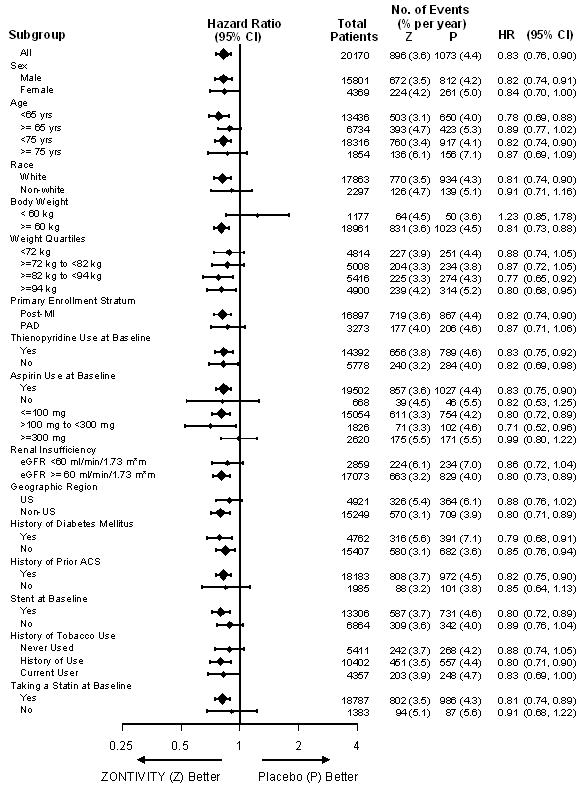
The effects of ZONTIVITY on bleeding were examined in a number of subsets based on demographic and other baseline characteristics. Many of these are shown in Figure 1. Such analyses must be interpreted cautiously, as differences can reflect the play of chance among a large number of analyses.
| Figure 1: Subgroup Analyses (GUSTO Moderate or Severe Bleeding) in Post-MI or PAD Patients without a History of Stroke or TIA in the TRA 2°P Study (First Dose to Last Dose + 30 Days) |
|---|
|
In TRA 2°P, 367 post-MI or PAD patients without a history of stroke or TIA underwent CABG surgery. Study investigators were encouraged not to discontinue treatment with study drug (i.e., ZONTIVITY or placebo) prior to surgery. Approximately 12.3% of patients discontinued ZONTIVITY more than 30 days prior to CABG. The relative risk for GUSTO moderate or severe bleeding was approximately 1.2 on ZONTIVITY vs. placebo.
Bleeding events that occurred on ZONTIVITY were treated in the same manner as for other antiplatelet agents.
Use in Patients with History of Stroke, TIA, or ICH
In the TRA 2°P study, patients with a history of ischemic stroke had a higher rate for ICH on ZONTIVITY than on placebo. ZONTIVITY is contraindicated in patients with a history of stroke, TIA, or ICH
[see
Contraindications (4)].
Other Adverse Reactions
Adverse reactions other than bleeding were evaluated in 19,632 patients treated with ZONTIVITY [13,186 patients in the TRA 2°P study and 6,446 patients in the TRA•CER (Thrombin Receptor Antagonist for Clinical Event Reduction in Acute Coronary Syndrome) study]. Adverse events other than bleeding that occurred at a rate that was at least 2% in the ZONTIVITY group and also 10% greater than the rate in the placebo group are shown in Table 2.
Table 2: TRA 2°P / TRA•CER - Percentage of Patients Reporting Non-hemorrhagic Adverse Reactions at a Rate at Least 2% in the ZONTIVITY Group and at Least 10% Greater than Placebo | ZONTIVITY
N=19,632
| Placebo
N=19,607
|
|---|
| n (%) | n (%) |
|---|
| Anemia | 982 (5.0) | 783 (4.0) |
| Depression | 477 (2.4) | 405 (2.1) |
| Rashes, Eruptions, and Exanthemas | 439 (2.2) | 395 (2.0) |
The following adverse reactions occurred at a rate less than 2% in the ZONTIVITY group but at least 40% greater than placebo. In descending order of rate in the ZONTIVITY group: iron deficiency, retinopathy or retinal disorder, and diplopia/oculomotor disturbances.
An increased rate of diplopia and related oculomotor disturbances was observed with ZONTIVITY treatment (30 subjects, 0.2%) vs. placebo (10 subjects, 0.06%). While some cases resolved during continued treatment, information on resolution of symptoms was not available for some cases.
Strong CYP3A Inhibitors
Avoid concomitant use of ZONTIVITY with strong inhibitors of CYP3A (e.g., ketoconazole, itraconazole, posaconazole, clarithromycin, nefazodone, ritonavir, saquinavir, nelfinavir, indinavir, boceprevir, telaprevir, telithromycin and conivaptan)
[see
Warnings and Precautions (5.2) and
Clinical Pharmacology (12.3)]
.
Strong CYP3A Inducers
Avoid concomitant use of ZONTIVITY with strong inducers of CYP3A (e.g., rifampin, carbamazepine, St. John's Wort and phenytoin)
[see
Warnings and Precautions (5.2) and
Clinical Pharmacology (12.3)].
Evaluation of Vorapaxar on QTc Interval
The effect of vorapaxar on the QTc interval was evaluated in a thorough QT study and in other studies. Vorapaxar had no effect on the QTc interval at single doses up to 48 times the recommended dose.
Absorption
After oral administration of a single ZONTIVITY 2.08 mg dose under fasted conditions, peak concentrations (C
max) occur at 1 hour post-dose (range: 1 to 2 h). The mean absolute bioavailability as determined from a microdosing study is approximately 100%.
Ingestion of vorapaxar with a high-fat meal resulted in no meaningful change in AUC with a small (21%) decrease in C
max and delayed time to peak concentration (45 minutes). ZONTIVITY may be taken with or without food.
Distribution
The mean volume of distribution of vorapaxar is approximately 424 liters (95% CI: 351-512). Vorapaxar and the major circulating active metabolite, M20, are extensively bound (≥99%) to human plasma proteins. Vorapaxar is highly bound to human serum albumin and does not preferentially distribute into red blood cells.
Metabolism
Vorapaxar is eliminated by metabolism via CYP3A4 and CYP2J2. The major active circulating metabolite is M20 (monohydroxy metabolite) and the predominant metabolite identified in excreta is M19 (amine metabolite). The systemic exposure of M20 is ~20% of the exposure to vorapaxar.
Excretion
The primary route of elimination is through the feces. In a 6-week study, 84% of the administered radiolabeled dose was recovered as total radioactivity with 58% collected in feces and 25% in urine. Vorapaxar is eliminated primarily in the form of metabolites, with no unchanged vorapaxar detected in urine.
Vorapaxar exhibits multi-exponential disposition with an effective half-life of 3-4 days and an apparent terminal elimination half-life of 8 days. Steady-state is achieved by 21 days following once-daily dosing with an accumulation of 5- to 6-fold. The apparent terminal elimination half-life for vorapaxar is approximately 8 days (range 5-13 days) and is similar for the active metabolite. The terminal elimination half-life is important to determine the time to offset the pharmacodynamic effect
[see
Clinical Pharmacology (12.2)]
.
Specific Populations
The effects of intrinsic factors on the pharmacokinetics of vorapaxar are presented in Figure 2
[see
Use in Specific Populations (8.5,
8.6,
8.7)]
.
In general, effects on the exposure of vorapaxar based on age, race, gender, weight, and moderate renal insufficiency were modest (20-40%; see
Figure 2). No dose adjustments are necessary based upon these factors. Because of the inherent bleeding risks in patients with severe hepatic impairment, ZONTIVITY is not recommended in such patients
[see
Warnings and Precautions (5.1) and
Use in Specific Populations (8.7)]
.
Drug Interactions [see also
Drug Interactions (7)]
Anticoagulants and Antiplatelet Agents
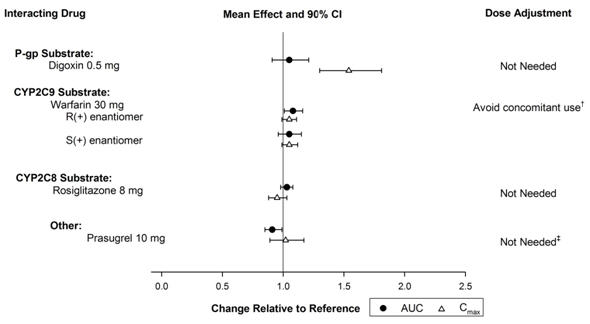
An interaction study with vorapaxar and warfarin in healthy subjects did not demonstrate a clinically significant pharmacokinetic or pharmacodynamic interaction
[see
Warnings and Precautions (5.1) and
Figure 4]
.
Vorapaxar did not affect prasugrel pharmacokinetics and prasugrel did not affect vorapaxar pharmacokinetics following multiple-dose administration at steady-state
[see
Warnings and Precautions (5.1) and
Figures 3 and
4]
. The pharmacokinetic interaction between vorapaxar and clopidogrel has not been evaluated. However, the use of vorapaxar on a background of clopidogrel is supported by the clinical data from TRA 2°P and TRA•CER
[see
Adverse Reactions (6.1) and
Clinical Studies (14)]
.
Effects of Other Drugs on Vorapaxar
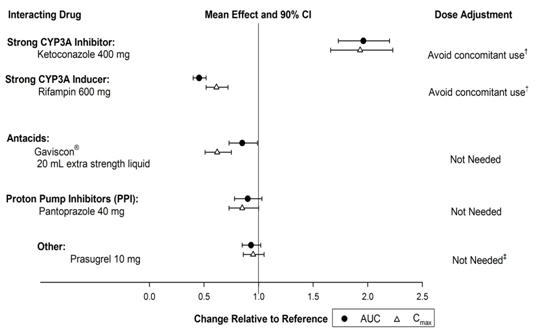
The effects of other drugs on the pharmacokinetics of vorapaxar are presented in Figure 3 as change relative to vorapaxar administered alone (test/reference). Phase 3 data suggest that coadministration of a weak or moderate CYP3A inhibitor with vorapaxar does not increase bleeding risk or alter the efficacy of vorapaxar. No dose adjustment for ZONTIVITY is required in patients taking weak to moderate inhibitors of CYP3A.
Effects of Vorapaxar on Other Drugs
In vitro metabolism studies demonstrate that vorapaxar or M20 is unlikely to cause clinically significant inhibition or induction of major CYP isoforms or inhibition of OATP1B1, OATP1B3, BCRP, OAT1, OAT3, and OCT2 transporters.
Specific
in vivo effects on the pharmacokinetics of digoxin, warfarin, rosiglitazone and prasugrel are presented in Figure 4 as a change relative to the interacting drug administered alone (test/reference). Vorapaxar is a weak inhibitor of the intestinal P-glycoprotein (P-gp) transporter. No dosage adjustment of digoxin or ZONTIVITY is required.
Carcinogenesis
Carcinogenicity studies were conducted in rats and mice dosed orally with vorapaxar for two years. Male and female rats dosed at 0, 3, 10 or 30 mg/kg/day showed no carcinogenic potential at systemic exposures (AUC) in males and females that were 9- and 29-fold, respectively, the human systemic exposure at the RHD. In male and female mice dosed at 0, 1, 5, and 15 mg/kg/day, vorapaxar showed no carcinogenic potential at systemic exposures (AUC) that were up to 30-fold the human systemic exposure.
Mutagenesis
Vorapaxar was not mutagenic in the Ames bacterial reverse mutation assay and not clastogenic in an
in vitro human peripheral blood lymphocyte assay or an
in vivo mouse micronucleus assay after intraperitoneal administration.
Impairment of Fertility
Fertility studies in rats showed that vorapaxar had no effect on either male or female fertility at doses up to 50 mg/kg/day, a dose resulting in systemic exposures (AUC) in male and female rats that are 40 and 67 times, respectively, the human systemic exposure at the RHD.
Benefits and Risks
- Summarize the benefits and potential side effects of ZONTIVITY.
- Tell patients to take ZONTIVITY exactly as prescribed.
- Inform patients not to discontinue ZONTIVITY without discussing it with the prescribing physician.
- Tell patients to read the Medication Guide.
Bleeding
Inform patients that they:
- May bleed and bruise more easily.
- Should report any unanticipated, prolonged or excessive bleeding, or blood in their stool or urine.
Invasive Procedures
Instruct patients to:
- Inform physicians and dentists that they are taking ZONTIVITY before any surgery or dental procedure.
- Tell the doctor performing any surgery or dental procedure to talk to the prescribing physician before stopping ZONTIVITY.
Concomitant Medications
Tell patients to list all prescription medications, over-the-counter medications, or dietary supplements they are taking or plan to take so that the physician knows about other treatments that may affect bleeding risk.
Lactation
Advise patients that breastfeeding is not recommended during treatment with Zontivity
Manufactured for:
WraSer Pharmaceuticals
Ridgeland, MS 39157
www.wraser.com
Manufactured for:
WraSer Pharmaceuticals
Ridgeland MS 39157
www.wraser.com
Revised: 03/2021