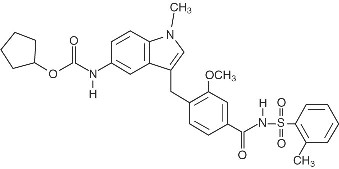
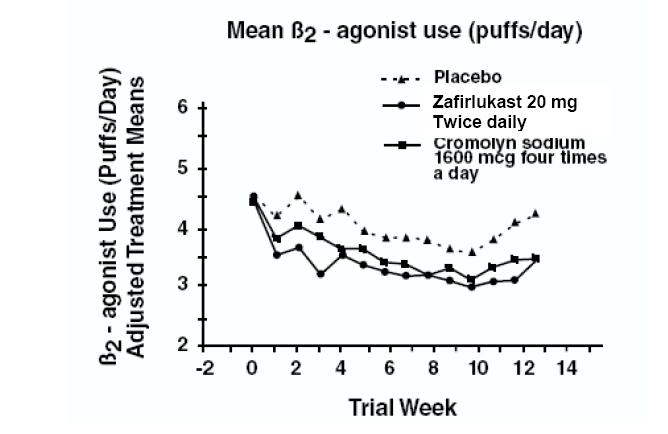
The safety database for zafirlukast consists of more than 4000 healthy volunteers and patients who received zafirlukast, of which 1723 were asthmatics enrolled in trials of 13 weeks duration or longer. A total of 671 patients received zafirlukast for 1 year or longer. The majority of the patients were 18 years of age or older; however, 222 patients between the age of 12 and 18 years received zafirlukast.
A comparison of adverse events reported by ≥1% of zafirlukast-treated patients, and at rates numerically greater than in placebo-treated patients, is shown for all trials in the table below.
| Zafirlukast | PLACEBO |
Adverse Event | N=4058 | N=2032 |
Headache | 12.9% | 11.7% |
Infection | 3.5% | 3.4% |
Nausea | 3.1% | 2.0% |
Diarrhea | 2.8% | 2.1% |
Pain (generalized) | 1.9% | 1.7% |
Asthenia | 1.8% | 1.6% |
Abdominal Pain | 1.8% | 1.1% |
Accidental Injury | 1.6% | 1.5% |
Dizziness | 1.6% | 1.5% |
Myalgia | 1.6% | 1.5% |
Fever | 1.6% | 1.1% |
Back Pain | 1.5% | 1.2% |
Vomiting | 1.5% | 1.1% |
SGPT Elevation | 1.5% | 1.1% |
Dyspepsia | 1.3% | 1.2% |
The frequency of less common adverse events was comparable between zafirlukast and placebo.
Rarely, elevations of one or more liver enzymes have occurred in patients receiving zafirlukast in controlled clinical trials. In clinical trials, most of these have been observed at doses four times higher than the recommended dose. The following hepatic events (which have occurred predominantly in females) have been reported from postmarketing adverse event surveillance of patients who have received the recommended dose of zafirlukast (40 mg/day): cases of symptomatic hepatitis (with or without hyperbilirubinemia) without other attributable cause; and rarely, hyperbilirubinemia without other elevated liver function tests. In most, but not all postmarketing reports, the patient’s symptoms abated and the liver enzymes returned to normal or near normal after stopping zafirlukast. In rare cases, patients have presented with fulminant hepatitis or progressed to hepatic failure, liver transplantation and death (see
WARNINGS, Hepatotoxicity and
PRECAUTIONS, Information for Patients).
In clinical trials, an increased proportion of zafirlukast patients over the age of 55 years reported infections as compared to placebo-treated patients. A similar finding was not observed in other age groups studied. These infections were mostly mild or moderate in intensity and predominantly affected the respiratory tract. Infections occurred equally in both sexes, were dose-proportional to total milligrams of zafirlukast exposure, and were associated with coadministration of inhaled corticosteroids. The clinical significance of this finding is unknown.
In rare cases, patients with asthma on zafirlukast may present with systemic eosinophilia, eosinophilic pneumonia, or clinical features of vasculitis consistent with Churg-Strauss syndrome, a condition which is often treated with systemic steroid therapy. Physicians should be alert to eosinophilia, vasculitic rash, worsening pulmonary symptoms, cardiac complications, and/or neuropathy presenting in their patients. These events have usually, but not always, been associated with reductions and/or withdrawal of steroid therapy. The possibility that zafirlukast may be associated with emergence of Churg-Strauss syndrome can neither be excluded nor established (see
PRECAUTIONS, Eosinophilic Conditions).
Neuropsychiatric adverse events, including insomnia and depression, have been reported in association with zafirlukast therapy, (see
PRECAUTIONS, Neuropsychiatric Events), Hypersensitivity reactions, including urticaria, angioedema and rashes, with or without blistering, have been reported in association with zafirlukast therapy. Additionally, there have been reports of patients experiencing agranulocytosis, bleeding, bruising, or edema, arthralgia, myalgia, malaise, and pruritus in association with zafirlukast therapy.
Rare cases of patients experiencing increased theophylline levels with or without clinical signs or symptoms of theophylline toxicity after the addition of zafirlukast to an existing theophylline regimen have been reported. The mechanism of the interaction between zafirlukast and theophylline in these patients is unknown and not predicted by available
in vitro metabolism data and the results of two clinical drug interaction studies (see
CLINICAL PHARMACOLOGY and
PRECAUTIONS, Drug Interactions).
The recommended dose of zafirlukast tablets in adults and children 12 years and older is 20 mg twice daily.