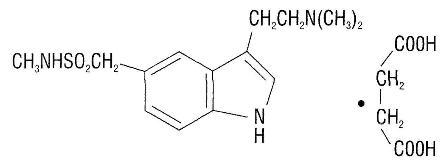
: The mean maximum concentration following oral dosing with 25 mg is 18 ng/mL (range: 7 to 47 ng/mL) and 51 ng/mL (range: 28 to 100 ng/mL) following oral dosing with 100 mg of sumatriptan. This compares with a C of 5 and 16 ng/mL following dosing with a 5 and 20 mg intranasal dose, respectively. The mean C following a 6 mg subcutaneous injection is 71 ng/mL (range: 49 to 110 ng/mL). The bioavailability is approximately 15%, primarily due to presystemic metabolism and partly due to incomplete absorption. The C is similar during a migraine attack and during a migraine-free period, but the T is slightly later during the attack, approximately 2.5 hours compared with 2 hours. When given as a single dose, sumatriptan displays dose proportionality in its extent of absorption (area under the curve [AUC]) over the dose range of 25 to 200 mg, but the C after 100 mg is approximately 25% less than expected (based on the 25 mg dose).
Absorption and Bioavailabilitymaxmaxmaxmaxmax
A food effect trial involving administration of sumatriptan succinate tablets 100 mg to healthy volunteers under fasting conditions and with a high-fat meal indicated that the C and AUC were increased by 15% and 12%, respectively, when administered in the fed state.
max
: Protein binding, determined by equilibrium dialysis over the concentration range of 10 to 1,000 ng/mL is low, approximately 14% to 21%. The effect of sumatriptan on the protein binding of other drugs has not been evaluated. The apparent volume of distribution is 2.7 L/kg.
Distribution
: In vitro studies with human microsomes suggest that sumatriptan is metabolized by MAO, predominantly the A isoenzyme. Most of a radiolabeled dose of sumatriptan excreted in the urine is the major metabolite indole acetic acid (IAA) or the IAA glucuronide, both of which are inactive.
Metabolism
: The elimination half-life of sumatriptan is approximately 2.5 hours. Radiolabeled 14C-sumatriptan administered orally is largely renally excreted (about 60%) with about 40% found in the feces. Most of the radiolabeled compound excreted in the urine is the major metabolite, indole acetic acid (IAA), which is inactive, or the IAA glucuronide. Only 3% of the dose can be recovered as unchanged sumatriptan.
Elimination
The pharmacokinetics of sumatriptan in the elderly (mean age: 72 years, 2 males and 4 females) and in subjects with migraine (mean age: 38 years, 25 males and 155 females) were similar to that in healthy male subjects (mean age: 30 years).
Special Populations:Age:
The effect of renal impairment on the pharmacokinetics of sumatriptan has not been examined.
Renal Impairment:
The liver plays an important role in the presystemic clearance of orally administered sumatriptan. Accordingly, the bioavailability of sumatriptan following oral administration may be markedly increased in patients with liver disease. In one small trial of patients with moderate liver impairment (n = 8) matched for sex, age, and weight with healthy subjects (n = 8), the hepatically-impaired patients had an approximately 70% increase in AUC and C and a T 40 minutes earlier compared to the healthy subjects.
Hepatic Impairment:maxmax
The pharmacokinetics of sumatriptan in patients with severe hepatic impairment has not been studied. The use of sumatriptan succinate tablets in this population is contraindicated .
[see Contraindications ( ) and Use in Specific Populations ( )]
48.6
In a trial comparing females to males, no pharmacokinetic differences were observed between genders for AUC, C , T , and half-life.
Gender:maxmax
The systemic clearance and C of subcutaneous sumatriptan were similar in black (n = 34) and Caucasian (n = 38) healthy male subjects. Oral sumatriptan has not been evaluated for race differences.
Race:max
: Treatment with MAO-A inhibitors generally leads to an increase of sumatriptan plasma levels .
Drug Interaction StudiesMonoamine Oxidase-A Inhibitors:[see Contraindications ( ) and Drug Interactions ( )]
47.2
Due to gut and hepatic metabolic first-pass effects, the increase of systemic exposure after coadministration of an MAO-A inhibitor with oral sumatriptan is greater than after coadministration of the MAO inhibitors with subcutaneous sumatriptan.
In a trial of 14 healthy females, pretreatment with an MAO-A inhibitor decreased the clearance of subcutaneous sumatriptan, resulting in a 2-fold increase in the area under the sumatriptan plasma concentration-time curve (AUC), corresponding to a 40% increase in elimination half-life.
A small trial evaluating the effect of pretreatment with an MAO-A inhibitor on the bioavailability from a 25 mg oral sumatriptan tablet resulted in an approximately 7-fold increase in systemic exposure.
Alcohol consumed 30 minutes prior to sumatriptan ingestion had no effect on the pharmacokinetics of sumatriptan.
:
Alcohol