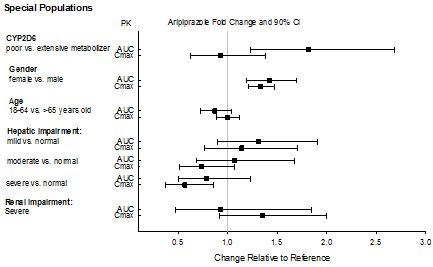
The recommended starting and target dose for ABILIFY is 10 or 15 mg/day administered on a once-a-day schedule without regard to meals. ABILIFY has been systematically evaluated and shown to be effective in a dose range of 10 to 30 mg/day, when administered as the tablet formulation; however, doses higher than 10 or 15 mg/day were not more effective than 10 or 15 mg/day. Dosage increases should generally not be made before 2 weeks, the time needed to achieve steady-state [see CLINICAL STUDIES (14.1)].
Maintenance Treatment: Maintenance of efficacy in schizophrenia was demonstrated in a trial involving patients with schizophrenia who had been symptomatically stable on other antipsychotic medications for periods of 3 months or longer. These patients were discontinued from those medications and randomized to either ABILIFY 15 mg/day or placebo, and observed for relapse [see CLINICAL STUDIES (14.1)]. Patients should be periodically reassessed to determine the continued need for maintenance treatment.
The recommended starting dose for ABILIFY as adjunctive treatment for patients already taking an antidepressant is 2 to 5 mg/day. The recommended dosage range is 2 to 15 mg/day. Dosage adjustments of up to 5 mg/day should occur gradually, at intervals of no less than 1 week [see CLINICAL STUDIES (14.3)]. Patients should be periodically reassessed to determine the continued need for maintenance treatment.
The recommended dose in these patients is 9.75 mg. The recommended dosage range is 5.25 to 15 mg. No additional benefit was demonstrated for 15 mg compared to 9.75 mg. A lower dose of 5.25 mg may be considered when clinical factors warrant. If agitation warranting a second dose persists following the initial dose, cumulative doses up to a total of 30 mg/day may be given. However, the efficacy of repeated doses of ABILIFY injection in agitated patients has not been systematically evaluated in controlled clinical trials. The safety of total daily doses greater than 30 mg or injections given more frequently than every 2 hours have not been adequately evaluated in clinical trials [see CLINICAL STUDIES (14. 6)].
If ongoing ABILIFY therapy is clinically indicated, oral ABILIFY in a range of 10 to 30 mg/day should replace ABILIFY injection as soon as possible [see DOSAGE AND ADMINISTRATION (2.1 and 2.2)].
In an analysis of 13 placebo-controlled monotherapy trials in adults, primarily with schizophrenia or bipolar disorder, the mean change in fasting glucose in ABILIFY-treated patients (+4.4 mg/dL; median exposure 25 days; N=1057) was not significantly different than in placebo-treated patients (+2.5 mg/dL; median exposure 22 days; N=799). Table 6 shows the proportion of ABILIFY-treated patients with normal and borderline fasting glucose at baseline (median exposure 25 days) that had treatment-emergent high fasting glucose measurements compared to placebo-treated patients (median exposure 22 days).
Table 6: Changes in Fasting Glucose From Placebo-Controlled Monotherapy Trials in Adult PatientsFasting Glucose | - Category Change (at least once) from Baseline
| | | |
- Normal to High
- (<100 mg/dL to ≥126 mg/dL)
| | | |
| | |
- Borderline to High
- (≥100 mg/dL and <126 mg/dL to ≥126 mg/dL)
| | | |
| | |
At 24 weeks, the mean change in fasting glucose in ABILIFY-treated patients was not significantly different than in placebo-treated patients [+2.2 mg/dL (n=42) and +9.6 mg/dL (n=28), respectively].
The mean change in fasting glucose in adjunctive ABILIFY-treated patients with major depressive disorder (+0.7 mg/dL; median exposure 42 days; N=241) was not significantly different than in placebo-treated patients (+0.8 mg/dL; median exposure 42 days; N=246). Table 7 shows the proportion of adult patients with changes in fasting glucose levels from two placebo-controlled, adjunctive trials (median exposure 42 days) in patients with major depressive disorder.
Table 7: Changes in Fasting Glucose From Placebo-Controlled Adjunctive Trials in Adult Patients with Major Depressive DisorderFasting Glucose | - Category Change (at least once) from Baseline
| | | |
- Normal to High
- (<100 mg/dL to ≥126 mg/dL)
| | | |
| | |
- Borderline to High
- (≥100 mg/dL and <126 mg/dL to ≥126 mg/dL)
| | | |
| | |
Table 9 shows the proportion of adult patients, primarily from pooled schizophrenia and bipolar disorder monotherapy placebo-controlled trials, with changes in total cholesterol (pooled from 17 trials; median exposure 21 to 25 days), fasting triglycerides (pooled from eight trials; median exposure 42 days), fasting LDL cholesterol (pooled from eight trials; median exposure 39 to 45 days, except for placebo-treated patients with baseline normal fasting LDL measurements, who had median treatment exposure of 24 days) and HDL cholesterol (pooled from nine trials; median exposure 40 to 42 days).
Table 9: Changes in Blood Lipid Parameters From Placebo-Controlled Monotherapy Trials in Adults | | | |
Total Cholesterol Normal to High (<200 mg/dL to ≥240 mg/dL) | | | |
| | |
Fasting Triglycerides Normal to High (<150 mg/dL to ≥200 mg/dL) | | | |
| | |
Fasting LDL Cholesterol Normal to High (<100 mg/dL to ≥160 mg/dL) | | | |
| | |
HDL Cholesterol Normal to Low (≥40 mg/dL to <40 mg/dL) | | | |
| | |
In monotherapy trials in adults, the proportion of patients at 12 weeks and 24 weeks with changes from Normal to High in total cholesterol (fasting/nonfasting), fasting triglycerides, and fasting LDL cholesterol were similar between ABILIFY- and placebo-treated patients: at 12 weeks, Total Cholesterol (fasting/nonfasting), 1/71 (1.4%) vs. 3/74 (4.1%); Fasting Triglycerides, 8/62 (12.9%) vs. 5/37 (13.5%); Fasting LDL Cholesterol, 0/34 (0%) vs. 1/25 (4.0%), respectively; and at 24 weeks, Total Cholesterol (fasting/nonfasting), 1/42 (2.4%) vs. 3/37 (8.1%); Fasting Triglycerides, 5/34 (14.7%) vs. 5/20 (25%); Fasting LDL Cholesterol, 0/22 (0%) vs. 1/18 (5.6%), respectively.
Table 10 shows the proportion of patients with changes in total cholesterol (fasting/nonfasting), fasting triglycerides, fasting LDL cholesterol, and HDL cholesterol from two placebo-controlled adjunctive trials in adult patients with major depressive disorder (median exposure 42 days).
Table 10: Changes in Blood Lipid Parameters From Placebo-Controlled Adjunctive Trials in Adult Patients with Major Depressive Disorder | | | |
Total Cholesterol Normal to High (<200 mg/dL to ≥240 mg/dL) | | | |
| | |
Fasting Triglycerides Normal to High (<150 mg/dL to ≥200 mg/dL) | | | |
| | |
Fasting LDL Cholesterol Normal to High (<100 mg/dL to ≥160 mg/dL) | | | |
| | |
HDL Cholesterol Normal to Low (≥40 mg/dL to <40 mg/dL) | | | |
| | |
In an analysis of 13 placebo-controlled monotherapy trials, primarily from pooled schizophrenia and bipolar disorder, with a median exposure of 21 to 25 days, the mean change in body weight in ABILIFY-treated patients was +0.3 kg (N=1673) compared to –0.1 kg (N=1100) in placebo-controlled patients. At 24 weeks, the mean change from baseline in body weight in ABILIFY-treated patients was –1.5 kg (n=73) compared to
–0.2 kg (n=46) in placebo-treated patients.
In the trials adding ABILIFY to antidepressants, patients first received 8 weeks of antidepressant treatment followed by 6 weeks of adjunctive ABILIFY or placebo in addition to their ongoing antidepressant treatment. The mean change in body weight in patients receiving adjunctive ABILIFY was +1.7 kg (N=347) compared to +0.4 kg (N=330) in patients receiving adjunctive placebo.
Table 14 shows the percentage of adult patients with weight gain ≥7% of body weight by indication.
Table 14:Percentage of Patients From Placebo-Controlled Trials in Adult Patients with Weight Gain ≥7% of Body WeightWeight gain ≥7% of body weight | | | | |
| | | |
| | |
| | | |
| | |
- Major Depressive Disorder (Adjunctive Therapy)c
| | | |
| | |
- a 4-6 weeks duration. b 3 weeks duration. c 6 weeks duration.
|
The efficacy of ABILIFY in the treatment of schizophrenia was evaluated in five short-term (4-week and 6-week), placebo-controlled trials of acutely relapsed inpatients who predominantly met DSM-III/IV criteria for schizophrenia. Four of the five trials were able to distinguish ABILIFY from placebo, but one study, the smallest, did not. Three of these studies also included an active control group consisting of either risperidone (one trial) or haloperidol (two trials), but they were not designed to allow for a comparison of ABILIFY and the active comparators.
In the four positive trials for ABILIFY, four primary measures were used for assessing psychiatric signs and symptoms. Efficacy was evaluated using the total score on the Positive and Negative Syndrome Scale (PANSS). The PANSS is a 30 item scale that measures positive symptoms of schizophrenia (7 items), negative symptoms of schizophrenia (7 items), and general psychopathology (16 items), each rated on a scale of 1 (absent) to 7 (extreme); total PANSS scores range from 30 to 210. The Clinical Global Impression (CGI) assessment reflects the impression of a skilled observer, fully familiar with the manifestations of schizophrenia, about the overall clinical state of the patient.
- In a 4-week trial (n=414) comparing two fixed doses of ABILIFY (15 or 30 mg/day) to placebo, both doses of ABILIFY were superior to placebo in the PANSS total score (Study 1 in Table 26), PANSS positive subscale, and CGI-severity score. In addition, the 15 mg dose was superior to placebo in the PANSS negative subscale.
- In a 4-week trial (n=404) comparing two fixed doses of ABILIFY (20 or 30 mg/day) to placebo, both doses of ABILIFY were superior to placebo in the PANSS total score (Study 2 in Table 26), PANSS positive subscale, PANSS negative subscale, and CGI-severity score.
- In a 6-week trial (n=420) comparing three fixed doses of ABILIFY (10, 15, or 20 mg/day) to placebo, all three doses of ABILIFY were superior to placebo in the PANSS total score (Study 3 in Table 26), PANSS positive subscale, and the PANSS negative subscale.
- In a 6-week trial (n=367) comparing three fixed doses of ABILIFY (2, 5, or 10 mg/day) to placebo, the 10 mg dose of ABILIFY was superior to placebo in the PANSS total score (Study 4 in Table 26), the primary outcome measure of the study. The 2 and 5 mg doses did not demonstrate superiority to placebo on the primary outcome measure.
Thus, the efficacy of 10, 15, 20, and 30 mg daily doses was established in two studies for each dose. Among these doses, there was no evidence that the higher dose groups offered any advantage over the lowest dose group of these studies.
An examination of population subgroups did not reveal any clear evidence of differential responsiveness on the basis of age, gender, or race.
A longer-term trial enrolled 310 inpatients or outpatients meeting DSM-IV criteria for schizophrenia who were, by history, symptomatically stable on other antipsychotic medications for periods of 3 months or longer. These patients were discontinued from their antipsychotic medications and randomized to ABILIFY 15 mg/day or placebo for up to 26 weeks of observation for relapse. Relapse during the double-blind phase was defined as CGI-Improvement score of ≥5 (minimally worse), scores ≥5 (moderately severe) on the hostility or uncooperativeness items of the PANSS, or ≥20% increase in the PANSS total score. Patients receiving ABILIFY 15 mg/day experienced a significantly longer time to relapse over the subsequent 26 weeks compared to those receiving placebo (Study 5 in Figure 6).
The efficacy of ABILIFY in the adjunctive treatment of major depressive disorder (MDD) was demonstrated in two short-term (6-week), placebo-controlled trials of adult patients meeting DSM-IV criteria for MDD who had had an inadequate response to prior antidepressant therapy (1 to 3 courses) in the current episode and who had also demonstrated an inadequate response to 8 weeks of prospective antidepressant therapy (paroxetine controlled-release, venlafaxine extended-release, fluoxetine, escitalopram, or sertraline). Inadequate response for prospective treatment was defined as less than 50% improvement on the 17-item version of the Hamilton Depression Rating Scale (HAMD17), minimal HAMD17 score of 14, and a Clinical Global Impressions Improvement rating of no better than minimal improvement. Inadequate response to prior treatment was defined as less than 50% improvement as perceived by the patient after a minimum of 6 weeks of antidepressant therapy at or above the minimal effective dose.
The primary instrument used for assessing depressive symptoms was the Montgomery-Asberg Depression Rating Scale (MADRS), a 10-item clinician-rated scale used to assess the degree of depressive symptomatology. The key secondary instrument was the Sheehan Disability Scale (SDS), a 3-item self-rated instrument used to assess the impact of depression on three domains of functioning with each item scored from 0 (not at all) to 10 (extreme).
In the two trials (n=381, n=362), ABILIFY was superior to placebo in reducing mean MADRS total scores (Studies 1, 2 in Table 28). In one study, ABILIFY was also superior to placebo in reducing the mean SDS score.
In both trials, patients received ABILIFY adjunctive to antidepressants at a dose of 5 mg/day. Based on tolerability and efficacy, doses could be adjusted by 5 mg increments, one week apart. Allowable doses were: 2, 5, 10, 15 mg/day, and for patients who were not on potent CYP2D6 inhibitors fluoxetine and paroxetine, 20 mg/day. The mean final dose at the end point for the two trials was 10.7 and 11.4 mg/day.
An examination of population subgroups did not reveal evidence of differential response based on age, choice of prospective antidepressant, or race. With regard to gender, a smaller mean reduction on the MADRS total score was seen in males than in females.
Table 28: Adjunctive Treatment of Major Depressive Disorder StudiesStudy Number | Treatment Group | Primary Efficacy Measure: MADRS |
| | Mean Baseline Score (SD) | LS Mean Change from Baseline (SE) | Placebo-subtracted Differencea (95% CI) |
Study 1 | ABILIFY (5-20 mg/day)* + Antidepressant | 25.2(6.2) | -8.49 (0.66) | -2.84 (-4.53 , -1.15) |
| Placebo + Antidepressant | 27.0 (5.5) | -5.65 (0.64) | -- |
Study 2 | ABILIFY (5-20 mg/day)* + Antidepressant | 26.0 (6.0) | -8.78 (0.63) | -3.01 (-4.66 , -1.37) |
| Placebo + Antidepressant | 26.0 (6.5) | -5.77 (0.67) | -- |
SD: standard deviation; SE: standard error; LS Mean: least-squares mean; CI: unadjusted confidence interval. a Difference (drug minus placebo) in least-squares mean change from baseline. * Doses statistically significantly superior to placebo. |