The pharmacokinetics of alfuzosin hydrochloride have been evaluated in adult healthy male volunteers after single and/or multiple administration with daily doses ranging from 7.5 mg to 30 mg, and in patients with BPH at doses from 7.5 mg to 15 mg.
Absorption
The absolute bioavailability of alfuzosin hydrochloride 10 mg tablets under fed conditions is 49%. Following multiple dosing of 10 mg alfuzosin hydrochloride under fed conditions, the time to maximum concentration is 8 hours. Cmax and AUC 0-24 are 13.6 (SD=5.6) ng/mL and 194 (SD= 75) ng·h/mL, respectively. Alfuzosin hydrochloride exhibits linear kinetics following single and multiple dosing up to 30 mg. Steady-state plasma levels are reached with the second dose of alfuzosin hydrochloride administration. Steady-state alfuzosin plasma concentrations are 1.2- to 1.6-fold higher than those observed after a single administration.
Effect of Food
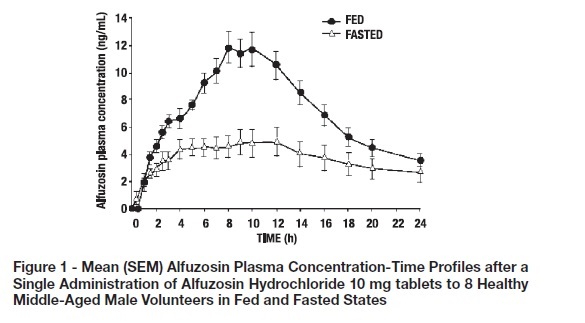
As illustrated in Figure 1, the extent of absorption is 50% lower under fasting conditions.
Therefore, alfuzosin hydrochloride should be taken with food and with the same meal each day [see Dosage and Administration (2)].
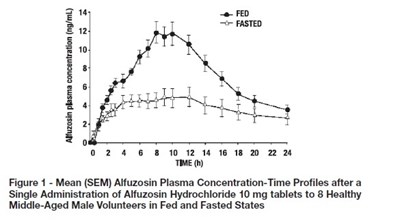
Image (3fb33b8f 9ec4 4a4b A520 De154673cfb0 05)
Distribution
The volume of distribution following intravenous administration in healthy male middle-aged volunteers was 3.2 L/kg. Results of in vitro studies indicate that alfuzosin is moderately bound to human plasma proteins (82% to 90%), with linear binding over a wide concentration range (5 to 5,000 ng/mL).
Metabolism
Alfuzosin undergoes extensive metabolism by the liver, with only 11 % of the administered dose excreted unchanged in the urine. Alfuzosin is metabolized by three metabolic pathways: oxidation, O-demethylation, and N-dealkylation. The metabolites are not pharmacologically active. CYP3A4 is the principal hepatic enzyme isoform involved in its metabolism.
Excretion
Following oral administration of 14C-labeled alfuzosin solution, the recovery of radioactivity after 7 days (expressed as a percentage of the administered dose) was 69% in feces and 24% in urine. Following oral administration of alfuzosin hydrochloride 10 mg tablets, the apparent elimination half-life is 10 hours.
Specific Populations
Geriatric Use: In a pharmacokinetic assessment during phase 3 clinical studies in patients with BPH, there was no relationship between peak plasma concentrations of alfuzosin and age.
However, trough levels were positively correlated with age. The concentrations in subjects ≥75 years of age were approximately 35% greater than in those below 65 years of age.
Renal Impairment: The Pharmacokinetic profiles of alfuzosin hydrochloride 10 mg tablets in subjects with normal renal function (CLCR>80 mL/min), mild impairment (CLCR 60 to 80 mL/min), moderate impairment (CLCR 30 to 59 mL/min), and severe impairment (CLCR <30 mL/min) were compared. These clearances were calculated by the Cockcroft-Gault formula. Relative to subjects with normal renal function, the mean Cmax and AUC values were increased by approximately 50% in patients with mild, moderate, or severe renal impairment [see Warnings and Precautions (5.2) and Use in Specific Populations (8.6)].
Hepatic Impairment: The pharmacokinetics of alfuzosin hydrochloride have not been studied in patients with mild hepatic impairment. In patients with moderate or severe hepatic insufficiency (Child-Pugh categories B and C), the plasma apparent clearance (CL/F) was reduced to approximately one-third to one-fourth that observed in healthy subjects. This reduction in clearance results in three to four-fold higher plasma concentrations of alfuzosin in these patients compared to healthy subjects. Therefore, alfuzosin hydrochloride is contraindicated in patients with moderate to severe hepatic impairment [see Contraindications (4), Warnings and Precautions (5.3) and Use in Specific Populations (8 7)].
Pediatric Use: Alfuzosin hydrochloride tablets are not indicated for use in the pediatric population [see Indications and Usage (1.1) and Use in Specific Populations (8.4)].
Drug-Drug Interactions
Metabolic Interactions
CYP3A4 is the principal hepatic enzyme isoform involved in the metabolism of alfuzosin.
Potent CYP3A4 Inhibitors
Repeated oral administration of 400 mg/day of ketoconazole, a potent inhibitor of CYP3A4, increased alfuzosin Cmax by 2.3-fold and AUClast by 3.2-fold, following a single 10 mg dose of alfuzosin.
In another study, repeated oral administration of a lower (200 mg/day) dose of ketoconazole increased alfuzosin Cmax by 2.1 -fold and AUClast by 2.5-fold, following a single 10 mg dose of alfuzosin.
Therefore, alfuzosin hydrochloride is contraindicated for co-administration with potent inhibitors of CYP3A4 (e.g., ketoconazole, itraconazole, or ritonavir) because of increased alfuzosin exposure [see Contraindications (4), Warnings and Precautions (5.4) and Drug Interactions (7.1)].
Moderate CYP3A4 Inhibitors
Diltiazem: Repeated co-administration of 240 mg/day of diltiazem, a moderately-potent inhibitor of CYP3A4, with 7.5 mg/day (2.5 mg three times daily) alfuzosin (equivalent to the exposure with alfuzosin hydrochloride) increased the Cmax and AUC0-24 of alfuzosin 1.5- and 1.3-fold, respectively. Alfuzosin increased the Cmax and AUC0-12 of diltiazem 1.4-fold. Although no changes in blood pressure were observed in this study, diltiazem is an antihypertensive medication and the combination of alfuzosin hydrochloride and antihypertensive medications has the potential to cause hypotension in some patients [see Warnings and Precautions (5.1)].
In human liver microsomes, at concentrations that are achieved at the therapeutic dose, alfuzosin did not inhibit CYP1A2, 2A6, 2C9, 2C19, 2D6 or 3A4 isoenzymes. In primary culture of human hepatocytes, alfuzosin did not induce CYP1A, 2A6 or 3A4 isoenzymes.
Other Interactions
Warfarin: Multiple dose administration of an immediate release tablet formulation of alfuzosin 5 mg twice daily for six days to six healthy male volunteers did not affect the pharmacological response to a single 25 mg oral dose of warfarin.
Digoxin: Repeated co-administration of alfuzosin hydrochloride 10 mg tablets and digoxin 0.25 mg/day for 7 days did not influence the steady-state pharmacokinetics of either drug.
Cimetidine: Repeated administration of 1 g/day cimetidine increased both alfuzosin Cmax and AUC values by 20%.
Atenolol: Single administration of 100 mg atenolol with a single dose of 2.5 mg of an immediate release alfuzosin tablet in eight healthy young male volunteers increased alfuzosin Cmax and AUC values by 28% and 21 %, respectively. Alfuzosin increased atenolol Cmax and AUC values by 26% and 14%, respectively. In this study, the combination of alfuzosin with atenolol caused significant reductions in mean blood pressure and in mean heart rate. [see Warnings and Precautions (5.1)].
Hydrochlorothiazide: Single administration of 25 mg hydrochlorothiazide did not modify the pharmacokinetic parameters of alfuzosin. There was no evidence of pharmacodynamic interaction between alfuzosin and hydrochlorothiazide in the 8 patients in this study.