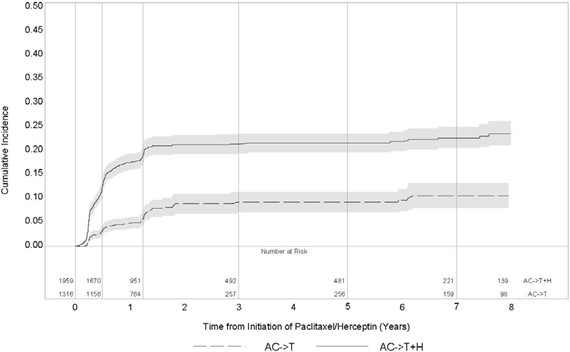
Figure 1
NSABP B31 and NCCTG N9831: Cumulative Incidence of Time to First LVEF Decline of ≥ 10 Percentage Points from Baseline and to Below 50% with Death as a Competing Risk Event
Time 0 is initiation of paclitaxel or trastuzumab + paclitaxel therapy.
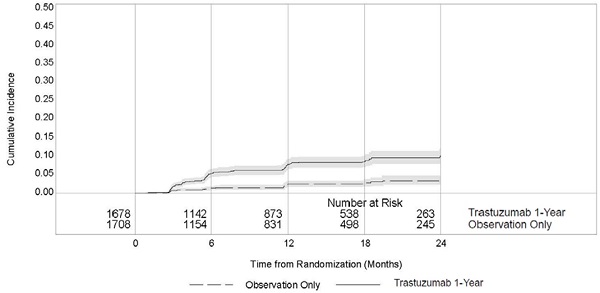
Figure 2
HERA: Cumulative Incidence of Time to First LVEF Decline of ≥ 10 Percentage Points from Baseline and to Below 50% with Death as a Competing Risk Event
Time 0 is the date of randomization.
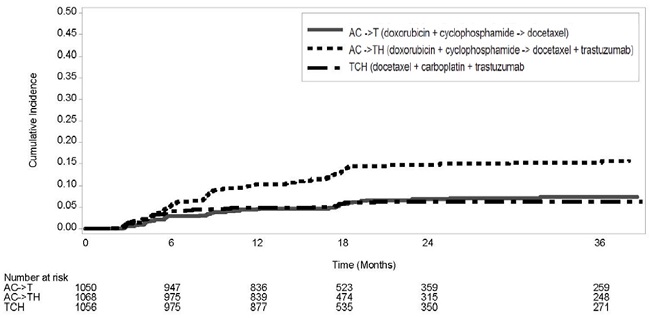
Figure 3
BCIRG006: Cumulative Incidence of Time to First LVEF Decline of ≥10 Percentage Points from Baseline and to Below 50% with Death as a Competing Risk Eventt
Time 0 is the date of randomization.
The incidence of congestive heart failure among patients in the metastatic breast cancer trials was classified for severity using the New York Heart Association classification system (I-IV, where IV is the most severe level of cardiac failure) (see Table 2). In the metastatic breast cancer trials, the probability of cardiac dysfunction was highest in patients who received trastuzumab concurrently with anthracyclines.
In ToGA, 5% of patients in the trastuzumab plus chemotherapy arm compared to 1.1% of patients in the chemotherapy alone arm had LVEF value below 50% with a ≥ 10% absolute decrease in LVEF from pretreatment values.
Infusion Reactions
During the first infusion with trastuzumab, the symptoms most commonly reported were chills and fever, occurring in approximately 40% of patients in clinical trials. Symptoms were treated with acetaminophen, diphenhydramine, and meperidine (with or without reduction in the rate of trastuzumab infusion); permanent discontinuation of trastuzumab for infusion reactions was required in < 1% of patients. Other signs and/or symptoms may include nausea, vomiting, pain (in some cases at tumor sites), rigors, headache, dizziness, dyspnea, hypotension, elevated blood pressure, rash, and asthenia. Infusion reactions occurred in 21% and 35% of patients, and were severe in 1.4% and 9% of patients, on second or subsequent trastuzumab infusions administered as monotherapy or in combination with chemotherapy, respectively. In the post-marketing setting, severe infusion reactions, including hypersensitivity, anaphylaxis, and angioedema have been reported.
Anemia
In randomized controlled clinical trials, the overall incidence of anemia (30% vs. 21% [H0648g]), of selected NCI-CTC Grade 2–5 anemia (12.3% vs. 6.7% [NSABP B31]), and of anemia requiring transfusions (0.1% vs. 0 patients [NCCTG N9831]) were increased in patients receiving trastuzumab and chemotherapy compared with those receiving chemotherapy alone. Following the administration of trastuzumab as a single agent (H0649g), the incidence of NCI-CTC Grade 3 anemia was < 1%. In ToGA (metastatic gastric cancer), on the trastuzumab containing arm as compared to the chemotherapy alone arm, the overall incidence of anemia was 28% compared to 21% and of NCI CTC Grade 3/4 anemia was 12.2% compared to 10.3%.
Neutropenia
In randomized controlled clinical trials in the adjuvant setting, the incidence of selected NCI-CTC Grade 45 neutropenia (1.7% vs. 0.8% [NCCTG N9831]) and of selected Grade 25 neutropenia (6.4% vs. 4.3% [NSABP B31]) were increased in patients receiving trastuzumab and chemotherapy compared with those receiving chemotherapy alone. In a randomized, controlled trial in patients with metastatic breast cancer, the incidences of NCI-CTC Grade 3/4 neutropenia (32% vs. 22%) and of febrile neutropenia (23% vs. 17%) were also increased in patients randomized to trastuzumab in combination with myelosuppressive chemotherapy as compared to chemotherapy alone. In ToGA (metastatic gastric cancer) on the trastuzumab containing arm as compared to the chemotherapy alone arm, the incidence of NCI-CTC Grade 3/4 neutropenia was 36.8% compared to 28.9%; febrile neutropenia 5.1% compared to 2.8%.
Infection
The overall incidences of infection (46% vs. 30% [H0648g]), of selected NCI-CTC Grade 25 infection/febrile neutropenia (24.3% vs. 13.4% [NSABP B31]) and of selected Grade 35 infection/febrile neutropenia (2.9% vs. 1.4% [NCCTG N9831]) were higher in patients receiving trastuzumab and chemotherapy compared with those receiving chemotherapy alone. The most common site of infections in the adjuvant setting involved the upper respiratory tract, skin, and urinary tract.
In BCIRG006, the overall incidence of infection was higher with the addition of trastuzumab to AC-T but not to TCH [44% (AC-TH), 37% (TCH), 38% (AC-T)]. The incidences of NCI-CTC Grade 3-4 infection were similar [25% (AC-TH), 21% (TCH), 23% (AC-T)] across the three arms.
In a randomized, controlled trial in treatment of metastatic breast cancer, the reported incidence of febrile neutropenia was higher (23% vs. 17%) in patients receiving trastuzumab in combination with myelosuppressive chemotherapy as compared to chemotherapy alone.
Pulmonary Toxicity
Adjuvant Breast Cancer
Among women receiving adjuvant therapy for breast cancer, the incidence of selected NCI-CTC Grade 2-5 pulmonary toxicity (14.3% vs. 5.4% [NSABP B31]) and of selected NCI-CTC Grade 3-5 pulmonary toxicity and spontaneous reported Grade 2 dyspnea (3.4% vs. 0.9% [NCCTG N9831]) was higher in patients receiving trastuzumab and chemotherapy compared with chemotherapy alone. The most common pulmonary toxicity was dyspnea (NCI-CTC Grade 2-5: 11.8% vs. 4.6% [NSABP B31]; NCI-CTC Grade 2-5: 2.4% vs. 0.2% [NCCTG N9831]).
Pneumonitis/pulmonary infiltrates occurred in 0.7% of patients receiving trastuzumab compared with 0.3% of those receiving chemotherapy alone. Fatal respiratory failure occurred in 3 patients receiving trastuzumab, one as a component of multi-organ system failure, as compared to 1 patient receiving chemotherapy alone.
In HERA, there were 4 cases of interstitial pneumonitis in the one-year trastuzumab treatment arm compared to none in the observation arm at a median follow-up duration of 12.6 months.
Metastatic Breast Cancer
Among women receiving trastuzumab for treatment of metastatic breast cancer, the incidence of pulmonary toxicity was also increased. Pulmonary adverse events have been reported in the post- marketing experience as part of the symptom complex of infusion reactions. Pulmonary events include bronchospasm, hypoxia, dyspnea, pulmonary infiltrates, pleural effusions, non-cardiogenic pulmonary edema, and acute respiratory distress syndrome. For a detailed description, see Warnings and Precautions (5.4).
Thrombosis/Embolism
In 4 randomized, controlled clinical trials, the incidence of thrombotic adverse events was higher in patients receiving trastuzumab and chemotherapy compared to chemotherapy alone in three studies (2.6% vs. 1.5% [NSABP B31], 2.5% and 3.7% vs. 2.2% [BCIRG006] and 2.1% vs. 0% [H0648g]).
Diarrhea
Among women receiving adjuvant therapy for breast cancer, the incidence of NCI-CTC Grade 2-5 diarrhea (6.7% vs. 5.4% [NSABP B31]) and of NCI-CTC Grade 3-5 diarrhea (2.2% vs. 0% [NCCTG N9831]), and of Grade 1-4 diarrhea (7% vs. 1% [HERA; one-year trastuzumab treatment at 12.6 months median duration of follow-up]) were higher in patients receiving trastuzumab as compared to controls. In BCIRG006, the incidence of Grade 3-4 diarrhea was higher [5.7% AC-TH, 5.5% TCH vs. 3.0% AC-T] and of Grade 1-4 was higher [51% AC-TH, 63% TCH vs. 43% AC-T] among women receiving trastuzumab. Of patients receiving trastuzumab as a single agent for the treatment of metastatic breast cancer, 25% experienced diarrhea. An increased incidence of diarrhea was observed in patients receiving trastuzumab in combination with chemotherapy for treatment of metastatic breast cancer.
Renal Toxicity
In ToGA (metastatic gastric cancer) on the trastuzumab-containing arm as compared to the chemotherapy alone arm the incidence of renal impairment was 18% compared to 14.5%. Severe (Grade 3/4) renal failure was 2.7% on the trastuzumab-containing arm compared to 1.7% on the chemotherapy only arm. Treatment discontinuation for renal insufficiency/failure was 2% on the trastuzumab-containing arm and 0.3% on the chemotherapy only arm.
In the post-marketing setting, rare cases of nephrotic syndrome with pathologic evidence of glomerulopathy have been reported. The time to onset ranged from 4 months to approximately 18 months from initiation of trastuzumab therapy. Pathologic findings included membranous glomerulonephritis, focal glomerulosclerosis, and fibrillary glomerulonephritis. Complications included volume overload and congestive heart failure.
Risk Summary
Trastuzumab products can cause fetal harm when administered to a pregnant woman. In post-marketing reports and published literature, use of trastuzumab during pregnancy resulted in cases of oligohydramnios and of oligohydramnios sequence, manifesting as pulmonary hypoplasia, skeletal abnormalities, and neonatal death
[see Data].Apprise the patient of the potential risks to a fetus. There are clinical considerations if a trastuzumab product is used in a pregnant woman or if a patient becomes pregnant within 7 months following the last dose of a trastuzumab product
[see Clinical Considerations].
The background risk of major birth defects and miscarriage for the indicated population is unknown. In the U.S. general population, the estimated background risk of major birth defects and miscarriage in clinically recognized pregnancies is 2% to 4% and 15% to 20%, respectively
Clinical Considerations
Fetal/Neonatal Adverse Reactions
Monitor women who received HERCESSI
TMduring pregnancy or within 7 months prior to conception for oligohydramnios. If oligohydramnios occurs, perform fetal/neonatal testing that is appropriate for gestational age and consistent with community standards of care.
Data
Human Data
In post-marketing reports and published literature, use of trastuzumab during pregnancy resulted in cases of oligohydramnios and of oligohydramnios sequence. Fetal manifestations included pulmonary hypoplasia, skeletal abnormalities, and neonatal death. These case reports described oligohydramnios in pregnant women who received trastuzumab either alone or in combination with chemotherapy. In most reported cases, amniotic fluid index increased after trastuzumab was stopped. In reported cases where trastuzumab therapy was resumed after amniotic index improved, oligohydramnios recurred.
Animal Data
In studies where trastuzumab was administered to pregnant cynomolgus monkeys during the period of organogenesis at doses up to 25 mg/kg given twice weekly (up to 25 times the recommended weekly human dose of 2 mg/kg), trastuzumab crossed the placental barrier during the early (Gestation Days 20 to 50) and late (Gestation Days 120 to 150) phases of gestation. The resulting concentrations of trastuzumab in fetal serum and amniotic fluid were approximately 33% and 25%, respectively, of those present in the maternal serum but were not associated with adverse developmental effects.
Risk Summary
There is no information regarding the presence of trastuzumab products in human milk, the effects on the breastfed infant, or the effects on milk production. Published data suggest human IgG is present in human milk but does not enter the neonatal and infant circulation in substantial amounts.
Trastuzumab was present in the milk of lactating Cynomolgus monkeys but not associated with neonatal toxicity
[see Data].Consider the developmental and health benefits of breastfeeding along with the mother’s clinical need for HERCESSI
TMtreatment and any potential adverse effects on the breastfed child from HERCESSI
TMor from the underlying maternal condition. This consideration should also take into account the trastuzumab product wash out period of 7 months
[see Clinical Pharmacology (12.3)].
Data
In lactating Cynomolgus monkeys, trastuzumab was present in breast milk at about 0.3% of maternal serum concentrations after pre- (beginning Gestation Day 120) and post-partum (through Post-partum Day 28) doses of 25 mg/kg administered twice weekly (25 times the recommended weekly human dose of 2 mg/kg of trastuzumab products). Infant monkeys with detectable serum levels of trastuzumab did not exhibit any adverse effects on growth or development from birth to 1 month of age.
Pregnancy Testing
Verify the pregnancy status of females of reproductive potential prior to the initiation of HERCESSI
TM.
Contraception
Females
Trastuzumab products can cause embryo-fetal harm when administered during pregnancy. Advise females of reproductive potential to use effective contraception during treatment with HERCESSI
TMand for 7 months following the last dose of HERCESSI
TM[see Use in Specific Populations (8.1) andClinical Pharmacology (12.3)].
Trastuzumab product exposure-response relationships and the time course of pharmacodynamic responses are not fully characterized.
Cardiac Electrophysiology
The effects of trastuzumab on electrocardiographic (ECG) endpoints, including QTc interval duration, were evaluated in patients with HER2 positive solid tumors. Trastuzumab had no clinically relevant effect on the QTc interval duration and there was no apparent relationship between serum trastuzumab concentrations and change in QTcF interval duration in patients with HER2 positive solid tumors.
Specific Populations
Based on a population pharmacokinetic analysis, no clinically significant differences were observed in the pharmacokinetics of trastuzumab based on age (< 65 (n = 1294); ≥ 65 (n = 288)), race (Asian (n = 264); non-Asian (n = 1324)) and renal impairment (mild (creatinine clearance [CLcr] 60 to 90 mL/min) (n = 636) or moderate (CLcr 30 to 60 mL/min) (n = 133)). The pharmacokinetics of trastuzumab products in patients with severe renal impairment, end-stage renal disease with or without hemodialysis, or hepatic impairment is unknown.
Drug Interaction Studies
There have been no formal drug interaction studies performed with trastuzumab products in humans. Clinically significant interactions between trastuzumab and concomitant medications used in clinical trials have not been observed.
Paclitaxel and doxorubicin: Concentrations of paclitaxel and doxorubicin and their major metabolites (i.e., 6-α hydroxyl-paclitaxel [POH], and doxorubicinol [DOL], respectively) were not altered in the presence of trastuzumab when used as combination therapy in clinical trials.
Trastuzumab concentrations were not altered as part of this combination therapy
Docetaxel and carboplatin: When trastuzumab was administered in combination with docetaxel or carboplatin, neither the plasma concentrations of docetaxel or carboplatin nor the plasma concentrations of trastuzumab were altered.
Cisplatin and capecitabine: In a drug interaction substudy conducted in patients in ToGA, the pharmacokinetics of cisplatin, capecitabine and their metabolites were not altered when administered in combination with trastuzumab
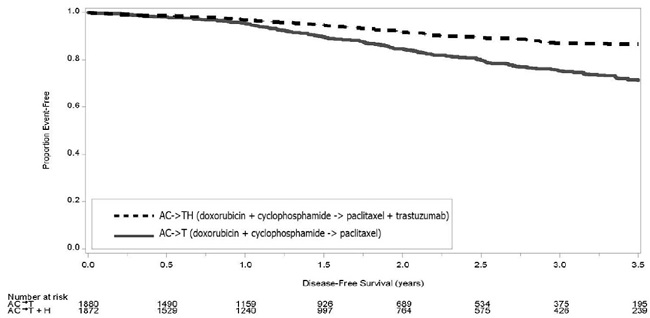
Figure 4:Duration of Disease-Free Survival in Patients with Adjuvant Treatment of Breast Cancer (NSABP B31 and NCCTG N9831)
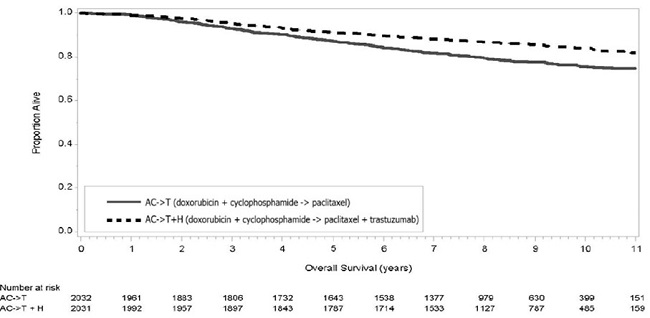
Figure 5 Overall Survival in Patients with
Adjuvant Treatment of Breast Cancer (NSABP B31 and NCCTG N9831)
|
|
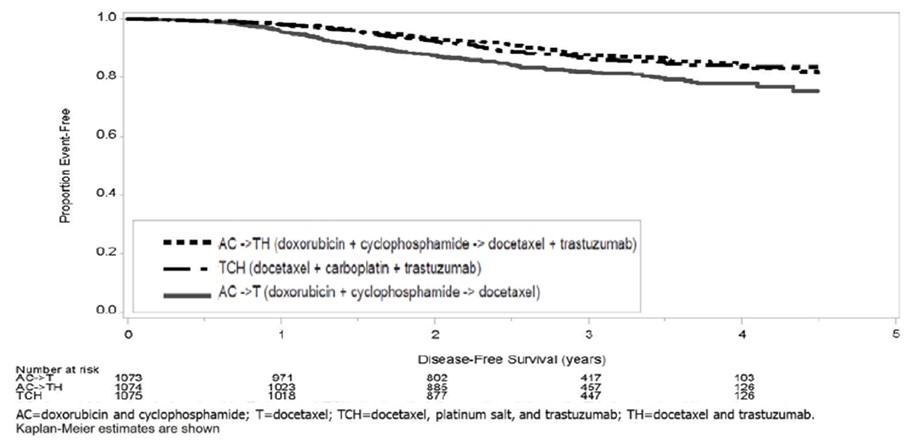
Figure 6
Disease-Free Survival in Patients with Adjuvant Treatment of Breast Cancer (BCIRG006)
Exploratory analyses of DFS as a function of HER2 overexpression or gene amplification were conducted for patients in Studies 2 and 3, where central laboratory testing data were available. The results are shown in Table 10. The number of events in NCCTG N9831 was small with the exception of the IHC 3+/FISH+ subgroup, which constituted 81% of those with data. Definitive conclusions cannot be drawn regarding efficacy within other subgroups due to the small number of events. The number of events in HERA was adequate to demonstrate significant effects on DFS in the IHC 3+/FISH unknown and the FISH+/IHC unknown subgroups.
Table 10: DFS in NCCTG N9831 and HERA for Patients with HER2 Overexpression or Amplification | NCCTG N9831 | HERA
c |
| HER2 Assay Result
a | Number of Patients | Hazard Ratio DFS (95% CI) | Number of Patients | Hazard Ratio DFS (95% CI) |
| IHC 3+ | | | | |
| FISH (+) | 1170 | 0.42
(0.27, 0.64)
| 91 | 0.56
(0.13, 2.50)
|
| FISH (−) | 51 | 0.71
(0.04, 11.79)
| 8 | — |
| FISH Unknown | 51 | 0.69
(0.09, 5.14)
| 2258 | 0.53
(0.41, 0.69)
|
IHC < 3+ /
FISH (+)
| 174 | 1.01
(0.18, 5.65)
| 299
b | 0.53
(0.20, 1.42)
|
| IHC unknown / FISH (+) | — | — | 724 | 0.59
(0.38, 0.93)
|
aIHC by HercepTest, FISH by PathVysion (HER2/CEP17 ratio ≥ 2.0) as performed at a central laboratory.
b All cases in this category in HERA were IHC 2+.
cMedian follow-up duration of 12.6 months in the one-year trastuzumab treatment arm.
Cardiomyopathy:
• Advise patients to contact a health care professional immediately for any of the following: new onset or worsening shortness of breath, cough, swelling of the ankles/legs, swelling of the face, palpitations, weight gain of more than 5 pounds in 24 hours, dizziness or loss of consciousness
[see Boxed Warning: Cardiomyopathy].
Embryo-Fetal Toxicity:
• Advise pregnant women and females of reproductive potential that HERCESSI
TMexposure during pregnancy or within 7 months prior to conception can result in fetal harm. Advise female patients to contact their healthcare provider with a known or suspected pregnancy
[see Use in Specific Populations (8.1)].
• Advise females of reproductive potential to use effective contraception during treatment and for 7 months following the last dose of HERCESSI
TM[see Use in Specific Populations (8.3)].
HERCESSI
TM[trastuzumab-strf]
Manufactured at:
Shanghai Henlius Biologics Co., Ltd.
Building 1, No. 182 Wenjun Road, Songjiang District
Shanghai, China
Manufactured by:
Accord BioPharma Inc.
8041 Arco Corporate Drive, Suite 200,
Raleigh, NC, 27617 USA
U.S. License No. 2105
HERCESSI
TMis a trademark of Accord BioPharma Inc.