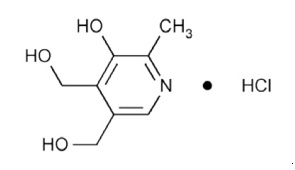
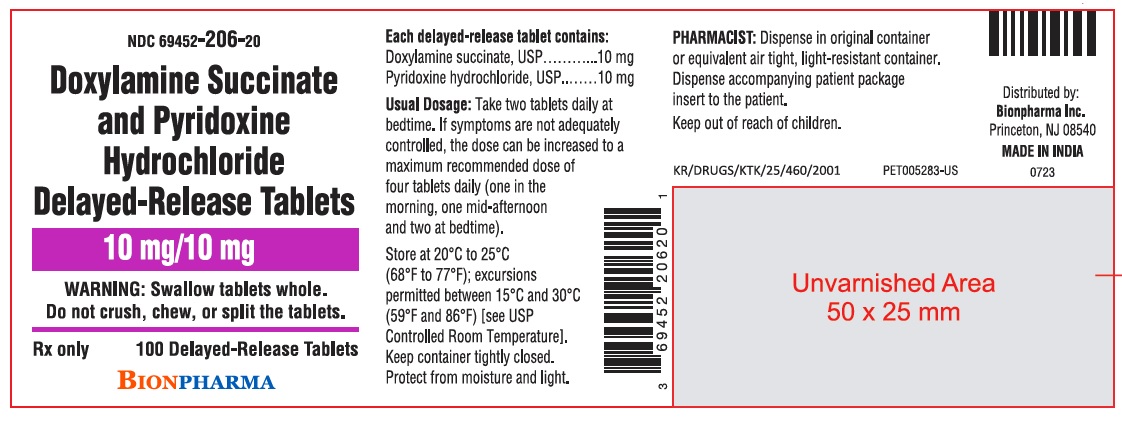
The pharmacokinetics of doxylamine succinate and pyridoxine hydrochloride has been characterized in healthy non-pregnant adult women. Pharmacokinetic results for doxylamine and pyridoxine, including its vitamin B
6metabolites, pyridoxal, pyridoxal 5’-phosphate, pyridoxamine and pyridoxamine 5’-phosphate, are summarized in Tables 2 to 5.
Absorption
A single-dose (two tablets) and multiple-dose (four tablets daily), open-label study was conducted to assess the safety and pharmacokinetic profile of doxylamine succinate and pyridoxine hydrochloride administered in healthy non-pregnant adult women. Single-doses (two tablets at bedtime) were administered on Days 1 and 2. Multiple-doses (one tablet in the morning, one tablet in the afternoon and two tablets at bedtime) were administered on Days 3 to 18.
Blood samples for pharmacokinetic analysis were collected pre-and post-dose on Days 2 and 18 as well as pre-dose prior to bedtime dose only (trough) on Days 9, 10, 11, 16, 17, and 18.
Doxylamine and pyridoxine are absorbed in the gastrointestinal tract, mainly in the jejunum.
The C
maxof doxylamine and pyridoxine are achieved within 7.5 hours and 5.5 hours, respectively (see Table 2).
Table 2: Single-Dose and Multiple-Dose Pharmacokinetics of Doxylamine Succinate and Pyridoxine Hydrochloride in Healthy Non-Pregnant Adult Women | Single Dose | Multiple Dose |
AUC
0-inf | C
max | T
max | AUC
0-inf | C
max | T
max |
(ng•h/mL) | (ng/mL) | (h) | (ng•h/mL) | (ng/mL) | (h) |
Doxylamine | 1,280.9 ± 369.3 | 83.3 ± 20.6 | 7.2 ± 1.9 | 3,721.5 ± 1,318.5 | 168.6 ± 38.5 | 7.8 ± 1.6 |
Pyridoxine | 43.4 ± 16.5 | 32.6 ± 15.0 | 5.7 ± 1.5 | 64.5 ± 36.4 | 46.1 ± 28.3 | 5.6 ± 1.3 |
Pyridoxal | 211.6 ± 46.1 | 74.3 ± 21.8 | 6.5 ± 1.4 | 1,587.2 ± 550.0 | 210.0 ± 54.4 | 6.8 ± 1.2 |
Pyridoxal 5`Phosphate | 1,536.4 ± 721.5 | 30.0 ± 10.0 | 11.7 ± 5.3 | 6,099.7 ± 1,383.7 | 84.9 ± 16.9 | 6.3 ± 6.6 |
Pyridoxamine | 4.1 ± 2.7 | 0.5 ± 0.7 | 5.9 ± 2.1 | 2.6 ± 0.8 | 0.5 ± 0.2 | 6.6 ± 1.4 |
Pyridoxamine 5'-Phosphate | 5.2 ± 3.8 | 0.7 ± 0.5 | 14.8 ± 6.6 | 94.5 ± 58.0 | 2.3 ± 1.7 | 12.4 ± 11.2 |
Multiple-dose administration of doxylamine succinate and pyridoxine hydrochloride results in increased concentrations of doxylamine as well as increases in doxylamine C
maxand AUC
0-lastof absorption. The time to reach the maximum concentration is not affected by multiple doses. The mean accumulation index is more than 1 suggesting that doxylamine accumulates following multiple dosing (see Table 3).
Although no accumulation was observed for pyridoxine, the mean accumulation index for each metabolite (pyridoxal, pyridoxal 5’-phosphate, and pyridoxamine 5’-phosphate) is more than 1 following multiple-dose administration of doxylamine succinate and pyridoxine hydrochloride. The time to reach the maximum concentration is not affected by multiple doses (see Table 2).
Table 3: Pharmacokinetics of Doxylamine and Pyridoxine Following Single Dose and Multiple Dose Administration of Doxylamine Succinate and Pyridoxine Hydrochloride to Healthy Non-Pregnant Adult Women | AUC
0-last(ng•h/mL)
| AUC
0-inf(ng•h/mL)
| C
max(ng/mL)
| T
max(h)
| T
1/2el(h)
|
Doxylamine
Mean ± SD
N = 18
| Single | 911.4 ± 205.6 | 1,280.9 ± 369.3 | 83.3 ± 20.6 | 7.2 ± 1.9 | 10.1 ± 2.1 |
Multiple | 3,661.3 ± 1,279.2 | 3,721.5 ± 1,318.5 | 168.6 ± 38.5 | 7.8 ± 1.6 | 11.9 ± 3.3 |
Pyridoxine
Mean ± SD
N = 18
| Single | 39.3 ± 16.5 | 43.4 ± 16.5 | 32.6 ± 15.0 | 5.7 ± 1.5 | 0.5 ± 0.2 |
Multiple | 59.3 ± 33.9 | 64.5 ± 36.4 | 46.1 ± 28.3 | 5.6 ± 1.3 | 0.5 ± 0.1 |
Food Effect
The administration of food delays the absorption of both doxylamine and pyridoxine. This delay is associated with a lower peak concentration of doxylamine, but the extent of absorption is not affected (see Table 4).
The effect of food on the peak concentration and the extent of absorption of the pyridoxine component is more complex because the pyridoxal, pyridoxamine, pyridoxal 5’-phosphate and pyridoxamine 5’-phosphate metabolites also contribute to the biological activity. Food significantly reduces the bioavailability of pyridoxine, lowering its C
maxand AUC by approximately 50% compared to fasting conditions. Similarly, food significantly reduces pyridoxal AUC and reduces its C
maxby 50% compared to fasting conditions. In contrast, food slightly increases pyridoxal 5’-phosphate C
maxand extent of absorption. As for pyridoxamine and pyridoxamine 5’-phosphate, the rate and extent of absorption seem to decrease under fed conditions.
Table 4: Pharmacokinetics of Doxylamine and Pyridoxine Following Administration of Doxylamine Succinate and Pyridoxine Hydrochloride Under Fed and Fasted Conditions in Healthy Non-Pregnant Adult Women | AUC
0-t(ng•h/mL)
| AUC
0-inf(ng•h/mL)
| C
max(ng/mL)
| T
max(h)
| T
1/2el(h)
|
Doxylamine
Mean ± SD
N = 42
| Fasted | 1,407.2 ± 336.9 | 1,447.9 ± 332.2 | 94.9 ± 18.4 | 5.1 ± 3.4 | 12.6 ± 3.4 |
| Fed | 1,488.0 ± 463.2 | 1,579.0 ± 422.7
N = 37; | 75.7 ± 16.6 | 14.9 ± 7.4 | 12.5 ± 2.9
|
Pyridoxine
Mean ± SD
N = 42
| Fasted | 33.8 ± 13.7 | 39.5 ± 12.9
N = 31; | 35.5 ± 21.4 | 2.5 ± 0.9 | 0.4 ± 0.2
|
| Fed | 18.3 ± 14.5 | 24.2 ±1 4.0
N = 18 | 13.7 ± 10.8 | 9.3 ± 4.0 | 0.5 ± 0.2
|
Distribution
Pyridoxine is highly protein bound, primarily to albumin. Its main active metabolite, pyridoxal 5’-phosphate (PLP) accounts for at least 60% of circulating vitamin B
6concentrations.
Metabolism
Doxylamine is biotransformed in the liver by N-dealkylation to its principal metabolites N-desmethyl-doxylamine and N, N-didesmethyldoxylamine.
Pyridoxine is a prodrug primarily metabolized in the liver.
Excretion
The principal metabolites of doxylamine, N-desmethyl-doxylamine and N, N-didesmethyldoxylamine, are excreted by the kidney.
The terminal elimination half-life of doxylamine and pyridoxine are 12.5 hours and 0.5 hours, respectively (see Table 5).
Table 5: Terminal Elimination Half-Life (T
1/2el) for Doxylamine Succinate and Pyridoxine Hydrochloride
Administered as a Single Dose of Two Tablets under Fasting Conditions in Healthy Non-Pregnant AdultWomen
| T
1/2el (h)
|
| Doxylamine | 12.6 ± 3.4 |
| Pyridoxine | 0.4 ± 0.2 |
| Pyridoxal | 2.1 ± 2.2 |
| Pyridoxal 5’-Phosphate | 81.6 ± 42.2 |
| Pyridoxamine | 3.1 ± 2.5 |
| Pyridoxamine 5’-Phosphate | 66.5 ± 51.3 |
Use in Specific Populations
Race:No pharmacokinetic studies have been conducted related to race.
Hepatic Impairment:No pharmacokinetic studies have been conducted in hepatic impaired patients.
Renal Impairment:No pharmacokinetic studies have been conducted in renal impaired patients.