1 Indications And Usage
NETSPOT, after radiolabeling with Ga 68, is indicated for use with positron emission tomography (PET) for localization of somatostatin receptor positive neuroendocrine tumors (NETs) in adult and pediatric patients.
The following Structured Product Label (SPL) was submitted to the FDA by Advanced Accelerator Applications Usa, Inc for the product Netspot (NDC 69488-001). This document serves as the official prescribing information, containing essential scientific data and clinical materials required for healthcare providers and patients.
This specific version of the label includes detailed information regarding 1 indications and usage, 2.1 radiation safety, 2.2 recommended dosage and administration instructions, 2.3 drug preparation, 2.4 administration, 2.5 specifications and quality control, 2.6 image acquisition, 2.7 image interpretation, and other regulatory disclosures. Use the navigation below to review specific sections of the FDA submission.
NETSPOT, after radiolabeling with Ga 68, is indicated for use with positron emission tomography (PET) for localization of somatostatin receptor positive neuroendocrine tumors (NETs) in adult and pediatric patients.
Drug Handling
After reconstitution and radiolabeling, handle the Ga 68 dotatate injection with appropriate safety measures to minimize radiation exposure [see
Warnings and Precautions (5.1)
]. Use waterproof gloves, effective radiation shielding and appropriate safety measures when preparing and handling Ga 68 dotatate injection.
Radiopharmaceuticals should be used by or under the control of physicians who are qualified by specific training and experience in the safe use and handling of radionuclides, and whose experience and training have been approved by the appropriate governmental agency authorized to license the use of radionuclides.
Patient Preparation
Instruct patients to drink a sufficient amount of water to ensure adequate hydration prior to administration of Ga 68 dotatate. Drink and void frequently during the first hours following administration to reduce radiation exposure.
In adults and pediatric patients, the recommended amount of radioactivity to be administered for PET imaging is 2 MBq/kg of body weight (0.054 mCi/kg) up to 200 MBq (5.4 mCi).
After reconstitution with Ga 68 chloride eluate from an Eckert & Ziegler GalliaPharm Germanium 68/Gallium 68 (Ge 68/Ga 68) generator and buffer, [see Drug Preparation (2.3) ], administer Ga 68 dotatate by intravenous injection (bolus).
Verify the injected radioactivity by measuring the radioactivity of the vial containing the Ga 68 dotatate injection with a dose calibrator before administration to the patient [see Administration (2.4) ]. Ensure that the injected radioactivity is within ±10% of the recommended dose.
The NETSPOT kit is supplied as 2 vials and an accessory cartridge [see Dosage Forms and Strengths (3) ] which allows for direct preparation of Ga 68 dotatate injection with the eluate from an Eckert & Ziegler GalliaPharm Germanium 68/Gallium 68 (Ge 68/Ga 68) generator. The Eckert & Ziegler GalliaPharm Ge 68/Ga 68 generator (“GalliaPharm generator”) is not supplied with the NETSPOT kit. The safety and efficacy of the Ga 68 dotatate injection drug product prepared from the NETSPOT kit has been established only when using a Ga 68 chloride solution eluted from the GalliaPharm generator.
Components of the kit:
Prepare Ga 68 dotatate for intravenous injection according to the following aseptic procedure (Figure 1):
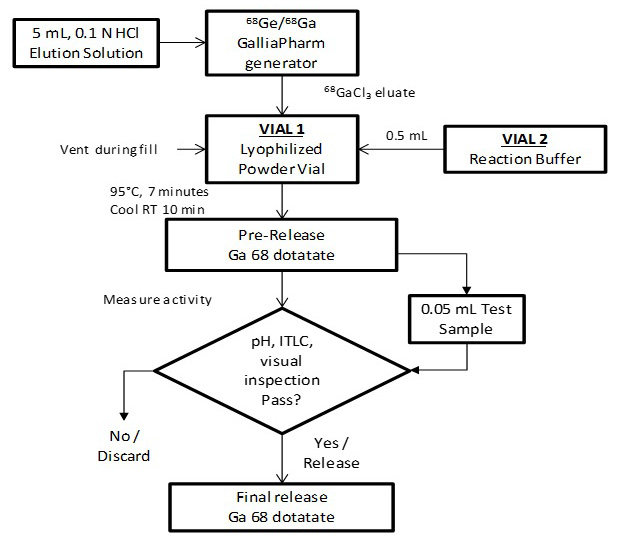
Fig1 (Fig1)
Prior to use, visually inspect the prepared Ga 68 dotatate injection behind a lead glass shield for radioprotection purposes. Only use solutions that are clear without visible particles. Using a
single-dose syringe fitted with a sterile needle and protective shielding, aseptically withdraw the prepared Ga 68 dotatate injection prior to administration. Measure the total radioactivity in the syringe by a dose calibrator immediately prior to administration. The dose calibrator must be calibrated with National Institute of Standards and Technology (NIST) traceable standards.
Handle and dispose radioactive material in accordance with applicable regulations.
Perform the quality controls in Table 1 behind a lead glass shield for radioprotection purposes.
Test | Acceptance Criteria | Method |
Appearance | Colorless and particulate free | Visual Inspection |
pH | 3.2 – 3.8 | pH-indicator strips |
Labeling Efficiency | Ga 68 dotatate ≥ 92% and Other Ga 68 species ≤ 5% | Thin layer chromatography (ITLC, see details below) |
Determine labeling efficiencyof Ga 68 dotatate:
Obtain the following materials:
Perform the following:
For Ga 68 dotatate PET imaging, the acquisition must include a whole body acquisition from skull to mid-thigh. Images can be acquired 40 to 90 minutes after the intravenous administration of the Ga 68 dotatate. Adapt imaging acquisition delay and duration according to the equipment used, and the patient and tumor characteristics, in order to obtain the best image quality possible.
Ga 68 dotatate binds to somatostatin receptors. Based upon the intensity of the signals, PET images obtained using Ga 68 dotatate indicate the presence and density of somatostatin receptors in tissues. Tumors that do not bear somatostatin receptors will not be visualized. Increased uptake in tumors is not specific for NET [see Warnings and Precautions (5.2)] .
Estimated radiation absorbed doses per injection activity for organs and tissues of adult patients following an intravenous bolus of Ga 68 dotatate are shown in Table 2. Estimated radiation effective doses per injection activity for adult and pediatric patients following an intravenous bolus of Ga 68 dotatate are shown in Table 3.
Gallium Ga 68 decays with a half-life of 68 minutes to stable zinc Zn 68:
The effective radiation dose resulting from the administration of 150 MBq (4.05 mCi) [within the range of the recommended Ga 68 dotatate injection dose] to an adult weighing 75 kg, is about 3.15 mSv. For an administered activity of 150 MBq (4.05 mCi) the typical radiation dose to the critical organs, which are the urinary bladder wall, the spleen and the kidneys/adrenals, are about 18, 16 and 12 mGy, respectively. Because the spleen has one of the highest physiological uptakes, higher uptake and radiation dose to other organs or pathologic tissues may occur in patients with splenectomy.
1. Physical data
Gamma constant: 0.67 mrem/hr per mCi at 1 meter [1.8E-4 mSv/hr per MBq at 1 meter]
Specific Activity: 4.1E7 Ci/g [1.51E18 Bq/g] max
2. Shielding
Lead [Pb] Half Value Layer [HVL]: 6 mm (0.24 in)
Tenth Value Layer [TVL]: 17 mm (0.67 in)
| Absorbed Dose per Injection Activity in Selected Organs and Tissues of Adults | mGy/MBq | mGy/150 MBq | |
| Mean | SD | ||
| Adrenals | 0.086 | 0.052 | 12.90 |
| Brain | 0.010 | 0.002 | 1.50 |
| Breasts | 0.010 | 0.002 | 1.50 |
| Gallbladder wall | 0.016 | 0.002 | 2.40 |
| Lower large intestine wall | 0.015 | 0.002 | 2.25 |
| Small intestine | 0.025 | 0.004 | 3.75 |
| Stomach wall | 0.013 | 0.002 | 1.95 |
| Upper large intestine wall | 0.021 | 0.003 | 3.15 |
| Heart wall | 0.018 | 0.003 | 2.70 |
| Kidneys | 0.093 | 0.016 | 13.95 |
| Liver | 0.050 | 0.015 | 7.50 |
| Lungs | 0.006 | 0.001 | 0.90 |
| Muscle | 0.012 | 0.002 | 1.80 |
| Ovaries | 0.016 | 0.001 | 2.40 |
| Pancreas | 0.015 | 0.002 | 2.25 |
| Red marrow | 0.015 | 0.003 | 2.25 |
| Osteogenic cells | 0.021 | 0.005 | 3.15 |
| Skin | 0.010 | 0.002 | 1.50 |
| Spleen | 0.109 | 0.058 | 16.35 |
| Testes | 0.010 | 0.001 | 1.50 |
| Thymus | 0.012 | 0.002 | 1.80 |
| Thyroid | 0.011 | 0.002 | 1.65 |
| Urinary bladder wall | 0.098 | 0.048 | 14.70 |
| Uterus | 0.015 | 0.002 | 2.25 |
| Total body | 0.014 | 0.002 | 2.10 |
| Effective dose per injection activity | mSy/MBq | mSy/150 MBq | |
| 0.021 | 0.003 | 3.15 |
Age | Effective Dose per Injection Activity (mSv/MBq) |
Adult | 0.021 |
15 years | 0.025 |
10 years | 0.040 |
5 years | 0.064 |
1 year | 0.13 |
Newborn | 0.35 |
Table 3 indicates how effective dose per injection activity scales with body habitus in computational models of adult and pediatric patients.
NETSPOT is supplied as a single-dose kit, containing two vials and an accessory cartridge for preparation of Ga 68 dotatate injection:
Gallium 68 is obtained from an Eckert & Ziegler GalliaPharm Ge 68/Ga 68 generator and is not part of the kit.
After reconstitution with Ga68 and pH adjustment with Reaction Buffer, Vial 1 contains a sterile solution of Ga68 dotatate at a strength of 79.3 – 201.8 MBq/mL (2.1 – 5.45 mCi/mL).
None
Ga 68 dotatate contributes to a patient’s overall long-term cumulative radiation exposure. Long-term cumulative radiation exposure is associated with an increased risk of cancer. Ensure safe handling and preparation reconstitution procedures to protect patients and health care workers from unintentional radiation exposure [ see Dosage and Administration (2.1)]
The uptake of Ga 68 dotatate reflects the level of somatostatin receptor density in NETs. However, uptake can also be seen in a variety of other tumor types (e.g. those derived from neural crest tissue). Increased uptake might also be seen in other pathologic conditions (e.g. thyroid disease or subacute inflammation) or might occur as a normal physiologic variant (e.g. uncinate process of the pancreas). The uptake may need to be confirmed by histopathology or other assessments [see Image Interpretation (2.7) ] .
The safety of Ga 68 dotatate was evaluated in three single center studies [see Clinical Studies (14)] and in a survey of the scientific literature. No serious adverse reactions were identified.
The following adverse reactions have been identified during post-approval use of NETSPOT. Because these reactions are reported voluntarily from a population of uncertain size, it is not always possible to reliably estimate their frequency or establish a causal relationship to the drug.
Gastrointestinal Disorders: Nausea and vomiting
General Disorders and Administration Site Conditions: Injection site pain and burning sensation
Non-radioactive somatostatin analogs competitively bind to the same somatostatin receptors as Ga 68 dotatate. Image patients with Ga 68 dotatate PET just prior to dosing with long-acting analogs of somatostatin. Short-acting analogs of somatostatin can be used up to 24 hours before imaging with Ga 68 dotatate.
Risk Summary
There are no studies with Ga 68 dotatate in pregnant women to inform any drug-associated risks; however, all radiopharmaceuticals, including Ga 68 dotatate have the potential to cause fetal harm. Animal reproduction studies have not been conducted with Ga 68 dotatate.
In the U.S general population, the estimated background risks of major birth defects and miscarriage in clinically recognized pregnancies are 2-4% and 15-20%, respectively.
Risk Summary
There is no information on the presence of Ga 68 dotatate in human milk, the effect on the breastfed infant, or the effect on milk production. The developmental and health benefits of breastfeeding should be considered along with the mother’s clinical need for Ga 68 dotatate injection and any potential adverse effects on the breastfed child from Ga 68 dotatate injection or from the underlying maternal condition.
Clinical Considerations
Advise a lactating woman to interrupt breastfeeding and pump and discard breast milk for 12 hours after Ga 68 dotatate administration in order to minimize radiation exposure to a breastfed infant.
The efficacy of Ga 68 dotatate PET imaging in pediatric patients with neuroendocrine tumors is based on extrapolation from adult studies, from studies demonstrating the ability of Ga 68 dotatate to bind to somatostatin receptors [see Clinical Pharmacology (12.1) ], and from a published study of Ga 68 dotatate PET imaging in pediatric patients with somatostatin receptor positive tumors. The safety profile of Ga 68 dotatate is similar in adult and pediatric patients with somatostatin receptor positive tumors. The recommended Ga 68 dotatate injection dose in pediatric patients is weight based as in adults [see Dosage and Administration (2.2) ].
Clinical studies of Ga 68 dotatate injection did not include sufficient numbers of subjects aged 65 and over, to determine whether they respond differently from younger subjects. Other reported clinical experience has not identified differences in responses between the elderly and younger patients.
In the event of a radiation overdose, the absorbed dose to the patient should be reduced where possible by increasing the elimination of the radionuclide from the body by reinforced hydration and frequent bladder voiding. A diuretic might also be considered. If possible, an estimate of the radioactive dose given to the patient should be performed.
NETSPOT is supplied as a sterile, single-dose kit for preparation of Ga 68 dotatate injection for intravenous use.
Dotatate, also known as DOTA-0-Tyr3-Octreotate, is a cyclic 8 amino acid peptide with a covalently bound chelator (dota). The peptide has the amino acid sequence: H-D-Phe-Cys-Tyr-D-Trp-Lys-Thr-Cys-Thr-OH, and contains one disulfide bond. Dotatate has a molecular weight of 1435.6 Daltons and its chemical structure is shown in Figure 2 .
Figure 2 Chemical Structure of dotatate
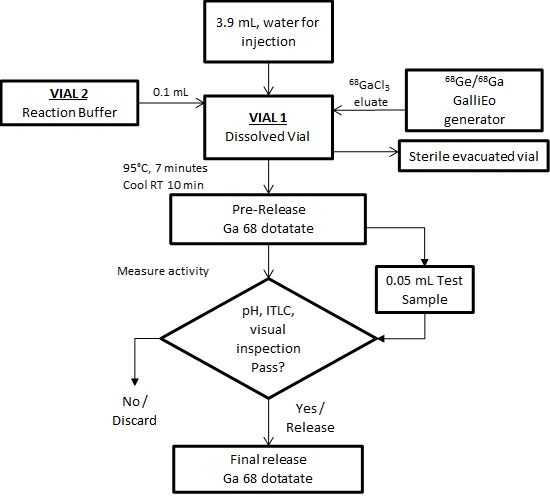
Fig2 (Fig2)
[(4,7,10-Tricarboxymethyl-1,4,7,10-tetrazacyclododec-1-yl)acetyl]-(D)-Phenylalanyl-(L)Cysteinyl-(L)-Tyrosyl-(D)-Tryptophanyl-(L)-Lysyl-(L)-Threoninyl-(L)-Cysteinyl-(L)-Threonine-cyclic(2-7) disulfide
NETSPOT is a Kit with the following components:
After reconstitution and radiolabeling, [see Dosage and Administration (2.3) ], Ga 68 dotatate injection also contains hydrochloric acid as an excipient derived from the generator eluate. The prepared Ga 68 dotatate injection for intravenous use, is a sterile, pyrogen free, clear, colorless, buffered solution, with a pH -between 3.2 - 3.8. Table 4, Table 5, and Table 6 display the principle radiation emission data, radiation attenuation by lead shielding, and physical decay of Ga 68.
| Radiation
/Emission | % Disintegration | Mean Energy
(MeV) |
| beta+ | 88% | 0.8360 |
| beta+ | 1.1% | 0.3526 |
| gamma | 178% | 0.5110 |
| gamma | 3% | 1.0770 |
| X-ray | 2.8% | 0.0086 |
| X-ray | 1.4% | 0.0086 |
| Shield Thickness (Pb) mm | Coefficient of Attenuation |
| 6 | 0.5 |
| 12 | 0.25 |
| 17 | 0.1 |
| 34 | 0.01 |
| 51 | 0.001 |
| Minutes | Fraction Remaining |
| 0 | 1.000 |
| 15 | 0.858 |
| 30 | 0.736 |
| 60 | 0.541 |
| 90 | 0.398 |
| 120 | 0.293 |
| 180 | 0.158 |
| 360 | 0.025 |
Ga 68 dotatate binds to somatostatin receptors, with highest affinity for subtype 2 receptors (sstr2).
It binds to cells that express somatostatin receptors including malignant cells, which overexpress sstr2 receptors. Gallium 68 ( 68Ga) is a β+ emitting radionuclide with an emission yield that allows positron emission tomography (PET) imaging.
The relationship between Ga 68 dotatate plasma concentrations and successful imaging was not explored in clinical trials.
Distribution
Ga 68 dotatate distributes to all sstr2-expressing organs such as pituitary, thyroid, spleen, adrenals, kidney, pancreas, prostate, liver, and salivary glands . There is no uptake in the cerebral cortex or in the heart, and usually thymus and lung uptakes are low.
Elimination
A total of 12% of the injected dose is excreted in urine in the first four hours post-injection.
No animal studies on fertility, embryology, mutagenic potential, or carcinogenic potential have been conducted with Ga 68 dotatate. However, genotoxicity studies conducted with a very similar molecule (mixture Lu 175 dotatate/dotatate) shows that these non-radioactive compounds do not induce mutation at the TK locus of L5178Y mouse lymphoma cells in vitro, nor reverse mutation in Salmonella typhimurium, or Escherichia coli (both in the absence or presence of S9 metabolic activation).
The efficacy of NETSPOT was established in three open label single center studies (Study A-C).
In Study A, 97 adult patients (mean age 54; 41men and 56 women) with known or suspected neuroendocrine tumors (NETs) were evaluated with Ga 68 dotatate PET. The Ga 68 dotatate images were read by two independent readers blinded to clinical information. The reads were compared to CT and/or MR images and to indium In 111 pentetreotide images obtained with Single Photon Emission Computed Tomography (SPECT) within previous 3 years. Among 78 patients in whom CT and/or MR images and In 111 pentetreotide images were available, Ga 68 dotatate PET was in agreement with the CT and/or MR images in 74 patients. Out of 50 patients with NETs localized by CT and/or MR imaging, Ga 68 dotatate was positive in 48 patients including 13 patients in whom In 111 pentetreotide was negative. Ga 68 dotatate was negative in 26 out of 28 patients in whom CT and/or MR imaging was negative.
Study B was a published study which involved 104 patients (mean age 58; 52 men and 52 women) with suspected NETs due to clinical symptoms, elevated levels of tumor markers, or indeterminate tumors suggestive of NET. Diagnostic performance of Ga 68 dotatate PET in localizing tumor sites was retrospectively assessed using a reference standard: histopathology (n=49) or clinical follow up of up to 5 month duration (n=55). Images were interpreted by consensus between two on-site readers who were not blinded to clinical information. NET sites were localized by reference standard in 36 patients (all by histopathology). Out of these, Ga 68 dotatate was positive, correctly identifying an NET site, in
29 patients and was falsely negative in seven. In 68 patients with no NET identified by a reference standard, the images were negative in 61 and falsely positive in seven patients.
Study C was a published study which involved 63 patients (mean age 58; 34 men and 29 women) evaluated for NET recurrence using a reference standard as described for Study B.
Ga 68 dotatate images were interpreted independently by two central readers blinded to clinical information. Reader 1 correctly localized NETs in 23 out of 29 reference standard-positive patients and reader 2 correctly localized NETs in 22 such patients. In 34 patients with no NET identified by a reference standard, reader 1 was correct in 29 patients and reader 2 in 32.
NETSPOT is supplied as a single-dose kit (NDC# 69488-001-40) for preparing a single-dose of gallium 68 (Ga 68) radiolabeled dotatate injection.
The kit contains:
The radionuclide is not part of the kit. Before reconstitution and radiolabelling with Ga 68, the contents of this kit are not radioactive.
Expiry date is indicated on the original outer packaging, and on the vials. This medicinal product must not be used beyond the date indicated on the packaging.
For prolonged storage, store NETSPOT in its original packaging at room temperature below 25°C (do not freeze). After reconstitution and radiolabeling [see Dosage and Administration (2.3) ] with activities of up to 1110 MBq (30 mCi), keep Ga 68 dotatate injection upright with an appropriate shielding to protect from radiation, at a temperature below 25 °C (do not freeze), and for a maximum of 4 hours. The storage of the radiolabelled product must comply with regulatory requirements for radioactive materials.
Adequate Hydration
Advise patients to drink a sufficient amount of water to ensure adequate hydration before their PET study and urge them to drink and urinate as often as possible during the first hours following the administration of Ga 68 dotatate injection, in order to reduce radiation exposure [see Dosage and Administration (2.3) ].
Lactation
Advise a lactating woman to interrupt breastfeeding and pump and discard breast milk for 12 hours after Ga 68 dotatate injection administration in order to minimize radiation exposure to a breastfed infant [see Use in Specific Populations (8.2)] .
Manufactured by:
Gipharma S.r.l.
Strada Crescentino snc-1
3040 Saluggia (Vc), Italy
Distributed by:
Advanced Accelerator Applications USA, Inc., NY 10118
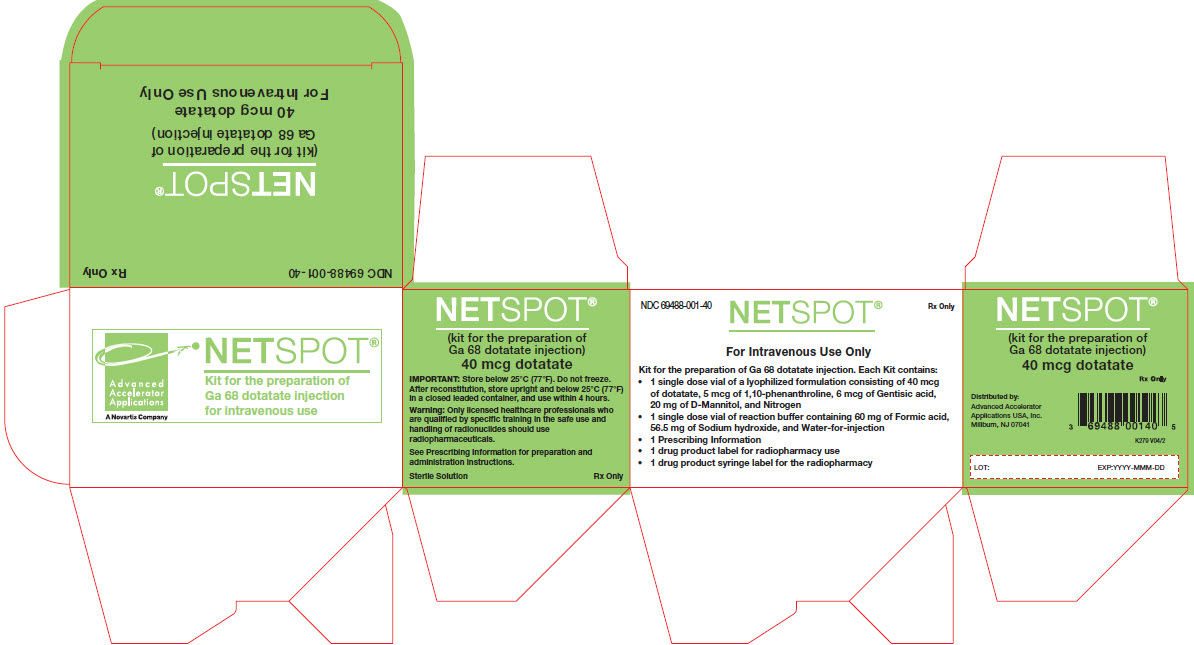
Carton (Carton)

Syringe (Syringe)
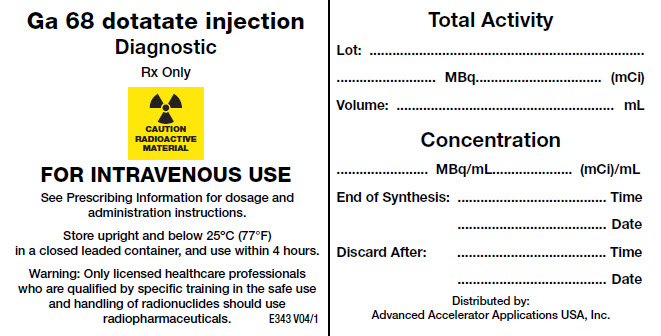
Reconstitution (Reconstitution)
* Please review the disclaimer below.
