Other
Ultra-Rapid Metabolism of Codeine and Other Risk Factors for Life-Threatening Respiratory Depression in Children
Life threatening respiratory depression and death have occurred in children who received codeine; most cases followed tonsillectomy and/or adenoidectomy and many of the children had evidence of being an ultra-rapid metabolizer of codeine due to a CYP2D6 polymorphism. [See Warnings and Precautions (5.1)]. TUXARIN ER is contraindicated in children younger than 12 years of age and in children younger than 18 years of age following tonsillectomy and/or adenoidectomy [See Contraindications(4)]. Avoid the use of TUXARIN ER in adolescents 12 to 18 years of age who have other risk factors that may increase their sensitivity to the respiratory depressant effects of codeine. [See Warnings and Precautions (5.1)].
Concomitant Use with Benzodiazepines, CNS Depressants
Concomitant use of opioids with benzodiazepines or other central nervous system (CNS) depressants, including alcohol, may result in profound sedation, respiratory depression, coma, and death [see Warning and Precautions (5.2) Drug Interactions (7.1)]. Avoid use of opioid cough medications in patients taking benzodiazepines, other CNS depressants, or alcohol.
Important Limitations of Use
Not indicated for pediatric patients under 18 years of age [see Use in Special Population (8.4)]
Nursing Mothers
At least one death was reported in a nursing infant who was exposed to high levels of morphine in breast milk because the mother was an ultra-rapid metabolizer of codeine. Breastfeeding is not recommended during treatment with TUXARIN ER [see Use in Specific Populations (8.3)].
CYP2D6 Genetic Variability: Ultra-rapid metabolizer
Some individuals may be ultra-rapid metabolizers because of a specific CYP2D6 genotype (e.g., gene duplications denoted as *1/*1×N or *1/*2×N). The prevalence of this CYP2D6 phenotype varies widely and has been estimated at 1 to 10% for Whites (European, North American), 3 to 4% for Blacks (African Americans), 1 to 2% for East Asians (Chinese, Japanese, Korean), and may be greater than 10% in certain ethnic groups (i.e., Oceanian, Northern African, Middle Eastern, Ashkenazi Jews, Puerto Rican). These individuals convert codeine into its active metabolite, morphine, more rapidly and completely than other people. This rapid conversion results in higher than expected serum morphine levels.
Even at labeled dosage regimens, individuals who are ultra-rapid metabolizers may have life-threatening or fatal respiratory depression or experience signs of overdose (such as extreme sleepiness, confusion, or shallow breathing) [see Overdosage (10)] . Therefore, individuals who are ultra-rapid metabolizers should not use TUXARIN ER.
Pregnancy Category C
There are no adequate and well-controlled studies of TUXARIN ER in pregnant women.
Reproductive toxicity studies have not been conducted with TUXARIN ER; however, studies are available with individual active ingredients or related active ingredients. Because animal reproduction studies are not always predictive of human response, TUXARIN ER should be used during pregnancy only if the benefit justifies the potential risk to the fetus.
Codeine:
Codeine has embryolethal and fetotoxic effects in rats. In a study in which pregnant rats were dosed throughout organogenesis, a dose approximately 15 times the maximum recommended human daily dose (MRHDD; on a mg/m2 basis at an oral maternal dose of 120 mg/kg/day) increased resorptions and decreased fetal weight; however, these effects occurred in the presence of maternal toxicity.
In studies in which rabbits and mice were dosed throughout organogenesis, codeine at doses approximately 7 and 35 times the MRHDD (on a mg/m2 basis at 30 and 600 mg/kg/day, respectively) produced no adverse developmental effects.
Chlorpheniramine:
A retrospective study found a small, but statistically significant, association between maternal use of chlorpheniramine and inguinal hernia and eye or ear anomalies in children. Other retrospective studies have found that the frequency of congenital anomalies, in general, was not increased among offspring of women who took chlorpheniramine during pregnancy. The significance of these findings to the therapeutic use of chlorpheniramine in human pregnancy is not known.
In studies with chlorpheniramine in which pregnant rats and rabbits were dosed throughout organogenesis, oral doses up to approximately 25 and 30 times the MRHDD on a mg/m2 basis, respectively, produced no adverse developmental effects. However, when mice were dosed throughout pregnancy, a dose approximately 9 times the MRHDD (on a mg/m2 basis at an oral maternal dose of 20 mg/kg/day) was embryolethal, and postnatal survival was decreased when dosing was continued after parturition. Embryolethality was also observed when male and female rats were dosed with approximately 9 times the MRHDD (on a mg/m2 basis at an oral parental dose of 10 mg/kg/day) prior to mating.
Codeine:
Babies born to mothers who have been taking opioids regularly prior to delivery will be physically dependent. The withdrawal signs include irritability and excessive crying, tremors, hyperactive reflexes, increased respiratory rate, increased stools, sneezing, yawning, vomiting, and fever. The intensity of the syndrome does not always correlate with the duration of maternal opioid use or dose.
Risk Summary
Codeine and its active metabolite, morphine, are present in human milk. There are published studies and cases that have reported excessive sedation, respiratory depression, and death in infants exposed to codeine via breast milk. Women who are ultra-rapid metabolizers of codeine achieve higher than expected serum levels of morphine, potentially leading to higher levels of morphine in breast milk that can be dangerous in their breastfed infants. In women with normal codeine metabolism (normal CYP2D6 activity), the amount of codeine secreted into human milk is low and dose- dependent. There is no information on the effects of the codeine on milk production. Because of the potential for serious adverse reactions, including excess sedation, respiratory depression, and death in a breastfed infant, advise patients that breastfeeding is not recommended during treatment with TUXARIN ER [see Warnings and Precautions (5.1)].
Clinical Considerations
If infants are exposed to TUXARIN ER through breast milk, they should be monitored for excess sedation and respiratory depression. Withdrawal symptoms can occur in breastfed infants when maternal administration of an opioid analgesic is stopped, or when breast-feeding is stopped.
Chlorpheniramine is excreted in human milk. The clinical significance is unknown; however, the anticholinergic action of chlorpheniramine may suppress lactation if taken prior to nursing.
Codeine
Overdosage with codeine is characterized by respiratory depression (a decrease in respiratory rate and/or tidal volume, Cheyne-Stokes respiration, cyanosis), extreme somnolence progressing to stupor or coma, skeletal muscle flaccidity, cold and clammy skin, and sometimes bradycardia and hypotension. In severe overdosage, apnea, circulatory collapse, cardiac arrest, and death may occur.
Codeine may cause miosis, even in total darkness. Pinpoint pupils are a sign of opioid overdose but are not pathognomonic (e.g., pontine lesions of hemorrhagic or ischemic origin may produce similar findings). Marked mydriasis rather than miosis may be seen with hypoxia in overdose situations.
Chlorpheniramine
Manifestations of chlorpheniramine overdosage may vary from central nervous system depression to stimulation. Central toxic effects are characterized by agitation, anxiety, delirium, disorientation, hallucinations, hyperactivity, sedation, and seizures. Severe overdosage may produce coma, medullary paralysis, and death. Peripheral toxicity includes hypertension, tachycardia, dysrhythmias, vasodilation, hyperpyrexia, mydriasis, urinary retention, and diminished gastrointestinal motility. Dry mouth, pharynx, bronchi, and nasal passages may be observed.
Impaired secretion from sweat glands following toxic doses of drugs with anticholinergic side effects may predispose to hyperthermia.
An adult ingested 400 mg chlorpheniramine with no reported serious adverse effects. Toxic psychosis, a possible class effect from overdose of sedating antihistamines, has been reported with accidental overdose of chlorpheniramine.
Treatment of overdosage consists of discontinuation of TUXARIN ER together with institution of appropriate therapy.
Give primary attention to re-establishment of adequate respiratory exchange through provision of a patent airway and the institution of assisted or controlled ventilation. The opioid antagonist naloxone hydrochloride is a specific antidote for respiratory depression that may result from overdosage or unusual sensitivity to opioids including codeine. Therefore, an appropriate dose of naloxone hydrochloride should be administered, preferably by the intravenous route, simultaneously with efforts at respiratory resuscitation. For further information, see full prescribing information for naloxone hydrochloride. An antagonist should not be administered in the absence of clinically significant respiratory or circulatory depression. Oxygen, intravenous fluids, vasopressors, and other supportive measures should be employed as indicated. Gastric emptying may be useful in removing unabsorbed drug.
Hemodialysis is not routinely used to enhance the elimination of codeine or chlorpheniramine from the body. Urinary excretion of chlorpheniramine is increased when the pH of the urine is acidic; however, acid diuresis is NOT recommended to enhance elimination in overdose, as the risks of acidemia and acute tubular necrosis in patients with rhabdomyolysis far outweigh any potential benefits.
Codeine: Codeine is a semisynthetic narcotic antitussive and analgesic with multiple actions qualitatively similar to those of morphine. The precise mechanism of action of codeine and other opiates is not known; however, codeine is believed to act centrally on the cough center. In excessive doses, codeine will depress respiration. Codeine can produce miosis, euphoria, and physical and physiological dependence.
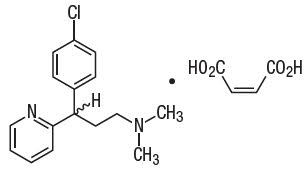
Chlorpheniramine: Chlorpheniramine is a propylamine derivative antihistamine (H1-receptor antagonist) of the alkylamine class that also possesses anticholinergic and sedative activity. It prevents released histamine from dilating capillaries and causing edema of the respiratory mucosa.
Absorption
Pharmacokinetic (PK) parameters (Mean ± SD) for TUXARIN ER in fasting, healthy volunteers are shown in the table below.
| PK Parameter | Single-dose | Multiple-dose (BID for 6.5 days) | ||
|---|---|---|---|---|
| Codeine Mean (±SD) | Chlorpheniramine Maleate Mean (± SD) | Codeine Mean (± SD) | Chlorpheniramine Maleate Mean (± SD) | |
| Tmax (h) (Range) | 3 (2-12) | 6 (4-12) | 3 (2-5) | 5 (3-7) |
| Cmax (ng/mL) | 46 (11) | 9 (3) | ||
| AUCinf (ng.h/mL) for single-dose OR AUC12 (ng.h/mL) for multiple-dose | 383 (99) | 312 (137) | ||
| Half life (h) | 4 (1) | 21 (7) | Not determined | Not determined |
Food Effect
The presence of a high-fat, high-calorie meal did not significantly impact the PK parameters of TUXARIN ER.
Distribution
Codeine has been reported to have an apparent volume of distribution of approximately 3-6 L/kg, indicating extensive distribution of the drug into tissues. About 7-25% of codeine, reportedly, is bound to plasma proteins. Codeine passes the blood brain barrier and the placental barrier. Small amounts of codeine and its metabolite, morphine, are transferred to human breast milk.
Chlorpheniramine is widely distributed throughout the tissues of the body, including the central nervous system. It reportedly has an apparent steady-state volume of distribution of approximately 3.2 L/kg in adults and children and is about 70% bound to plasma proteins. Chlorpheniramine and its metabolites likely cross the placental barrier and are excreted into human breast milk.
Metabolism
About 70-80% of the administered dose of codeine is metabolized by conjugation with glucuronic acid to codeine-6-glucuronide (C6G) and via O-demethylation to morphine (about 5-10%) and N-demethylation to norcodeine (about 10%) respectively. UDP-glucuronosyltransferase (UGT) 2B7 and 2B4 are the major enzymes mediating glucurodination of codeine to C6G. Cytochrome P-450 (CYP) 2D6 and CYP3A4 are the major enzymes mediating O-demethylation and N-demethylation of codeine respectively. Morphine and norcodeine are further metabolized by conjugation with glucuronic acid. Morphine and its M6 glucuronide conjugate are pharmacologically active. Whether C6G has pharmacological activity is unknown. Norcodeine and M3 glucuronide conjugate of morphine are generally not considered to be pharmacologically active.
Chlorpheniramine is rapidly and extensively metabolized via demethylation in the liver, forming mono- and didesmethyl derivatives. Oxidative metabolism of chlorpheniramine is catalyzed by cytochrome P-450 2D6.
Elimination
Approximately 90% of the total dose of codeine is excreted through the kidneys, of which approximately 10% is unchanged codeine. Plasma half-life of codeine was observed to be about 4 hours with TUXARIN ER.
Chlorpheniramine and its metabolites are primarily excreted through the kidneys, with large individual variation. Urinary excretion depends on urine pH and flow rate. Plasma half-life of chlorpheniramine was observed to be about 21 hours with TUXARIN ER.
Codeine: In 2-year studies in F344/N rats and B6C3F1 mice, codeine showed no evidence of tumorigenicity at dietary doses up to 70 and 400 mg/kg/day, respectively (approximately 9 and 25 times, respectively, the MRHDD dose for adults and children on a mg/m2 basis).
Codeine was not mutagenic in the in vitro bacterial reverse mutation assay or clastogenic in the in vitro Chinese hamster ovary (CHO) cell chromosomal aberration assay.
Fertility studies with codeine have not been conducted.
Chlorpheniramine: In 2-year studies in F344/N rats and B6C3F1 mice, chlorpheniramine maleate showed no evidence of tumorigenicity when administered 5 days/week at oral doses up to 30 and 50 mg/kg/day, respectively (approximately 25 and 20 times, respectively, the MRHDD on a mg/m2 basis).
Chlorpheniramine maleate was not mutagenic in the in vitro bacterial reverse mutation assay or the in vitro mouse lymphoma forward mutation assay. Chlorpheniramine maleate was clastogenic in the in vitro CHO cell chromosomal aberration assay.
Chlorpheniramine maleate had no effects on fertility in rats and rabbits at oral doses approximately 25 and 30 times, respectively, the MRHDD on a mg/m2 basis.
Ultra-Rapid Metabolism of Codeine and Other Risk Factors for Life-threatening Respiratory Depression in Children: Advise patients of the risks of respiratory depression and death with TUXARIN ER in children younger than 18 years of age. Advise patients that TUXARIN ER should not be used in children younger than 12 years of age or in a child younger than 18 years of age for treatment after tonsillectomy and/or adenoidectomy [see Warnings and Precautions (5.1)] .
Overdosage: Advise patients not to increase the dose or dosing frequency of TUXARIN ER because serious adverse events such as respiratory depression may occur with overdosage. [see Warnings and Precautions (5.2); Overdosage (10)]
Interactions with Benzodiazepines and Other Central Nervous System Depressants: Inform patients and caregivers that potentially fatal additive effects may occur if TUXARIN ER is used with benzodiazepines or other CNS depressants, including alcohol. Because of this risk, patients should avoid concomitant use of TUXARIN ER with benzodiazepines or other CNS depressants, including alcohol [see Warnings and Precautions (5.3), Drug Interactions (7.1)].
Activities Requiring Mental Alertness: Caution patients that TUXARIN ER may produce marked drowsiness and impair the mental and/or physical abilities required for the performance of potentially hazardous tasks such as driving a car or operating machinery. [see Warnings and Precautions (5.6)]
Controlled Substance Status/Potential for Abuse and Dependence: Caution patients that TUXARIN ER contains codeine and can produce drug dependence. [see Abuse and Dependence (9.2, 9.3)].
Lactation: Advise women that breastfeeding is not recommended during treatment with TUXARIN ER [see Use in Specific Populations (8.3)].
Distributed By:
MainPointe Pharmaceuticals, LLC
Louisville, KY, 40202
NXG Rev 02/18