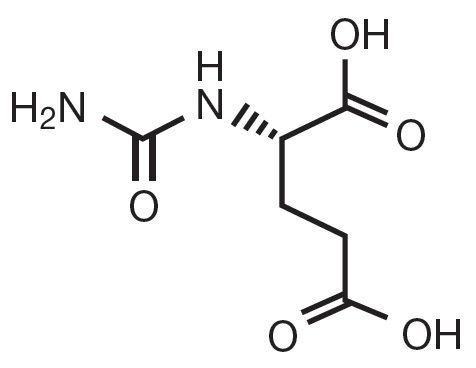
The pharmacokinetics of carglumic acid in healthy subjects following an intravenous (IV) infusion over 2 hours at 8 mg/kg or an oral administration at 100 mg/kg are summarized in Table 3.
Table 3: Mean (SD) Pharmacokinetic Parameter Values of Carglumic Acid in Healthy Subjects
PK parameter
| IV infusion 8mg/kg
(N=10)
| Oral 100 mg/kg
(N=12)
|
Cmax (ng/mL)
| 8613 (558)
| 3284 (321)
|
Tmax (hr)#
| 2 (1-2)
| 3 (2-4)
|
AUC (ng*hr/mL)
| 24501 (1613)
| 31426 (2150)
|
T1/2 (hr)
| 31 (3)
| 25 (2)
|
CL (L/hr/kg)
| 0.34 (0.02)
| N/A
|
Vd (L/kg)
| 15 (1)
| N/A
|
#Median (range); N/A, not applicable
Absorption
Following an oral administration of Carglumic acid tablets for oral suspension 100 mg/kg in healthy subjects, the absolute bioavailability was approximately 10%.
Distribution
Carglumic acid is not bound to plasma proteins.
Elimination
Carglumic acid is predominantly excreted by the kidneys as unchanged product.
Metabolism
A proportion of carglumic acid may be metabolized by the intestinal bacterial flora.
The likely end product of carglumic acid metabolism is carbon dioxide, eliminated through the lungs.
Excretion
Following an oral administration of radiolabeled Carglumic acid tablets for oral suspension at 100 mg/kg, 9% of the dose is excreted unchanged in the urine and up to 60% of the dose is recovered unchanged in the feces.
Specific Populations
Patients with Renal Impairment
The pharmacokinetics of carglumic acid in subjects with renal impairment were compared with healthy subjects with normal renal function following oral administration of a single dose of Carglumic acid tablets for oral suspension 40 mg/kg or 80 mg/kg. The Cmax and AUC0-t of carglumic acid are summarized in Table 4. The geometric mean ratio (90% CI) of AUC0-t in subjects with mild, moderate, and severe renal impairment relative to those in their matched control subjects with normal renal function were approximately 1.3 (1.01, 1.68), 2.0 (1.65, 2.54), and 4.6 (3.36, 6.34) respectively[see Dosage and Administration (2.3)].
Table 4: Mean (SD) Cmax and AUC0-tof Carglumic Acid Following Single Oral Dose Administration of Carglumic acid tablets for oral suspension 80 mg/kg or 40 mg/kg in Subjects with Renal Impairment and Matched Healthy Control Subjects with Normal Renal Function
PK Parameters
| Normal Renal Function 1a: eGFR ≥ 90 mL/min/1.73m2 (N=8)
| Mild Renal Impairment: eGFR 60-89 mL/min/1.73m2 (N=8)
| Moderate Renal Impairment: eGFR 30-59 mL/min/1.73m2 (N=8)
| Normal Renal Function 1b: eGFR ≥ 90 mL/min/1.73m2 (N=8)
| Severe Renal Impairment: eGFR ≤ 29 mL/min/1.73m2 (N=8)
|
80 mg/kg
| 40 mg/kg
|
Cmax (ng/mL)
| 2983 (552)
| 4310 (1937)
| 6129 (1854)
| 1890 (901)
| 8377 (3815)
|
AUC0-t (ng*hr/mL)
| 28313 (6204)
| 39545 (12109)
| 79766 (19708)
| 20212 (6186)
| 143075 (55910)
|
Treatment groups 1a and 1b represent two separate matched control groups of healthy subjects with normal renal function.
Drug Interaction Studies
Based on in vitro studies, carglumic acid is not an inducer of CYP1A1/2, CYP2B6, CYP2C, and CYP3A4/5 enzymes, and not an inhibitor of CYP1A2, CYP2A6, CYP2B6, CYP2C8, CYP2C9, CYP2C19, CYP2D6, CYP2E1, and CYP3A4/5 enzymes.
Based on in vitro studies, carglumic acid is a substrate of the human OAT1 transporter. Carglumic acid is not a substrate of MDR1, BCRP, MATE1, MATE2-K, OAT1, OAT3, OATP1B1, OATP1B3, OCT1, and OCT2. Carglumic acid is not an inhibitor of human BSEP, BCRP, MDR1, MATE1, MATE2-K, OAT1, OAT3, OATP1B1, OATP1B3, OCT1, and OCT2 transporters.