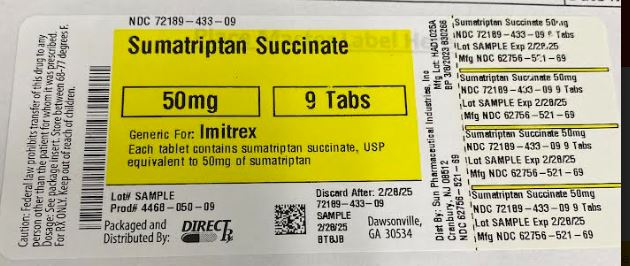
Advise the patient to read the FDA-approved patient labeling (Patient Information).
Risk of Myocardial Ischemia and/or Infarction, Prinzmetal’s Angina, Other Vasospasm-Related Events, Arrhythmias, and Cerebrovascular Events
Inform patients that sumatriptan succinate tablets may cause serious cardiovascular side effects such as myocardial infarction or stroke. Although serious cardiovascular events can occur without warning symptoms, patients should be alert for the signs and symptoms of chest pain, shortness of breath, irregular heartbeat, significant rise in blood pressure, weakness, and slurring of speech, and should ask for medical advice if any indicative sign or symptoms are observed. Apprise patients of the importance of this follow-up [see Warnings and Precautions (5.1, 5.2, 5.4, 5.5, 5.8)].
Anaphylactic/Anaphylactoid Reactions
Inform patients that anaphylactic/anaphylactoid reactions have occurred in patients receiving sumatriptan succinate tablets. Such reactions can be life-threatening or fatal. In general, anaphylactic reactions to drugs are more likely to occur in individuals with a history of sensitivity to multiple allergens [see Contraindications (4), Warnings and Precautions (5.9)].
Concomitant Use with Other Triptans or Ergot Medications
Inform patients that use of sumatriptan succinate tablets within 24 hours of another triptan or an ergot-type medication (including dihydroergotamine or methysergide) is contraindicated [see Contraindications (4), Drug Interactions (7.1, 7.3)].
Serotonin Syndrome
Caution patients about the risk of serotonin syndrome with the use of sumatriptan succinate tablets or other triptans, particularly during combined use with SSRIs, SNRIs, TCAs, and MAO inhibitors [see Warnings and Precautions (5.7), Drug Interactions (7.4)].
Medication Overuse Headache
Inform patients that use of acute migraine drugs for 10 or more days per month may lead to an exacerbation of headache and encourage patients to record headache frequency and drug use (e.g., by keeping a headache diary) [see Warnings and Precautions (5.6)].
Pregnancy
Advise patients to notify their healthcare provider if they become pregnant during treatment or plan to become pregnant [see Use in Specific Populations (8.1)].
Lactation
Advise patients to notify their healthcare provider if they are breastfeeding or plan to breastfeed [see Use in Specific Populations (8.2)].
Ability to Perform Complex Tasks
Treatment with sumatriptan succinate tablets may cause somnolence and dizziness; instruct patients to evaluate their ability to perform complex tasks after administration of sumatriptan succinate tablets.
PATIENT INFORMATION
Sumatriptan Succinate Tablets
(sue-muh-TRIP-tan SUX-in-ate)
What is the most important information I should know about sumatriptan succinate tablets?
Sumatriptan succinate tablets can cause serious side effects, including:
Heart attack and other heart problems. Heart problems may lead to death.
Stop taking sumatriptan succinate tablets and get emergency medical help right away if you have any of the following symptoms of a heart attack:
discomfort in the center of your chest that lasts for more than a few minutes, or that goes away and comes back
severe tightness, pain, pressure, or heaviness in your chest, throat, neck, or jaw
pain or discomfort in your arms, back, neck, jaw, or stomach
shortness of breath with or without chest discomfort
breaking out in a cold sweat
nausea or vomiting
feeling lightheaded
Sumatriptan succinate tablets are not for people with risk factors for heart disease unless a heart exam is done and shows no problem. You have a higher risk for heart disease if you:
have high blood pressure
have high cholesterol levels
smoke
are overweight
have diabetes
have a family history of heart disease
What are sumatriptan succinate tablets?
Sumatriptan succinate tablets are a prescription medicine used to treat acute migraine headaches with or without aura in adults.
Sumatriptan succinate tablets are not used to treat other types of headaches such as hemiplegic (that make you unable to move on one side of your body) or basilar (rare form of migraine with aura) migraines.
Sumatriptan succinate tablets are not used to prevent or decrease the number of migraine headaches you have.
It is not known if sumatriptan succinate tablets are safe and effective to treat cluster headaches.
It is not known if sumatriptan succinate tablets are safe and effective in children under 18 years of age.
Do not take sumatriptan succinate tablets if you have:
heart problems or a history of heart problems
narrowing of blood vessels to your legs, arms, stomach, or kidneys (peripheral vascular disease)
uncontrolled high blood pressure
severe liver problems
hemiplegic migraines or basilar migraines. If you are not sure if you have these types of migraines, ask your healthcare provider.
had a stroke, transient ischemic attacks (TIAs), or problems with your blood circulation
taken any of the following medicines in the last 24 hours:
almotriptan (AXERT®*)
eletriptan (RELPAX®*)
frovatriptan (FROVA®*)
naratriptan (AMERGE®*)
rizatriptan (MAXALT®*, MAXALT-MLT®*)
sumatriptan and naproxen (TREXIMET®*)
ergotamines (CAFERGOT®*, ERGOMAR®*, MIGERGOT®*)
dihydroergotamine (D.H.E. 45®*, MIGRANAL®*)
Ask your healthcare provider if you are not sure if your medicine is listed above.
an allergy to sumatriptan or any of the ingredients in sumatriptan succinate tablets. See the end of this leaflet for a complete list of ingredients in sumatriptan succinate tablets.
Before you take sumatriptan succinate tablets, tell your healthcare provider about all of your medical conditions, including if you:
have high blood pressure.
have high cholesterol.
have diabetes.
smoke.
are overweight.
have heart problems or family history of heart problems or stroke.
have kidney problems.
have liver problems.
have had epilepsy or seizures.
are not using effective birth control.
are pregnant or plan to become pregnant. It is not known if sumatriptan succinate tablets can harm your unborn baby.
are breastfeeding or plan to breastfeed. Sumatriptan succinate passes into your breast milk. It is not known if this can harm your baby. Talk with your healthcare provider about the best way to feed your baby if you take sumatriptan succinate tablets.
Tell your healthcare provider about all the medicines you take, including prescription and over-the-counter medicines, vitamins, and herbal supplements.
Sumatriptan succinate tablets and certain other medicines can affect each other, causing serious side effects.
Especially tell your healthcare provider if you take antidepressant medicines called:
selective serotonin reuptake inhibitors (SSRIs)
serotonin norepinephrine reuptake inhibitors (SNRIs)
tricyclic antidepressants (TCAs)
monoamine oxidase inhibitors (MAOIs)
Ask your healthcare provider or pharmacist for a list of these medicines if you are not sure.
Know the medicines you take. Keep a list of them to show your healthcare provider or pharmacist when you get a new medicine.
How should I take sumatriptan succinate tablets?
Certain people should take their first dose of sumatriptan succinate tablets in their healthcare provider's office or in another medical setting. Ask your healthcare provider if you should take your first dose in a medical setting.
Take sumatriptan succinate tablets exactly as your healthcare provider tells you to take it.
Your healthcare provider may change your dose. Do not change your dose without first talking to your healthcare provider.
Take sumatriptan succinate tablets whole with water or other liquids.
If you do not get any relief after your first tablet, do not take a second tablet without first talking with your healthcare provider.
If your headache comes back or you only get some relief from your headache, you can take a second tablet 2 hours after the first tablet.
Do not take more than 200 mg of sumatriptan succinate tablets in a 24-hour period.
If you take too many sumatriptan succinate tablets, call your healthcare provider or go to the nearest hospital emergency room right away.
You should write down when you have headaches and when you take sumatriptan succinate tablets so you can talk with your healthcare provider about how sumatriptan succinate tablets are working for you.
What should I avoid while taking sumatriptan succinate tablets?
Sumatriptan succinate tablets can cause dizziness, weakness, or drowsiness. If you have these symptoms, do not drive a car, use machinery, or do anything where you need to be alert.
What are the possible side effects of sumatriptan succinate tablets?
Sumatriptan succinate tablets may cause serious side effects. See “What is the most important information I should know about sumatriptan succinate tablets?”
These serious side effects include:
changes in color or sensation in your fingers and toes (Raynaud’s syndrome)
stomach and intestinal problems (gastrointestinal and colonic ischemic events). Symptoms of gastrointestinal and colonic ischemic events include:
sudden or severe stomach pain
stomach pain after meals
weight loss
fever
nausea or vomiting
constipation or diarrhea
bloody diarrhea
problems with blood circulation to your legs and feet (peripheral vascular ischemia). Symptoms of peripheral vascular ischemia include:
cramping and pain in your legs or hips
feeling of heaviness or tightness in your leg muscles
burning or aching pain in your feet or toes while resting
numbness, tingling, or weakness in your legs
cold feeling or color changes in 1 or both legs or feet
medication overuse headaches. Some people who use too many sumatriptan succinate tablets may have worse headaches (medication overuse headache). If your headaches get worse, your healthcare provider may decide to stop your treatment with sumatriptan succinate tablets
serotonin syndrome. Serotonin syndrome is a rare but serious problem that can happen in people using sumatriptan succinate tablets, especially if sumatriptan succinate tablets are used with anti-depressant medicines called SSRIs or SNRIs. Call your healthcare provider right away if you have any of the following symptoms of serotonin syndrome:
mental changes such as seeing things that are not there (hallucinations), agitation, or coma fast heartbeat
changes in blood pressure
high body temperature
tight muscles
trouble walking
hives (itchy bumps); swelling of your tongue, mouth, or throat.
seizures. Seizures have happened in people taking sumatriptan succinate tablets who have never had seizures before. Talk with your healthcare provider about your chance of having seizures while you take sumatriptan succinate tablets.
The most common side effects of sumatriptan succinate tablets include:
tingling or numbness in your fingers or toes
warm or cold feeling
feeling weak, drowsy, or tired
pain, discomfort, or stiffness in your neck, throat, jaw, or chest
dizziness
Tell your healthcare provider if you have any side effect that bothers you or that does not go away.
These are not all the possible side effects of sumatriptan succinate tablets.
Call your doctor for medical advice about side effects. You may report side effects to FDA at 1-800-FDA-1088.
How should I store sumatriptan succinate tablets?
Store at 20° to 25°C (68° to 77°F); excursions permitted to 15° to 30°C (59° to 86°F).
Keep sumatriptan succinate tablets and all medicines out of the reach of children.
General information about the safe and effective use of sumatriptan succinate tablets.
Medicines are sometimes prescribed for purposes other than those listed in Patient Information leaflets. Do not use sumatriptan succinate tablets for a condition for which it was not prescribed. Do not give sumatriptan succinate tablets to other people, even if they have the same symptoms you have. It may harm them.
This Patient Information leaflet summarizes the most important information about sumatriptan succinate tablets. If you would like more information, talk with your healthcare provider. You can ask your healthcare provider or pharmacist for information about sumatriptan succinate tablets that is written for healthcare professionals.
For more information, call 1-800-818-4555.
What are the ingredients in sumatriptan succinate tablets?
Active ingredient: sumatriptan succinate
Inactive ingredients: colloidal silicon dioxide, croscarmellose sodium, D&C Red # 27 aluminum lake (100 mg only), dibasic calcium phosphate, hypromellose, iron oxide red (100 mg only), magnesium stearate, microcrystalline cellulose, polyethylene glycol (25 mg & 50 mg only), polysorbate 80 (25 mg & 50 mg only) propylene glycol (100 mg only), talc and titanium dioxide.
This Patient Information has been approved by the U.S. Food and Drug Administration.
* All trademarks are the properties of their respective owners.
Distributed by:
Sun Pharmaceutical Industries, Inc.
Cranbury, NJ 08512
Manufactured by:
Sun Pharmaceutical Industries Ltd.
Halol-Baroda Highway,
Halol-389 350, Gujarat, India.
ISS. 11/2019