The safety and efficacy of IMCIVREE for chronic weight management in patients with obesity due to POMC, PCSK1, and LEPR deficiency were assessed in 2 identically designed, 1-year, open-label studies, each with an 8-week, double-blind withdrawal period. Study 1 (NCT02896192) enrolled patients aged 6 years and above with obesity and genetically confirmed or suspected POMC or PCSK1 deficiency, and Study 2 (NCT03287960) enrolled patients aged 6 years and above with obesity and genetically confirmed or suspected LEPR deficiency. In both studies, the local genetic testing results were centrally confirmed using Sanger sequencing. The studies enrolled patients with homozygous or presumed compound heterozygous pathogenic, likely pathogenic variants, or VUS for either the POMC or PCSK1 genes (Study 1) or the LEPR gene (Study 2). Patients with double heterozygous variants in 2 different genes were not eligible for treatment with IMCIVREE. In both studies, adult patients had a body mass index (BMI) of ≥30 kg/m2. Weight in pediatric patients was ≥95th percentile using growth chart assessments.
Dose titration occurred over a 2- to 12-week period, followed by a 10-week, open-label treatment period. Patients who achieved at least a 5-kilogram weight loss (or at least 5% weight loss if baseline body weight was <100 kg) at the end of the open-label treatment period continued into a double-blind withdrawal period lasting 8 weeks, including 4 weeks of IMCIVREE followed by 4 weeks of placebo (investigators and patients were blinded to this sequence). Following the withdrawal sequence, patients re-initiated active treatment with IMCIVREE at the therapeutic dose for up to 32 weeks.
Efficacy analyses were conducted in 21 patients (10 in Study 1 and 11 in Study 2) who had completed at least 1 year of treatment at the time of a prespecified data cutoff. Six additional patients enrolled in the studies (4 in Study 1 and 2 in Study 2) who had not yet completed 1 year of treatment at the time of the cutoff were not included in the efficacy analyses.
Of the 21 patients included in the efficacy analysis in Studies 1 and 2, 62% were adults and 38% were aged 16 years or younger. In Study 1, 50% of patients were female, 70% were White, and the median BMI was 40.0 kg/m2 (range: 26.6-53.3) at baseline. In Study 2, 73% of patients were female, 91% were White, and the median BMI was 46.6 kg/m2 (range: 35.8-64.6) at baseline.
Effect of IMCIVREE on Body Weight
In Study 1, 80% of patients with obesity due to POMC or PCSK1 deficiency met the primary endpoint, achieving a ≥10% weight loss after 1 year of treatment with IMCIVREE. In Study 2, 46% of patients with obesity due to LEPR deficiency achieved a≥10% weight loss after 1 year of treatment with IMCIVREE (Table 2).
Table 2: Body Weight (kg) – Proportion of Patients Achieving at Least 10% Weight Loss from Baseline at 1 Year in Study 1 and Study 2 |
| Parameter | Statistic | Study 1 (POMC
or PCSK1)
(N=10) | Study 2 (LEPR)
(N=11) |
| Patients Achieving at Least 10% Weight Loss at Year 1 | n (%) | 8 (80.0%) | 5 (45.5%) |
| 95% CI1 | (44.4%, 97.5%) | (16.8%, 76.6%) |
| P-value2 | <0.0001 | <0.0002 |
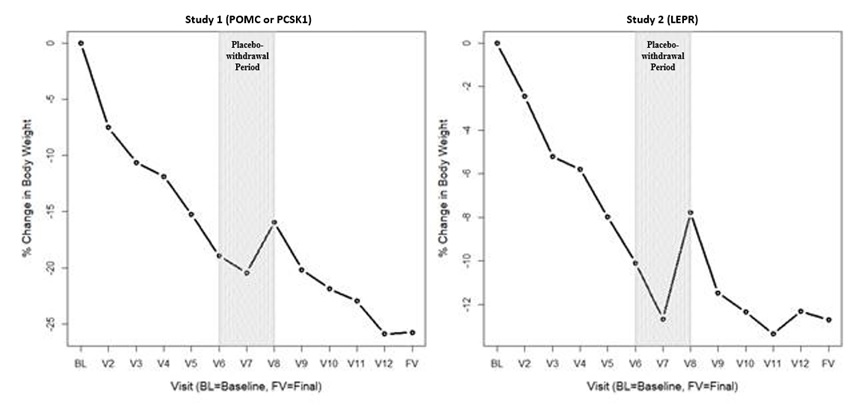
When treatment with IMCIVREE was withdrawn in the 16 patients who had lost at least 5 kg (or 5% of body weight if baseline body weight was <100 kg) during the 10-week open-label period, these patients gained an average of 5.5 kg in Study 1 and 5.0 kg in Study 2 over 4 weeks. Re-initiation of treatment with IMCIVREE resulted in subsequent weight loss (see Figure 1).
Table 3: Percent Change from Baseline in Weight at 1 Year in Studies 1 and 2 (Full Analysis Set) |
| Parameter | Statistic | Study 1 (POMC
or PCSK1)
(N=10) | Study 2 (LEPR)
(N=11) |
| Baseline Body Weight (kg) | Mean (SD) | 118.7 (37.5) | 133.3 (26.0) |
| Median | 115.0 | 132.3 |
| Min, Max | 55.9, 186.7 | 89.4, 170.4 |
| 1-Year Body Weight (kg) | Mean (SD) | 89.8 (29.4) | 119.2 (27.0) |
| Median | 84.1 | 120.3 |
| Min, Max | 54.5, 150.5 | 81.7, 149.9 |
| Percent Change from Baseline to 1 Year (%) | Mean (SD) | -23.1 (12.1) | -9.7 (8.8) |
| Median | -26.7 | -9.8 |
| Min, Max | -35.6, -1.2 | -23.3, 0.1 |
| LS Mean1 | -23.12 | -9.65 |
| 95% CI1 | (-31.9, -14.4) | (-16.0, -3.3) |
| P-value2 | 0.0003 | 0.0074 |
Figure 1: Mean Percent Change in Body Weight from Baseline by Visit (Study 1 [N=9] and Study 2 [N=7])
BL=Baseline (day of first dose)
V2 to V3 = variable dose titration period (2 to 12 weeks)
V3 to V6 = 10-week open-label treatment period
V6 to V8 = 8-week placebo withdrawal period (4 weeks active, 4 weeks placebo)
V8 to V12 = 32-week open-label treatment period
FV = Final visit; time point for primary efficacy analysis
Note: This figure includes patients who had lost at least 5 kg (or 5% of body weight if baseline body weight was <100 kg) during the 10-week open-label period.
Effect of IMCIVREE on Hunger
Patients 12 years and older self-reported their daily maximal hunger in a diary, assessed by the Daily Hunger Questionnaire Item 2. Hunger was scored on an 11-point scale from 0 (“not hungry at all”) to 10 (“hungriest possible”). Weekly means of daily hunger scores at Baseline and Week 52 are summarized in Table 4.
Table 4: Daily Hunger Scores – Change from Baseline at 1 Year in Subjects Aged ≥12 Years in Study 1 and Study 2 with Available Hunger Data |
| Parameter | Statistic | Hunger in 24 Hours |
Study 1 (POMC
or PCSK1
(N=8) | Study 2 (LEPR)
(N=8) |
| Baseline Hunger Score | Median | 7.9 | 7.0 |
| Median | 7.0, 9.1 | 5.0, 8.4 |
| 1-Year Hunger Score | Min, Max | 5.5 | 4.4 |
| Min, Max | 2.5, 8.0 | 2.1, 8.0 |
| Change from Baseline to 1 Year | Median | 5.5 | 4.4 |
| Min, Max | 2.5, 8.0 | 2.1, 8.0 |
Hunger scores generally worsened during the double-blind, placebo withdrawal period among those patients who had experienced an improvement from baseline, and scores improved when IMCIVREE was reinitiated.
Supportive of IMCIVREE’s effect on weight loss, there were general numeric improvements in cardiometabolic parameters, such as blood pressure, lipids, glycemic parameters, and waist circumference. However, because of the limited number of patients studied and the lack of a control group, the treatment effects on these parameters could not be accurately quantified.