Nexplanon Implant
Product Images NDC 78206-145

34 FDA label images from Organon Llc · Packaging, Regulatory Labels, and Product Appearance

Product Visual Gallery

This gallery contains 34 technical images submitted to the FDA as part of the official labeling for Nexplanon (NDC 78206-145). Unlike standard consumer photos, these assets often include clinical data figures, molecular chemical structures, and official manufacturer packaging layouts.

As provided by Organon Llc, these visuals offer a comprehensive scientific overview of the product's physical and chemical identity, aiding pharmacists and researchers in product verification and study.

FDA Label Image

Figure 1 (Nexplanon 01)

Figure 1 (Nexplanon 01)
An illustration showing a woman lying on her side with her arm raised and bent, likely demonstrating the positioning for subcutaneous implant insertion or examination.*
FDA Label Image

Figure (Nexplanon 02)

FDA Label Image

Figure 2a (Nexplanon 03)

Figure 2a (Nexplanon 03)
An instructional diagram showing the recommended implant insertion site and location for Nexplanon (etonogestrel implant) in relation to anatomical landmarks. It indicates the implant location, insertion site, medial epicondyle, sulcus, and distances for proper placement under the skin.*
FDA Label Image

Figure 2b (Nexplanon 04)

Figure 2b (Nexplanon 04)
An anatomical illustration indicating the subcutaneous implant insertion site for Nexplanon (etonogestrel 68 mg implant). It shows the relationship between biceps and triceps muscles, with landmarks including the sulcus, guiding mark, insertion site located approximately 3-5 cm from the sulcus and 8-10 cm from the medial epicondyle, demonstrating proper placement area on the inner upper arm.*
FDA Label Image

Figure 2c (Nexplanon 05)

Figure 2c (Nexplanon 05)
An anatomical diagram showing a cross-section of the upper arm with labeled biceps muscle, triceps muscle, humerus bone, brachial artery, median nerve, ulnar nerve, basilic vein, and the area of the sulcus. The diagram indicates the location of the Nexplanon implant after insertion in the subcutaneous tissue near the medial side of the arm.*
FDA Label Image

Figure 3 (Nexplanon 06)

Figure 3 (Nexplanon 06)
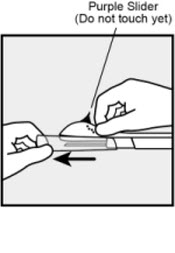
An instructional illustration depicting the use of a purple slider mechanism on a device, with a hand sliding the purple component to the left as indicated by an arrow. The image includes a note "Purple Slider (Do not touch yet)" above the slider, suggesting a step in the handling or preparation of the device.*
FDA Label Image

Figure 4 (Nexplanon 07)

Figure 4 (Nexplanon 07)
An instructional diagram showing the upper arm with labeled points: 'Guiding Mark' and 'Insertion Site' for a subcutaneous implant procedure. It depicts hand positioning, indicating where Nexplanon, a 68 mg etonogestrel implant, is to be inserted.*
FDA Label Image

Figure 5a (Nexplanon 08)

Figure 5a (Nexplanon 08)
An instructional diagram showing a hand holding a device at a 30-degree angle to the skin surface, likely illustrating the proper technique for subcutaneous insertion or application associated with the Nexplanon implant.*
FDA Label Image

Figure (Nexplanon 09)

FDA Label Image

Figure 5b (Nexplanon 10)

Figure 5b (Nexplanon 10)
An instructional illustration showing a hand pressing a device onto a surface, with an inset close-up of a small pointed tip or needle on the device, likely related to subcutaneous implant placement or removal technique for Nexplanon (etonogestrel) implant.*
FDA Label Image

Figure 6 (Nexplanon 11)

Figure 6 (Nexplanon 11)
An instructional diagram showing a hand using a device, with arrows indicating upward and leftward movements, likely demonstrating a step in the process of implant insertion or removal for the Nexplanon etonogestrel subcutaneous implant.*
FDA Label Image

Figure 7 (Nexplanon 12)

Figure 7 (Nexplanon 12)
A black-and-white instructional illustration showing a hand pressing down and sliding a rectangular object. The illustration includes directional arrows indicating a leftward sliding motion from front (P) to back (D). This likely demonstrates part of the usage or activation process for the Nexplanon implant device.*
FDA Label Image

Figure 8a (Nexplanon 13)

Figure 8a (Nexplanon 13)
An instructional diagram showing a hand holding a small implant device, likely demonstrating how to handle or position it prior to subcutaneous insertion. The implant appears to be a thin, elongated object with rounded ends, consistent with a subcutaneous implant like Nexplanon.*
FDA Label Image

Figure 8b (Nexplanon 14)

Figure 8b (Nexplanon 14)
An instructional illustration showing the process of handling a Nexplanon implant. A hand is depicted peeling back a protective covering to reveal the implant beneath. The implant is labeled and positioned between markers 'P' and 'D'.*
FDA Label Image

Figure 8c (Nexplanon 15)

Figure 8c (Nexplanon 15)
An instructional illustration showing a hand pressing down on an applicator device with an implant inside. The implant is labeled and positioned near the tip of the device, demonstrating its placement prior to subcutaneous insertion.*
FDA Label Image

Figure 9 (Nexplanon 16)

Figure 9 (Nexplanon 16)
An instructional diagram showing the placement of a Nexplanon implant subcutaneously in the inner side of the upper arm. The image depicts hands inserting the implant beneath the skin, labeled with 'P' (proximal) and 'D' (distal) to indicate orientation.*
FDA Label Image

Figure (Nexplanon 17)

FDA Label Image

Figure (Nexplanon 18)

FDA Label Image

Figure 10 (Nexplanon 19)

Figure 10 (Nexplanon 19)
An instructional illustration showing the correct placement of a Nexplanon implant subcutaneously on the inner side of the upper arm. The diagram highlights the implant's position beneath the skin with arrows pointing to the implant's location under the skin surface. The letters P and D label anatomical directions proximal and distal on the arm.*
FDA Label Image

Figure 11 (Nexplanon 20)

Figure 11 (Nexplanon 20)
An instructional diagram depicting the subcutaneous insertion of the Nexplanon implant. It shows a healthcare professional using an applicator to insert the implant under the skin of the inner side of the upper arm. A magnified circle highlights the tip of the applicator deploying the implant beneath the skin.*
FDA Label Image

Figure 12 (Nexplanon 21)

Figure 12 (Nexplanon 21)
Instructional illustration showing the subcutaneous implantation of Nexplanon (etonogestrel) in the inner side of a person's upper arm. The image depicts a hand holding the implant applicator near the targeted implantation site, indicated by a downward arrow on the skin between two fingers labeled P and D.*
FDA Label Image

Figure 13 (Nexplanon 22)

Figure 13 (Nexplanon 22)
An instructional diagram illustrating the subcutaneous implantation of Nexplanon (etonogestrel 68 mg implant). The image shows the insertion technique with a close-up of the implant being guided underneath the skin using a specialized applicator, highlighting the correct placement direction.*
FDA Label Image

Figure 14 (Nexplanon 23)

Figure 14 (Nexplanon 23)
An instructional illustration showing the subcutaneous insertion of a Nexplanon implant into the inner side of a person's upper arm. The image highlights the use of an applicator for proper placement of the implant just below the skin surface, with labels indicating posterior (P) and distal (D) arm directions.*
FDA Label Image

Figure 15 (Nexplanon 24)

Figure 15 (Nexplanon 24)
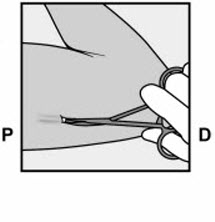
An instructional illustration showing the subcutaneous insertion procedure of an implant, possibly the Nexplanon 68 mg etonogestrel implant. The figure depicts a hand using forceps to place the implant under the skin, indicated by an arrow pointing towards the insertion site.*
FDA Label Image

Figure 16 (Nexplanon 25)

Figure 16 (Nexplanon 25)
Instructional illustration showing a close-up of a hand using forceps to hold or insert a small implant under the skin, depicting a subcutaneous procedure likely related to Nexplanon etonogestrel implant use.*
FDA Label Image

Figure 17 (Nexplanon 26)

Figure 17 (Nexplanon 26)
An instructional diagram showing the subcutaneous insertion of the Nexplanon etonogestrel implant. It depicts a hand holding the insertion device under skin, with arrows indicating the direction for implant placement, illustrating proper technique for subdermal administration.*
FDA Label Image

Figure (Nexplanon 27)

FDA Label Image

Figure 18 (Nexplanon 28)

Figure 18 (Nexplanon 28)
An instructional illustration showing the subcutaneous insertion of a Nexplanon implant into the inner side of the forearm using an applicator. The image depicts a hand holding the insertion device and positioning the implant under the skin, indicated by an arrow, with anatomical orientation marked as proximal (P) and distal (D).*
FDA Label Image

Figure 19 (Nexplanon 29)

Figure 19 (Nexplanon 29)
Nexplanon implant containing 68 mg etonogestrel is shown as a thin, solid, flexible rod approximately 4 cm in length and 2 mm in diameter. The image displays the implant's size for subcutaneous insertion. Labeler is Organon LLC.*
FDA Label Image

Figure 20 (Nexplanon 30)

Figure 20 (Nexplanon 30)
Chemical structure of etonogestrel, the active ingredient in Nexplanon 68 mg subcutaneous implant, showing the molecular formula C22H28O2 with characteristic steroid ring structures and functional groups.*
FDA Label Image

Figure 21 (Nexplanon 31)

Figure 21 (Nexplanon 31)
A line graph showing etonogestrel concentration (pg/mL) levels over time in days and months. The curve rises sharply within the first days, peaks around day 6, then gradually declines through days up to 21, followed by a more gradual decrease over months extending to 36, with error bars indicating variability at each time point.*
FDA Label Image

Figure (Nexplanon 32)

Figure (Nexplanon 32)
Black and white photograph showing a close-up of a human hand holding a Nexplanon implant device. The implant is a small, thin, white rod designed for subcutaneous insertion as a contraceptive implant containing 68 mg of etonogestrel.*
FDA Label Image

Figure (Nexplanon 33)

Figure (Nexplanon 33)
A data table categorizing various birth control methods by estimated pregnancy rates per 100 women in one year. The table lists implants, injections, intrauterine devices, and sterilization with fewer than 1 pregnancy; birth control pills, skin patch, and vaginal ring with hormones with slightly higher rates; condoms and diaphragm with moderate pregnancy rates; abstinence during fertile days, spermicide, and withdrawal with higher pregnancy rates; and no birth control with the highest pregnancy rate of 85 or more pregnancies per 100 women.*
FDA Label Image

Principal Display Panel (68 mg Implant Blister Pack Carton)

Principal Display Panel (68 mg Implant Blister Pack Carton)
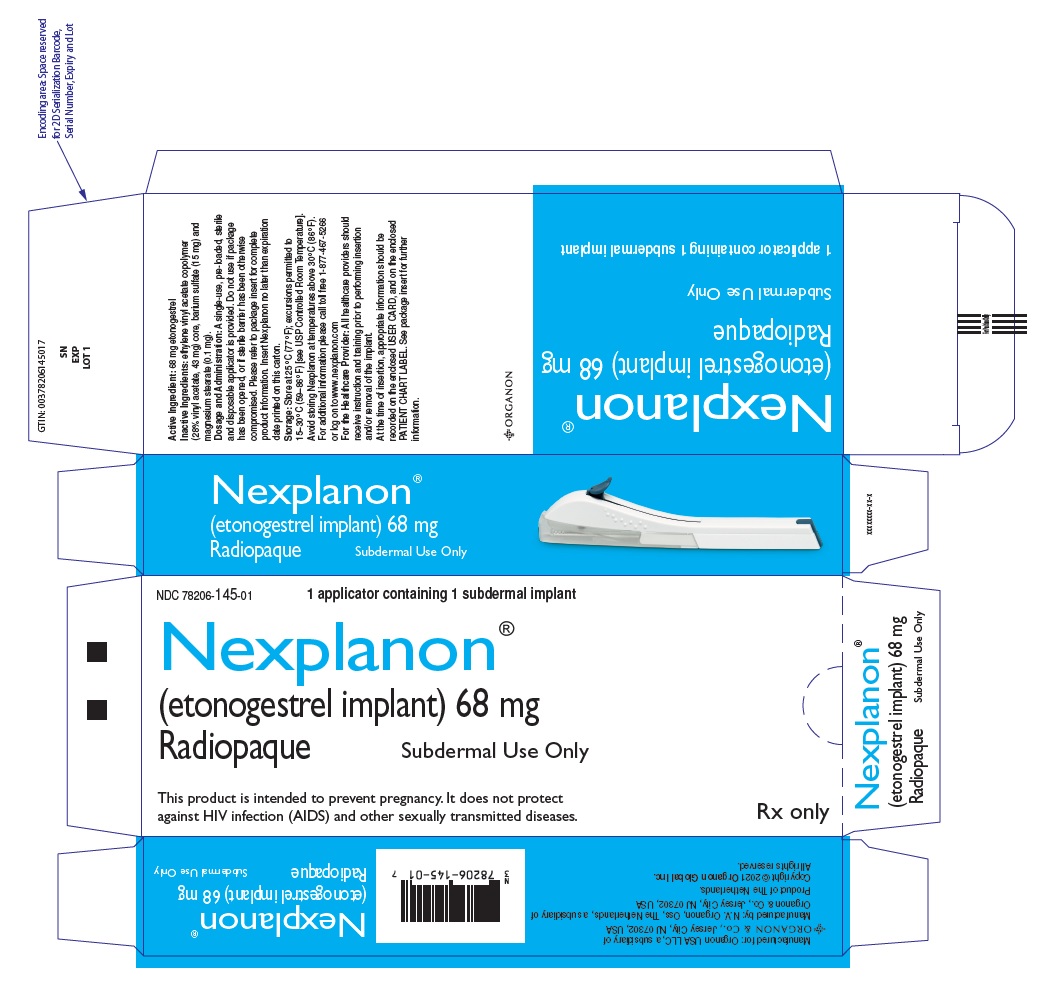
Packaging label for Nexplanon etonogestrel implant 68 mg radiopaque subdermal implant by Organon LLC. The label states it contains 1 applicator with 1 subdermal implant, for subdermal use only, Rx only. The label includes text about the product's use, a barcode, and an image of the implant applicator device.*

* About these descriptions: Image descriptions on this page are generated by automated AI analysis of the product label images from the manufacturer's FDA label submission (SPL). They are provided for reference only and may contain errors or omissions. Always rely on the printed label itself and the official FDA labeling, and consult a pharmacist or healthcare professional with any questions about this product.