The following equipment is needed for removal of the implant:
- An examination table for the woman to lie on
- Sterile surgical drapes, sterile gloves, antiseptic solution, surgical marker
- Local anesthetic, needles, and syringe
- Sterile scalpel, forceps (straight and curved mosquito)
- Skin closure, sterile gauze, and pressure bandage
Removal Procedure
For illustrative purposes, Figures depict the left inner arm
Step 1. Have the woman lie on her back on the table. The arm should be positioned with the elbow flexed and the hand underneath the head (or as close as possible). (See Figure 1.)
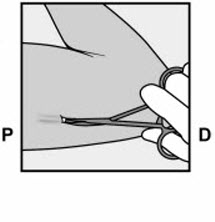
Step 2. Locate the implant by palpation. Push down the end of the implant closest to the shoulder (Figure 10) to stabilize it; a bulge should appear indicating the tip of the implant that is closest to the elbow. If the tip does not pop up, removal of the implant may be more challenging and should be performed by professionals experienced with removing deeper implants. Call 1-844-674-3200 for further information. Mark the distal end (end closest to the elbow), for example, with a surgical marker.
|
Figure 10
P – Proximal (toward the shoulder)
D – Distal (toward the elbow) |
Step 3. Clean the site with an antiseptic solution.
Step 4. Anesthetize the site, for example, with 0.5 to 1 mL 1% lidocaine, where the incision will be made (Figure 11). Be sure to inject the local anesthetic under the implant to keep the implant close to the skin surface. Injection of local anesthetic over the implant may make removal more difficult.
Step 5. Push down the end of the implant closest to the shoulder (Figure 12) to stabilize it throughout the procedure. Starting over the tip of the implant closest to the elbow, make a longitudinal (parallel to the implant) incision of 2 mm towards the elbow. Take care not to cut the tip of the implant.
Step 6. The tip of the implant should pop out of the incision. If it does not, gently push the implant towards the incision until the tip is visible. Grasp the implant with forceps and, if possible, remove the implant (Figure 13). If needed, gently remove adherent tissue from the tip of the implant using blunt dissection. If the implant tip is not exposed following blunt dissection, make an incision into the tissue sheath and then remove the implant with the forceps (Figures 14 and 15).
Step 7. If the tip of the implant does not become visible in the incision, insert forceps (preferably curved mosquito forceps, with the tips pointed up) superficially into the incision (Figure 16). Gently grasp the implant and then flip the forceps over into your other hand (Figure 17).
Step 8. With a second pair of forceps carefully dissect the tissue around the implant and grasp the implant (Figure 18). The implant can then be removed. If the implant cannot be grasped, stop the procedure and refer the woman to a healthcare professional experienced with complex removals or call 1-844-674-3200. Step 9. Confirm that the entire implant, which is 4 cm long, has been removed by measuring its length. There have been reports of broken implants while in the patient's arm. In some cases, difficult removal of the broken implant has been reported. If a partial implant (less than 4 cm) is removed, the remaining piece should be removed by following the instructions in section 2.3. If the woman would like to continue using NEXPLANON, a new implant may be inserted immediately after the old implant is removed using the same incision as long as the site is in the correct location [see Dosage and Administration (2.4)].
Step 10. After removing the implant, close the incision with a sterile adhesive wound closure.
Step 11. Apply a pressure bandage with sterile gauze to minimize bruising. The woman may remove the pressure bandage in 24 hours and the sterile adhesive wound closure in 3 to 5 days.
Localization and Removal of a Non-Palpable Implant
There have been reports of migration of the implant; usually this involves minor movement relative to the original position [see Warnings and Precautions (5.1)], but may lead to the implant not being palpable at the location in which it was placed. An implant that has been deeply inserted or has migrated may not be palpable and therefore imaging procedures, as described below, may be required for localization.
A non-palpable implant should always be located prior to attempting removal. Given the radiopaque nature of the implant, suitable methods for localization include two-dimensional X-ray and X-ray computer tomography (CT). Ultrasound scanning (USS) with a high-frequency linear array transducer (10 MHz or greater) or magnetic resonance imaging (MRI) may be used. Once the implant has been localized in the arm, the implant should be removed by a healthcare professional experienced in removing deeply placed implants and familiar with the anatomy of the arm. The use of ultrasound guidance during the removal should be considered.
If the implant cannot be found in the arm after comprehensive localization attempts, consider applying imaging techniques to the chest as events of migration to the pulmonary vasculature have been reported. If the implant is located in the chest, surgical or endovascular procedures may be needed for removal; healthcare professionals familiar with the anatomy of the chest should be consulted.
If at any time these imaging methods fail to locate the implant, etonogestrel blood level determination can be used for verification of the presence of the implant. For details on etonogestrel blood level determination, call 1-844-674-3200 for further instructions.
If the implant migrates within the arm, removal may require a minor surgical procedure with a larger incision or a surgical procedure in an operating room. Removal of deeply-inserted implants should be conducted with caution to help prevent injury to deeper neural or vascular structures in the arm. Non-palpable and deeply-inserted implants should be removed by healthcare professionals familiar with the anatomy of the arm and removal of deeply-inserted implants.
Exploratory surgery without knowledge of the exact location of the implant is strongly discouraged.
Substances decreasing the plasma concentrations of hormonal contraceptives (HCs) and potentially diminishing the efficacy of HCs:
Drugs or herbal products that induce certain enzymes, including cytochrome P450 3A4 (CYP3A4), may decrease the plasma concentrations of HCs and potentially diminish the effectiveness of HCs or increase breakthrough bleeding.
Some drugs or herbal products that may decrease the effectiveness of HCs include efavirenz, phenytoin, barbiturates, carbamazepine, bosentan, felbamate, griseofulvin, oxcarbazepine, rifampicin, topiramate, rifabutin, rufinamide, aprepitant, and products containing St. John's wort. Interactions between HCs and other drugs may lead to breakthrough bleeding and/or contraceptive failure. Counsel women to use an alternative non-hormonal method of contraception or a back-up method when enzyme inducers are used with HCs, and to continue back-up non-hormonal contraception for 28 days after discontinuing the enzyme inducer to ensure contraceptive reliability.
Substances increasing the plasma concentrations of HCs:
Co-administration of certain HCs and strong or moderate CYP3A4 inhibitors such as itraconazole, voriconazole, fluconazole, grapefruit juice, or ketoconazole may increase the serum concentrations of progestins, including etonogestrel.
Human Immunodeficiency Virus (HIV) protease inhibitors and non-nucleoside reverse transcriptase inhibitors:
Significant changes (increase or decrease) in the plasma concentrations of progestin have been noted in cases of co-administration with HIV protease inhibitors (decrease [e.g., nelfinavir] or increase [e.g., indinavir, ritonavir and ritonavir-boosted protease inhibitors]) or with non-nucleoside reverse transcriptase inhibitors (decrease [e.g., nevirapine, efavirenz] or increase [e.g., etravirine]). These changes may be clinically relevant in some cases.
Consult the prescribing information of anti-viral and anti-retroviral concomitant medications to identify potential interactions.
Risk Summary
NEXPLANON is contraindicated during pregnancy because there is no need for pregnancy prevention in a woman who is already pregnant [see Contraindications (4)]. Epidemiologic studies and meta-analyses have not shown an increased risk of genital or non-genital birth defects (including cardiac anomalies and limb-reduction defects) following maternal exposure to low dose CHCs prior to conception or during early pregnancy. No adverse development outcomes were observed in pregnant rats and rabbits with the administration of etonogestrel during organogenesis at doses of 315 or 781 times the anticipated human dose (60 µg/day) (see
Data).
NEXPLANON should be removed if maintaining a pregnancy.
Data
Animal Data
Teratology studies have been performed in rats and rabbits using oral administration up to 315 and 781 times the human etonogestrel dose (based upon body surface) and revealed no evidence of fetal harm due to etonogestrel exposure.
Risk Summary
Small amounts of contraceptive steroids and/or metabolites, including etonogestrel are present in human milk. No significant adverse effects have been observed in the production or quality of breast milk, or on the physical and psychomotor development of breastfed infants (see
Data).
Hormonal contraceptives, including etonogestrel, can reduce milk production in breastfeeding mothers. This is less likely to occur once breastfeeding is well-established; however, it can occur at any time in some women. When possible, advise the nursing mother about both hormonal and non-hormonal contraceptive options, as steroids may not be the initial choice for these patients. The developmental and health benefits of breastfeeding should be considered along with the mother's clinical need for NEXPLANON and any potential adverse effects on the breastfed child from NEXPLANON or from the underlying maternal condition.
Data
The amount of etonogestrel contained within breast milk was measured in 38 lactating women who began using IMPLANON during the fourth to eighth week postpartum. The study evaluated Implanon versus another contraceptive, was not randomized and data were considered observational and exploratory; therefore, comparisons could not be made. Based on the findings of this study, during the first months after insertion of IMPLANON, when maternal blood levels of etonogestrel are highest, about 100 ng of etonogestrel may be ingested by the child per day based on an average daily milk ingestion of 658 mL. Based on daily milk ingestion of 150 mL/kg, the mean daily infant etonogestrel dose one month after insertion of IMPLANON is about 2.2% of the weight-adjusted maternal daily dose, or about 0.2% of the estimated absolute maternal daily dose. Adverse reactions were not observed in breastfed infants exposed to etonogestrel through breast milk. No adverse effects on the production or quality of breast milk were detected.
Absorption
After subdermal insertion of the etonogestrel implant, etonogestrel is released into the circulation and is approximately 100% bioavailable. Maximum serum concentrations were reached within the first two weeks after insertion and gradually decreased over time. Table 8 shows mean (± standard deviation) serum concentrations of etonogestrel after insertion of NEXPLANON.
Table 8: Etonogestrel serum concentrations after NEXPLANON insertion | Etonogestrel serum concentrations [pg/mL]
Mean (±standard deviation) |
|---|
| Time after insertion | Study 34528 NEXPLANON use duration: 3 years. | Study MK-8415-060 Subjects had used NEXPLANON for 3 years (± 2 weeks) at time of study enrollment. |
|---|
| NA = not available |
| 2 weeks | 1200 (± 604) | NA |
| 1 year | 202 (± 55) | NA |
| 2 years | 164 (± 58) | NA |
| 3 years | 138 (± 43) | 143 (± 74) |
| 4 years | NA | 123 (± 45) |
| 5 years | NA | 111 (± 51) |
Distribution
The apparent volume of distribution averages about 201 L. Etonogestrel is approximately 32% bound to sex hormone binding globulin (SHBG) and 66% bound to albumin in blood.
Metabolism
In vitro data shows that etonogestrel is metabolized in liver microsomes by the cytochrome P450 3A4 isoenzyme. The biological activity of etonogestrel metabolites is unknown.
Excretion
The elimination half-life of etonogestrel is approximately 25 hours. Excretion of etonogestrel and its metabolites, either as free steroid or as conjugates, is mainly in urine and to a lesser extent in feces. After removal of the implant, etonogestrel concentrations decreased below sensitivity of the assay by one week.
Specific Population
Women with Obesity
Pharmacokinetics of etonogestrel was evaluated in a clinical trial during the use of NEXPLANON from years 3 to 5. The median (range) body mass index (BMI) of 215 study treatment completers was 27.9 (17.4 to 63.9) kg/m2 at baseline. Among the completers, 86 had a BMI ≥30 kg/m2 and 23 had a BMI ≥40 kg/m2. Mean etonogestrel serum concentrations were relatively lower in subjects with a BMI ≥30 kg/m2 compared with those with a BMI <30 kg/m2; the ratio of mean etonogestrel serum concentrations ranged from 0.76-0.88 during the use of NEXPLANON from years 3 to 5. There is a substantial overlap in etonogestrel serum concentration ranges between the two BMI categories ≥30 kg/m2 versus <30 kg/m2 (49.7-455 pg/mL versus 33-363 pg/mL, respectively, at 5 years).
Manufactured for: Organon USA LLC, a subsidiary of
ORGANON & Co.,
Jersey City, NJ 07302, USA
Manufactured by: N.V. Organon, Oss, The Netherlands, a subsidiary of Organon & Co., Jersey City, NJ 07302, USA
For patent information: www.organon.com/our-solutions/patent/
© 2026 Organon group of companies. All rights reserved.
uspi-og8415-iptx-2605r004
Manufactured for: Organon USA LLC, a subsidiary of
ORGANON & Co.,
Jersey City, NJ 07302, USA
Manufactured by: N.V. Organon, Oss, The Netherlands, a subsidiary of Organon & Co., Jersey City, NJ 07302, USA
For patent information: www.organon.com/our-solutions/patent/
© 2026 Organon group of companies. All rights reserved.
usppi-og8415-iptx-2605r004
For more information, go to www.nexplanon.com or call 1-844-674-3200.
This Patient Information has been approved by the U.S. Food and Drug Administration.
Revised: 05/2026