Because clinical studies are conducted under widely varying conditions, adverse reaction rates observed in the clinical studies of a drug cannot be directly compared to rates in the clinical studies of another drug and may not reflect the rates observed in practice.
The safety data in Warnings and Precautions and described below reflect exposure to bevacizumab in 4463 patients including those with mCRC (AVF2107g, E3200), non-squamous NSCLC (E4599), GBM (EORTC 26101), mRCC (BO17705), cervical cancer (GOG-0240), epithelial ovarian, fallopian tube, or primary peritoneal cancer (MO22224), or other cancers at the recommended dose and schedule for a median of 6 to 23 doses. The most common adverse reactions observed in patients receiving bevacizumab as a single agent or in combination with other anti-cancer therapies at a rate >10% were epistaxis, headache, hypertension, rhinitis, proteinuria, taste alteration, dry skin, hemorrhage, lacrimation disorder, back pain, and exfoliative dermatitis.
Across clinical studies, bevacizumab was discontinued in 8% to 22% of patients because of adverse reactions
[see Clinical Studies (
14)].
Metastatic Colorectal Cancer
In Combination with bolus-IFL
The safety of bevacizumab was evaluated in 392 patients who received at least one dose of bevacizumab in a double-blind, active-controlled study (AVF2107g), which compared bevacizumab (5 mg/kg every 2 weeks) with bolus-IFL to placebo with bolus-IFL in patients with mCRC
[see Clinical Studies (
14.1)]
. Patients were randomized (1:1:1) to placebo with bolus-IFL, bevacizumab with bolus-IFL, or bevacizumab with fluorouracil and leucovorin. The demographics of the safety population were similar to the demographics of the efficacy population. All Grades 3−4 adverse reactions and selected Grades 1−2 adverse reactions (i.e., hypertension, proteinuria, thromboembolic events) were collected in the entire study population. Adverse reactions are presented in Table 2.
Table 2: Grades 3-4 Adverse Reactions Occurring at Higher Incidence (≥2%) in Patients Receiving Bevacizumab vs. Placebo in Study AVF2107g
AdverseReaction
a | Bevacizumab with IFL (N=392) | Placebo with IFL (N=396) |
Hematology |
Leukopenia | 37% | 31% |
Neutropenia | 21% | 14% |
Gastrointestinal |
Diarrhea | 34% | 25% |
Abdominal pain | 8% | 5% |
Constipation | 4% | 2% |
Vascular |
Hypertension | 12% | 2% |
Deep vein thrombosis | 9% | 5% |
Intra-abdominal thrombosis | 3% | 1% |
Syncope | 3% | 1% |
General |
Asthenia | 10% | 7% |
Pain | 8% | 5% |
aNCI-CTC version 3
In Combination with FOLFOX4
The safety of bevacizumab was evaluated in 521 patients in an open-label, active-controlled study (E3200) in patients who were previously treated with irinotecan and fluorouracil for initial therapy for mCRC. Patients were randomized (1:1:1) to FOLFOX4, bevacizumab (10 mg/kg every 2 weeks prior to FOLFOX4 on Day 1) with FOLFOX4, or bevacizumab alone (10 mg/kg every 2 weeks). Bevacizumab was continued until disease progression or unacceptable toxicity.
The demographics of the safety population were similar to the demographics of the efficacy population.
Selected Grades 3−5 non-hematologic and Grades 4−5 hematologic occurring at a higher incidence (≥2%) in patients receiving bevacizumab with FOLFOX4 compared to FOLFOX4 alone were fatigue (19% vs. 13%), diarrhea (18% vs. 13%), sensory neuropathy (17% vs. 9%), nausea (12% vs. 5%), vomiting (11% vs. 4%), dehydration (10% vs. 5%), hypertension (9% vs. 2%), abdominal pain (8% vs. 5%), hemorrhage (5% vs. 1%), other neurological (5% vs. 3%), ileus (4% vs. 1%) and headache (3% vs. 0%). These data are likely to under-estimate the true adverse reaction rates due to the reporting mechanisms.
First-Line Non Squamous Non-Small Cell Lung Cancer
The safety of bevacizumab was evaluated as first-line treatment in 422 patients with unresectable NSCLC who received at least one dose of bevacizumab in an active-controlled, open-label, multicenter trial (E4599)
[see Clinical Studies (
14.3)]
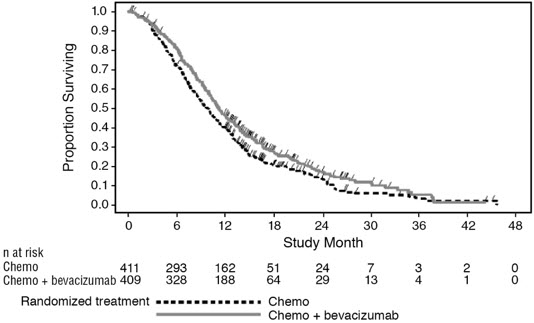
. Chemotherapy naïve patients with locally advanced, metastatic or recurrent non–squamous NSCLC were randomized (1:1) to receive six 21-day cycles of paclitaxel and carboplatin with or without bevacizumab (15 mg/kg every 3 weeks). After completion or upon discontinuation of chemotherapy, patients randomized to receive bevacizumab continued to receive bevacizumab alone until disease progression or until unacceptable toxicity. The trial excluded patients with predominant squamous histology (mixed cell type tumors only), CNS metastasis, gross hemoptysis (1/2 teaspoon or more of red blood), unstable angina, or receiving therapeutic anticoagulation. The demographics of the safety population were similar to the demographics of the efficacy population.
Only Grades 3-5 non-hematologic and Grades 4-5 hematologic adverse reactions were collected. Grades 3-5 non-hematologic and Grades 4-5 hematologic adverse reactions occurring at a higher incidence (≥2%) in patients receiving bevacizumab with paclitaxel and carboplatin compared with patients receiving chemotherapy alone were neutropenia (27% vs. 17%), fatigue (16% vs. 13%), hypertension (8% vs. 0.7%), infection without neutropenia (7% vs. 3%), venous thromboembolism (5% vs. 3%), febrile neutropenia (5% vs. 2%), pneumonitis/pulmonary infiltrates (5% vs. 3%), infection with Grade 3 or 4 neutropenia (4% vs. 2%), hyponatremia (4% vs. 1%), headache (3% vs. 1%) and proteinuria (3% vs. 0%).
Recurrent Glioblastoma
The safety of bevacizumab was evaluated in a multicenter, randomized, open-label study (EORTC 26101) in patients with recurrent GBM following radiotherapy and temozolomide of whom 278 patients received at least one dose of bevacizumab and are considered safety evaluable
[see Clinical Studies (
14.4)]
. Patients were randomized (2:1) to receive bevacizumab (10 mg/kg every 2 weeks) with lomustine or lomustine alone until disease progression or unacceptable toxicity. The demographics of the safety population were similar to the demographics of the efficacy population. In the bevacizumab with lomustine arm, 22% of patients discontinued treatment due to adverse reactions compared with 10% of patients in the lomustine arm. In patients receiving bevacizumab with lomustine, the adverse reaction profile was similar to that observed in other approved indications.
Metastatic Renal Cell Carcinoma
The safety of bevacizumab was evaluated in 337 patients who received at least one dose of bevacizumab in a multicenter, double-blind study (BO17705) in patients with mRCC. Patients who had undergone a nephrectomy were randomized (1:1) to receive either bevacizumab (10 mg/kg every 2 weeks) or placebo with interferon alfa
[see Clinical Studies (
14.5)]
. Patients were treated until disease progression or unacceptable toxicity. The demographics of the safety population were similar to the demographics of the efficacy population.
Grades 3-5 adverse reactions occurring at a higher incidence (≥2%) were fatigue (13% vs. 8%), asthenia (10% vs. 7%), proteinuria (7% vs. 0%), hypertension (6% vs. 1%; including hypertension and hypertensive crisis), and hemorrhage (3% vs. 0.3%; including epistaxis, small intestinal hemorrhage, aneurysm ruptured, gastric ulcer hemorrhage, gingival bleeding, hemoptysis, hemorrhage intracranial, large intestinal hemorrhage, respiratory tract hemorrhage, and traumatic hematoma). Adverse reactions are presented in Table 3.
Table 3: Grades 1-5 Adverse Reactions Occurring at Higher Incidence (≥5%) of Patients Receiving Bevacizumab vs. Placebo with Interferon Alfa in Study BO17705
Adverse Reaction
a | Bevacizumab with Interferon Alfa (N=337) | Placebo with Interferon Alfa (N=304) |
Metabolism and nutrition |
Decreased appetite | 36% | 31% |
Weight loss | 20% | 15% |
General |
Fatigue | 33% | 27% |
Vascular |
Hypertension | 28% | 9% |
Respiratory, thoracic and mediastinal |
Epistaxis | 27% | 4% |
Dysphonia | 5% | 0% |
Nervous system |
Headache | 24% | 16% |
Gastrointestinal |
Diarrhea | 21% | 16% |
Renal and urinary |
Proteinuria | 20% | 3% |
Musculoskeletal and connective tissue |
Myalgia | 19% | 14% |
Back pain | 12% | 6% |
aNCI-CTC version 3
The following adverse reactions were reported at a 5-fold greater incidence in patients receiving bevacizumab with interferon-alfa compared to patients receiving placebo with interferon-alfa and not represented in Table 3: gingival bleeding (13 patients vs. 1 patient); rhinitis (9 vs. 0); blurred vision (8 vs. 0); gingivitis (8 vs. 1); gastroesophageal reflux disease (8 vs. 1); tinnitus (7 vs. 1); tooth abscess (7 vs. 0); mouth ulceration (6 vs. 0); acne (5 vs. 0); deafness (5 vs. 0); gastritis (5 vs. 0); gingival pain (5 vs. 0) and pulmonary embolism (5 vs. 1).
Persistent, Recurrent, or Metastatic Cervical Cancer
The safety of bevacizumab was evaluated in 218 patients who received at least one dose of bevacizumab in a multicenter study (GOG-0240) in patients with persistent, recurrent, or metastatic cervical cancer
[see Clinical Studies (
14.6)]
. Patients were randomized (1:1:1:1) to receive paclitaxel and cisplatin with or without bevacizumab (15 mg/kg every 3 weeks), or paclitaxel and topotecan with or without bevacizumab (15 mg/kg every 3 weeks). The demographics of the safety population were similar to the demographics of the efficacy population.
Grades 3-4 adverse reactions occurring at a higher incidence (≥2%) in 218 patients receiving bevacizumab with chemotherapy compared to 222 patients receiving chemotherapy alone were abdominal pain (12% vs. 10%), hypertension (11% vs. 0.5%), thrombosis (8% vs. 3%), diarrhea (6% vs. 3%), anal fistula (4% vs. 0%), proctalgia (3% vs. 0%), urinary tract infection (8% vs. 6%), cellulitis (3% vs. 0.5%), fatigue (14% vs. 10%), hypokalemia (7% vs. 4%), hyponatremia (4% vs. 1%), dehydration (4% vs. 0.5%), neutropenia (8% vs. 4%), lymphopenia (6% vs. 3%), back pain (6% vs. 3%), and pelvic pain (6% vs. 1%). Adverse reactions are presented in Table 4.
Table 4: Grades 1-4 Adverse Reactions Occurring at Higher Incidence (≥5%) in Patients Receiving Bevacizumab with Chemotherapy vs. Chemotherapy Alone in Study GOG-0240
Adverse Reaction
a | Bevacizumab with Chemotherapy (N=218) | Chemotherapy (N=222) |
General |
Fatigue | 80% | 75% |
Peripheral edema | 15% | 22% |
Metabolism and nutrition |
Decreased appetite | 34% | 26% |
Hyperglycemia | 26% | 19% |
Hypomagnesemia | 24% | 15% |
Weight loss | 21% | 7% |
Hyponatremia | 19% | 10% |
Hypoalbuminemia | 16% | 11% |
Vascular |
Hypertension | 29% | 6% |
Thrombosis | 10% | 3% |
Infections |
Urinary tract infection | 22% | 14% |
Infection | 10% | 5% |
Nervous system |
Headache | 22% | 13% |
Dysarthria | 8% | 1% |
Psychiatric |
Anxiety | 17% | 10% |
Respiratory, thoracic and mediastinal |
Epistaxis | 17% | 1% |
Renal and urinary |
Increased blood creatinine | 16% | 10% |
Proteinuria | 10% | 3% |
Gastrointestinal |
Stomatitis | 15% | 10% |
Proctalgia | 6% | 1% |
Anal fistula | 6% | 0% |
Reproductive system and breast |
Pelvic pain | 14% | 8% |
Hematology |
Neutropenia | 12% | 6% |
Lymphopenia | 12% | 5% |
aNCI-CTC version 3
Epithelial Ovarian, Fallopian Tube or Primary Peritoneal Cancer
Platinum-
Resistant Recurrent Epithelial Ovarian, Fallopian Tube, or Primary Peritoneal Cancer
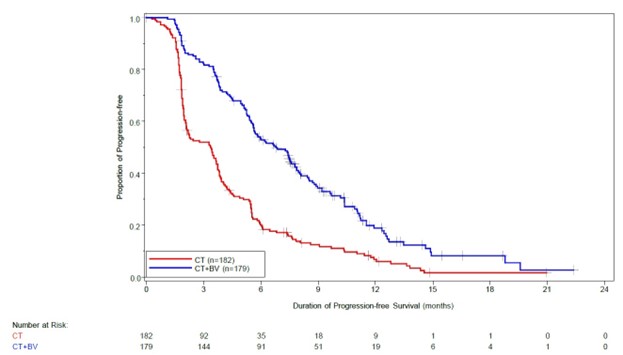
The safety of bevacizumab was evaluated in 179 patients who received at least one dose of bevacizumab in a multicenter, open-label study (MO22224) in which patients were randomized (1:1) to bevacizumab with chemotherapy or chemotherapy alone in patients with platinum resistant, recurrent epithelial ovarian, fallopian tube, or primary peritoneal cancer that recurred within <6 months from the most recent platinum based therapy
[see Clinical Studies (
14.8)]
. Patients were randomized to receive bevacizumab 10 mg/kg every 2 weeks or 15 mg/kg every 3 weeks. Patients had received no more than 2 prior chemotherapy regimens. The trial excluded patients with evidence of recto-sigmoid involvement by pelvic examination or bowel involvement on CT scan or clinical symptoms of bowel obstruction. Patients were treated until disease progression or unacceptable toxicity. Forty percent of patients on the chemotherapy alone arm received bevacizumab alone upon progression. The demographics of the safety population were similar to the demographics of the efficacy population.
Grades 3-4 adverse reactions occurring at a higher incidence (≥2%) in 179 patients receiving bevacizumab with chemotherapy compared to 181 patients receiving chemotherapy alone were hypertension (6.7% vs. 1.1%) and palmar-plantar erythrodysaesthesia syndrome (4.5% vs. 1.7%).
Adverse reactions are presented in Table 5.
Table 5: Grades 2−4 Adverse Reactions Occurring at Higher Incidence (≥5%) in Patients Receiving Bevacizumab with Chemotherapy vs. Chemotherapy Alone in Study MO22224
Adverse Reaction
a | Bevacizumab with Chemotherapy (N=179) | Chemotherapy (N=181) |
Hematology |
Neutropenia | 31% | 25% |
Vascular |
Hypertension | 19% | 6% |
Nervous system |
Peripheral sensory neuropathy | 18% | 7% |
General |
Mucosal inflammation | 13% | 6% |
Renal and urinary |
Proteinuria | 12% | 0.6% |
Skin and subcutaneous tissue |
Palmar-plantar erythrodysaesthesia | 11% | 5% |
Infections |
Infection | 11% | 4% |
Respiratory, thoracic and mediastinal |
Epistaxis | 5% | 0% |
aNCI-CTC version 3