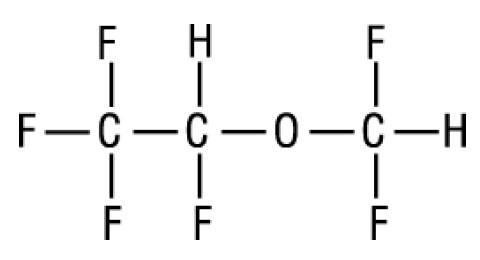
Changes in the clinical effects of desflurane rapidly follow changes in the inspired concentration. The duration of anesthesia and selected recovery measures for Desflurane are given in the following tables:
In 178 female outpatients undergoing laparoscopy, premedicated with fentanyl (1.5-2.0 mcg/kg), anesthesia was initiated with propofol 2.5 mg/kg, desflurane/N
2O 60% in O
2 or desflurane/O
2 alone. Anesthesia was maintained with either propofol 1.5-9.0 mg/kg/hr, desflurane 2.6-8.4% in N
2O 60% in O
2, or desflurane 3.1-8.9% in O
2.
Emergence and Recovery After Outpatient Laparoscopy
178 Females, Ages 20-47
Times in Minutes: Mean ± SD (Range)
Induction: | Propofol | Propofol | Desflurane/ N
2O
| Desflurane/ O
2 |
Maintenance: | Propofol/ N
2O
| Desflurane/ N
2O
| Desflurane/ N
2O
| Desflurane/ O
2 |
Number of Pts: | N = 48 | N = 44 | N = 43 | N = 43 |
Median age | 30 (20 – 43) | 26 (21 – 47) | 29 (21 – 42) | 30 (20 – 40) |
Anesthetic Time | 49 ± 53 (8 – 336) | 45 ± 35 (11 – 178) | 44 ± 29 (14 – 149) | 41 ± 26 (19 – 126) |
Time to open eyes | 7 ± 3 (2 – 19) | 5 ± 2* (2 – 10) | 5 ± 2* (2 – 12) | 4 ± 2* (1 – 11) |
Time to state name | 9 ± 4 (4 – 22) | 8 ± 3 (3 – 18) | 7 ± 3* (3 – 16) | 7 ± 3* (2 – 15) |
Time to stand | 80 ± 34 (40 – 200) | 86 ± 55 (30 – 320) | 81 ± 38 (35 – 190) | 77 ± 38 (35 – 200) |
Time to walk | 110 ± 6 (47 – 285) | 122 ± 85 (37 – 375) | 108 ± 59 (48 – 220) | 108 ± 66 (49 – 250) |
Time to fit for discharge | 152 ± 75 (66 – 375) | 157 ± 80 (73 – 385) | 150 ± 66 (68 – 310) | 155 ± 73 (69 – 325) |
*Differences were statistically significant (p < 0.05) by Dunnett's procedure comparing all treatments to the propofol- propofol/N
2O (induction and maintenance) group. Results for comparisons greater than one hour after anesthesia show no differences between groups and considerable variability within groups.
In 88 unpremedicated outpatients, anesthesia was initiated with thiopental 3-9 mg/kg or desflurane in O
2. Anesthesia was maintained with isoflurane 0.7-1.4% in N
2O 60%, desflurane 1.8-7.7% in N
2O 60%, or desflurane 4.4-11.9% in O
2.
Emergence and Recovery Times in Outpatient Surgery
46 Males, 42 Females, Ages 19-70
Times In Minutes: Mean ± SD (Range)
Induction: | Thiopental | Thiopental | Thiopental | Desflurane/ O
2 |
Maintenance: | Isoflurane/ N
2O
| Desflurane/ N
2O
| Desflurane/ O
2 | Desflurane/ O
2 |
Number of Pts: | N = 23 | N = 21 | N = 23 | N = 21 |
Median age | 43
(20 – 70)
| 40
(22 – 67)
| 43
(19 – 70)
| 41
(21 – 64)
|
Anesthetic Time | 49 ± 23
(11 – 94)
| 50 ± 19
(16 – 80)
| 50 ± 27
(16 – 113)
| 51 ± 23
(19 – 117)
|
Time to open eyes | 13 ± 7
(5 – 33)
| 9 ± 3*
(4 – 16)
| 12 ± 8
(4 – 39)
| 8 ± 2*
(4 – 13)
|
Time to state name | 17 ± 10
(6 – 44)
| 11 ± 4*
(6 – 19)
| 15 ± 10
(6 – 46)
| 9 ± 3*
(5 – 14)
|
Time to walk | 195 ± 67
(124 – 365)
| 176 ± 60
(101 – 315)
| 168 ± 34
(119 – 258)
| 181 ± 42
(92 – 252)
|
Time to fit for discharge | 205 ± 53
(153 – 365)
| 202 ± 41
(144 – 315)
| 197 ± 35
(155 – 280)
| 194 ± 37
(134 – 288)
|
*Differences were statistically significant (p < 0.05) by Dunnett's procedure comparing all treatments to the thiopental-isoflurane/N
2O (induction and maintenance) group. Results for comparisons greater than one hour after anesthesia show no differences between groups and considerable variability within groups.
Recovery from anesthesia was assessed at 30, 60, and 90 minutes following 0.5 MAC desflurane (3%) or isoflurane (0.6%) in N
2O 60% using subjective and objective tests. At 30 minutes after anesthesia, only 43% of the patients in the isoflurane group were able to perform the psychometric tests compared to 76% in the desflurane group (p < 0.05).
Recovery Tests: Percent of Preoperative Baseline Values
16 Males, 22 Females, Ages 20-65
Percent: Mean ± SD
Maintenance: | 60 Minutes After Anesthesia | 90 Minutes After Anesthesia |
Desflurane/ N
2O
| Isoflurane/ N
2O
| Desflurane/ N
2O
| Isoflurane/ N
2O
|
Confusion Δ | 66 ± 6 | 47 ± 8 | 75 ± 7* | 56 ± 8 |
Fatigue Δ | 70 ± 9* | 33 ± 6 | 89 ± 12* | 47 ± 8 |
Drowsiness Δ | 66 ± 5* | 36 ± 8 | 76 ± 7* | 49 ± 9 |
Clumsiness Δ | 65 ± 5 | 49 ± 8 | 80 ± 7* | 57 ± 9 |
Comfort Δ | 59 ± 7* | 30 ± 6 | 60 ± 8* | 31 ± 7 |
DSST+ score | 74 ± 4* | 50 ± 9 | 75 ± 4* | 55 ± 7 |
Trieger Tests++ | 67 ± 5 | 74 ± 6 | 90 ± 6 | 83 ± 7 |
Δ Visual analog scale (values from 0-100; 100 = baseline)
+ DSST = Digit Symbol Substitution Test
++ Trieger Test = Dot Connecting Test
*Differences were statistically significant (p < 0.05) using a two-sample t-test
Desflurane was studied in twelve volunteers receiving no other drugs. Hemodynamic effects during controlled ventilation (PaCO
2 38 mm Hg) were:
Hemodynamic Effects of Desflurane During Controlled Ventilation
12 Male Volunteers, Ages 16-26
Mean ± SD (Range)
Total MAC Equivalent | End-Tidal % Des/O
2 | End-Tidal % Des/ N
2O
| Heart Rate (beats/min) | Mean Arterial Pressure (mm Hg) | Cardiac Index (L/min/m
2)
|
O
2 | N
2O
| O
2 | N
2O
| O
2 | N
2O
|
0 | 0% / 21% | 0% / 0% | 69 ± 4 (63 – 76) | 70 ± 6 (62 – 85) | 85 ± 9 (74 – 102) | 85 ± 9 (74 – 102) | 3.7 ± 0.4 (3.0 – 4.2) | 3.7 ± 0.4 (3.0 – 4.2) |
0.8 | 6% / 94% | 3% / 60% | 73 ± 5
(67 – 80)
| 77 ± 8
(67 – 97)
| 61 ± 5*
(55 – 70)
| 69 ± 5*
(62 – 80)
| 3.2 ± 0.5
(2.6 – 4.0)
| 3.3 ± 0.5
(2.6 – 4.1)
|
1.2 | 9% / 91% | 6% / 60% | 80 ± 5*
(72 – 84)
| 77 ± 7
(67 – 90)
| 59 ± 8*
(44 – 71)
| 63 ± 8*
(47 – 74)
| 3.4 ± 0.5
(2.6 – 4.1)
| 3.1 ± 0.4*
(2.6 – 3.8)
|
1.7 | 12% / 88% | 9% / 60% | 94 ± 14* (78 – 109) | 79 ± 9
(61 – 91)
| 51 ± 12*
(31 – 66)
| 59 ± 6*
(46 – 68)
| 3.5 ± 0.9
(1.7 – 4.7)
| 3.0 ± 0.4*
(2.4 – 3.6)
|
*Differences were statistically significant (p < 0.05) compared to awake values, Newman-Keul's method of multiple comparison.
When the same volunteers breathed spontaneously during desflurane anesthesia, systemic vascular resistance and mean arterial blood pressure decreased; cardiac index, heart rate, stroke volume, and central venous pressure (CVP) increased compared to values when the volunteers were conscious. Cardiac index, stroke volume, and CVP were greater during spontaneous ventilation than during controlled ventilation.
During spontaneous ventilation in the same volunteers, increasing the concentration of Desflurane from 3% to 12% decreased tidal volume and increased arterial carbon dioxide tension and respiratory rate. The combination of N
2O 60% with a given concentration of desflurane gave results similar to those with desflurane alone. Respiratory depression produced by desflurane is similar to that produced by other potent inhalation agents.
The use of desflurane concentrations higher than 1.5 MAC may produce apnea.
Figure 1. PaCO
2 During Spontaneous Ventilation in Unstimulated Volunteers