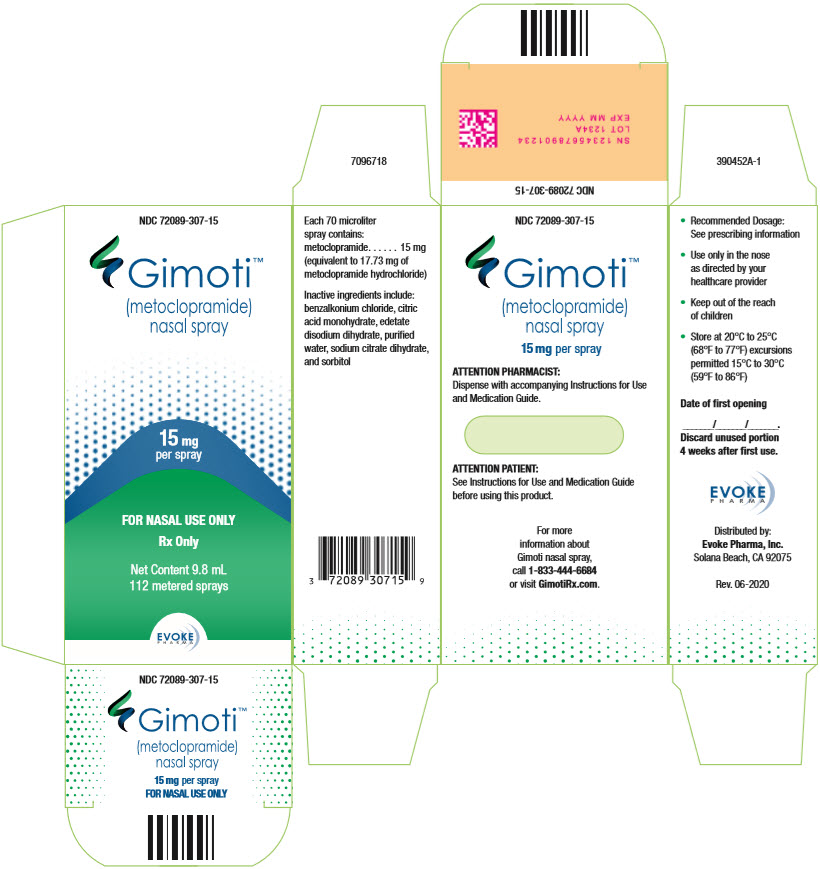
Discard GIMOTI 4 weeks after opening even if the bottle contains unused drug.
Geriatric patients receiving an alternative metoclopramide product at a stable dosage of 10 mg four times daily can be switched to GIMOTI 1 spray (15 mg) in one nostril, 30 minutes before each meal and at bedtime (maximum four times daily) for 2 to 8 weeks, depending on symptomatic response. Avoid treatment with metoclopramide (all dosage forms and routes of administration) for longer than 12 weeks [see Dosage and Administration (2.1)].
In a randomized, placebo-controlled clinical trial of 190 male and female patients of GIMOTI 14 mg, a slightly lower than recommended dosage, administered nasally four times daily for 4 weeks, dysgeusia was the most commonly reported adverse reaction (15% of GIMOTI-treated patients and 4% of placebo-treated patients). Other adverse reactions were similar to those reported for oral metoclopramide.
The most common adverse reactions (in approximately 10% of patients receiving the recommended oral metoclopramide dosage of 10 mg four times daily) were restlessness, drowsiness, fatigue, and lassitude. In general, the incidence of adverse reactions correlated with the dosage and duration of metoclopramide administration.
Adverse reactions, especially those involving the nervous system, occurred after stopping metoclopramide including dizziness, nervousness, and headaches.
- Tardive dyskinesia, acute dystonic reactions, drug-induced parkinsonism, akathisia, and other extrapyramidal symptoms
- Convulsive seizures
- Hallucinations
- Restlessness, drowsiness, fatigue, and lassitude occurred in approximately 10% of patients who received metoclopramide orally 10 mg four times daily. Insomnia, headache, confusion, dizziness, or depression with suicidal ideation occurred less frequently.
- Neuroleptic malignant syndrome, serotonin syndrome (in combination with serotonergic agents)
Endocrine Disorders: Fluid retention secondary to transient elevation of aldosterone, galactorrhea, amenorrhea, gynecomastia, impotence secondary to hyperprolactinemia
Cardiovascular Disorders: Acute congestive heart failure, possible atrioventricular block, hypotension, hypertension, supraventricular tachycardia, bradycardia, fluid retention
Gastrointestinal Disorders: Nausea, bowel disturbances (primarily diarrhea)
Hepatic Disorders: Hepatotoxicity, characterized by, e.g., jaundice and altered liver function tests, when metoclopramide was administered with other drugs with known hepatotoxic potential
Renal and Urinary Disorders: Urinary frequency, urinary incontinence
Hematologic Disorders: Agranulocytosis, neutropenia, leukopenia, methemoglobinemia, sulfhemoglobinemia
Hypersensitivity Reactions: Bronchospasm (especially in patients with a history of asthma), urticaria, rash, angioedema, including glossal or laryngeal edema
Eye Disorders: Visual disturbances
Metabolism Disorders: Porphyria
Risk Summary
Published studies, including retrospective cohort studies, national registry studies, and meta-analyses, do not report a consistent pattern or a consistently increased risk of adverse pregnancy-related outcomes with oral use of metoclopramide during pregnancy. However, available data from a case report of GIMOTI use in pregnancy is insufficient to evaluate for a drug-associated risk of major birth defects, miscarriage, or adverse maternal or fetal outcomes.
There are potential risks to the neonate following exposure in utero to metoclopramide during delivery (see Clinical Considerations).
In animal reproduction studies, no adverse developmental effects were observed with oral administration of metoclopramide to pregnant rats and rabbits at exposures about 6 and 12 times the maximum recommended human dose (MRHD) (see Data).
The estimated background risk of major birth defects and miscarriage for the indicated population is unknown. All pregnancies have a background risk of birth defects, loss, or other adverse outcomes. In the U.S. general population, the estimated background risk of major birth defects and miscarriage in clinically recognized pregnancies is 2% to 4% and 15% to 20%, respectively.
Clinical Considerations
Fetal/Neonatal Adverse Reactions
Metoclopramide crosses the placental barrier and may cause extrapyramidal signs and methemoglobinemia in neonates with maternal administration during delivery. Monitor neonates for extrapyramidal signs [see Warnings and Precautions (5.1, 5.2), Use in Specific Populations (8.4)].
Data
Animal Data
Reproduction studies have been performed following administration of oral metoclopramide during organogenesis in pregnant rats at about 6 times the MRHD calculated on body surface area and in pregnant rabbits at about 12 times the MRHD calculated on body surface area. No evidence of adverse developmental effects due to metoclopramide was observed.
Risk Summary
There are no data on the presence of metoclopramide in human milk following nasal administration; however, published data report the presence of metoclopramide in human milk in variable amounts following oral administration (see Data). Systemic exposure following nasal administration of GIMOTI 15 mg is expected to be similar to oral administration of metoclopramide 10 mg [see Clinical Pharmacology (12.3)]. Breastfed infants exposed to metoclopramide have experienced gastrointestinal adverse reactions, including intestinal discomfort and increased intestinal gas formation (see Clinical Considerations). Metoclopramide elevates prolactin levels [see Warnings and Precautions (5.7)]; however, the published data are not adequate to support drug effects on milk production. The developmental and health benefits of breastfeeding should be considered along with the mother's clinical need for GIMOTI and any potential adverse effects on the breastfed child from GIMOTI or from the underlying maternal condition.
Clinical Considerations
Monitor breastfeeding neonates because metoclopramide may cause extrapyramidal signs (dystonias) and methemoglobinemia [see Warnings and Precautions (5.1, 5.2), Use in Specific Populations (8.4)].
Data
In published clinical studies, the estimated amount of metoclopramide received by the breastfed infant was less than 10% of the maternal weight-adjusted oral dose. In one study, the estimated daily amount of metoclopramide received by infants from breast milk ranged from 6 to 24 mcg/kg/day in early puerperium (3 to 9 days postpartum) and from 1 to 13 mcg/kg/day at 8 to 12 weeks postpartum.
Cardiac Electrophysiology
In a randomized, double-blind, positive-controlled thorough ECG study in 48 healthy subjects, a single administration of 80 mg metoclopramide nasal spray (approximately 5 times the recommended GIMOTI dose) had no effect on the QTc interval.
Absorption
The absolute bioavailability of metoclopramide following nasal administration of 10 mg metoclopramide is 47% in healthy subjects compared to intravenous injection of metoclopramide 10 mg. The systemic absorption after nasal administration is lower than that after oral administration given the same dose. Following nasal administration of GIMOTI 15 mg in healthy subjects, the systemic exposure (Cmax and AUC) to metoclopramide and the time to reach Cmax (Tmax) were similar to orally administered 10 mg metoclopramide tablet.
After single nasal administration of metoclopramide at doses ranging from 10 mg to 80 mg in healthy subjects, there was a dose-proportional increase in the mean values for Cmax and AUC.
The pharmacokinetic parameters of metoclopramide in healthy subjects following a single nasal administration of GIMOTI 15 mg are summarized in Table 3.
Table 3. Summary of Metoclopramide Pharmacokinetic Parameters in Healthy Subjects after a Single Nasal Administration of GIMOTI 15 mg | Parameter Arithmetic mean (SD) except tmax for which the median (range) is reported. | GIMOTI
15 mg |
|---|
| N | 94 |
| Cmax (ng/mL) | 41.0 (19.9) |
| tmax (h) | 1.25
(0.50 – 3.50) |
| AUC0-t (ng∙h/mL) | 349 (174.7) |
| AUC0-inf (ng∙h/mL) N = 93 | 367 (184.8) |
| t1/2 (h) | 8.1 (2.0) |
Distribution
Metoclopramide is not extensively bound to plasma proteins (about 30%). The whole body volume of distribution is high (about 3.5 L/kg), which suggests extensive distribution of drug to the tissues.
Elimination
The mean elimination half-life in individuals with normal renal function is approximately 8 hours for administration with GIMOTI 15 mg.
Metabolism: Metoclopramide undergoes enzymatic metabolism via oxidation as well as glucuronide and sulfate conjugation reactions in the liver. Monodeethylmetoclopramide, a major oxidative metabolite, is formed primarily by CYP2D6, an enzyme subject to genetic variability [see Warnings and Precautions (5.9), Use in Specific Populations (8.9)].
Excretion: Approximately 85% of the radioactivity of an orally administered dose appeared in the urine within 72 hours. After oral administration of 10 or 20 mg, a mean of 18% and 22% of the dose, respectively, was recovered as free metoclopramide in urine within 36 hours.
Specific Populations
Patients with Renal Impairment: In a study of 24 patients with varying degrees of renal impairment (moderate, severe, and end-stage renal disease [ESRD] requiring dialysis), the systemic exposure (AUC) of metoclopramide following oral administration in patients with moderate to severe renal impairment was about 2-fold the AUC in subjects with normal renal function. The AUC of metoclopramide in patients with ESRD on dialysis was about 3.5-fold the AUC in subjects with normal renal function [see Warnings and Precautions (5.9), Use in Specific Populations (8.6)].
Patients with Hepatic Impairment: In a group of 8 patients with severe hepatic impairment (Child-Pugh C), the average metoclopramide clearance was reduced by approximately 50% compared to patients with normal hepatic function after administration of oral metoclopramide [see Warnings and Precautions (5.9), Use in Specific Populations (8.7)].
Sex and Body Weight: The AUC0-t and Cmax of metoclopramide were 34% and 42% higher in females than in males, respectively, following administration of metoclopramide nasal spray to healthy subjects. Based on population pharmacokinetic analysis, lean body weight (34.3 to 93.5 kg) has a significant impact on metoclopramide pharmacokinetics, with lower systemic exposure expected with higher lean body weight. The clinical significance of these findings is unknown.
Drug Interactions
Effect of Metoclopramide on CYP2D6 Substrates
Although in vitro studies suggest that metoclopramide can inhibit CYP2D6, metoclopramide is unlikely to interact with CYP2D6 substrates in vivo at therapeutically relevant concentrations.
Effect of CYP2D6 Inhibitors on Metoclopramide
Metoclopramide 20 mg was orally administered as a single dose to 24 healthy males, without (Period 1) and with (Period 2) a concomitant dose of fluoxetine 60 mg (a strong CYP2D6 inhibitor). Between the two periods, fluoxetine was administered orally for 8 days. The subjects who received concomitant metoclopramide and fluoxetine had a 40% and 90% increase in metoclopramide Cmax and AUC0-inf, respectively, compared to subjects who received metoclopramide alone. The mean half-life for metoclopramide was increased from 5.5 (±1.1) hours to 8.5 (±2.2) hours with concomitant fluoxetine [see Warnings and Precautions (5.9), Drug Interactions (7.1)].
Carcinogenesis
A 77-week study was conducted in rats with oral metoclopramide doses up to 40 mg/kg/day (about 6 times the maximum recommended human dose on body surface area basis). Metoclopramide elevated prolactin levels, and the elevation persisted during chronic administration. An increase in mammary neoplasms was found in rodents after chronic administration of metoclopramide [see Warnings and Precautions (5.7)]. In a rat model for assessing the tumor promotion potential, a 2-week oral treatment with metoclopramide at a dose of 260 mg/kg/day (about 35 times the MRHD based on body surface area) enhanced the tumorigenic effect of N-nitrosodiethylamine.
Mutagenesis
Metoclopramide was positive in the in vitro Chinese hamster lung cell/HGPRT forward mutation assay for mutagenic effects and in the in vitro human lymphocyte chromosome aberration assay for clastogenic effects. It was negative in the in vitro Ames mutation assay, the in vitro unscheduled DNA synthesis assay with rat and human hepatocytes, and the in vivo rat micronucleus assay.
Impairment of Fertility
Metoclopramide at intramuscular doses up to 20 mg/kg/day (about 3 times the maximum recommended human dose based on body surface area) was found to have no effect on fertility and reproductive performance of male and female rats.
Adverse Reactions
Inform the patients or their caregivers that metoclopramide can cause serious adverse reactions. Instruct patients to discontinue GIMOTI and contact a healthcare provider immediately if the following serious reactions occur:
- Tardive dyskinesia and/or other extrapyramidal reactions [see Warnings and Precautions (5.1, 5.2)]
- Neuroleptic malignant syndrome [see Warnings and Precautions (5.3)]
- Depression and/or possible suicidal ideation [see Warnings and Precautions (5.4)]
Inform the patient or their caregiver that metoclopramide can cause drowsiness or dizziness, or otherwise impair the mental and/or physical abilities required for the performance of hazardous tasks such as operating machinery or driving a motor vehicle [see Warnings and Precautions (5.8)].
Drug Interactions
Inform the patients or their caregivers that concomitant treatment with numerous other medications can precipitate or worsen serious adverse reactions such as tardive dyskinesia or other extrapyramidal reactions, neuroleptic malignant syndrome, and CNS depression [see Drug Interactions (7.1, 7.2)]. Explain that the prescriber of any other medication must be made aware that the patient is taking GIMOTI.
Administration Instructions [see Dosage and Administration (2.1)]
Advise the patients or their caregiver to read the Instructions for Use on how to appropriately administer GIMOTI:
- Avoid treatment with metoclopramide (all dosage forms and routes of administration) for longer than 12 weeks because of the increased risk of developing TD with longer-term use [see Warnings and Precautions (5.1)].
- One spray in one nostril administers the appropriate dose.
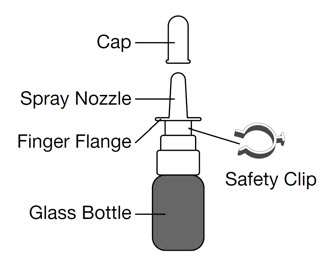
- Before administering the first dose from a bottle, prime the pump by pressing down on the finger flange and releasing 10 sprays in the air.
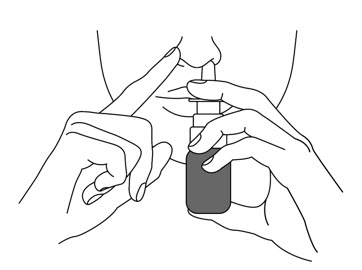
- Place the spray nozzle tip under one nostril and lean the head slightly forward so the tip of spray nozzle is aimed away from the septum and toward the back of the nose.
- Close the other nostril with the other index finger. Move spray pump upwards so the tip of the nozzle is in the nostril.
- To ensure a full dose, hold the bottle upright while pressing down firmly and completely on finger flange and release while inhaling slowly through the open nostril.
- Remove spray pump nozzle tip from nostril and exhale slowly through the mouth.
- Wipe the spray nozzle with a clean tissue.
Missed or Incomplete Doses
- If uncertain that the spray entered the nose, do not repeat the dose. Take the next dose at the scheduled time.
- If a dose is missed, take the next dose of GIMOTI at the regularly scheduled time. Do not make up for the missed dose or double the next dose.
Manufactured for: Evoke Pharma, Inc.
Solana Beach, CA 92075 USA
By: Patheon, a Division of Thermo Fisher
Bourgoin Jallieu Cedex, 38307, France
© 2020 Evoke Pharma, Inc. All right reserved.